


Why Big Tech is Shifting from Chatbots to AI Agents?
Big Tech is moving from chatbots toward AI agents because businesses want outcomes, not just answers. A chatbot mainly responds to prompts, while an agent can plan work, use tools and complete tasks with less back-and-forth.
Competition for productivity gains and improved user experience across devices, apps and enterprise platforms also drives this shift. It changes how developers build, secure and measure software.
What AI Agents are?
AI agents are software systems that can pursue a goal by deciding what to do next, taking actions through tools and checking progress. They combine language understanding with reasoning, memory and integration with data sources and services.
Unlike a single prompt-response cycle, agents operate across multiple turns and can persist context. They can coordinate subtasks such as retrieving information, drafting content, updating records and notifying stakeholders.
Core traits of many agents include autonomy within limits, tool use and feedback loops. In practice, autonomy is usually bounded by policies, approvals and scoped permissions.
AI Agents Vs Chatbots
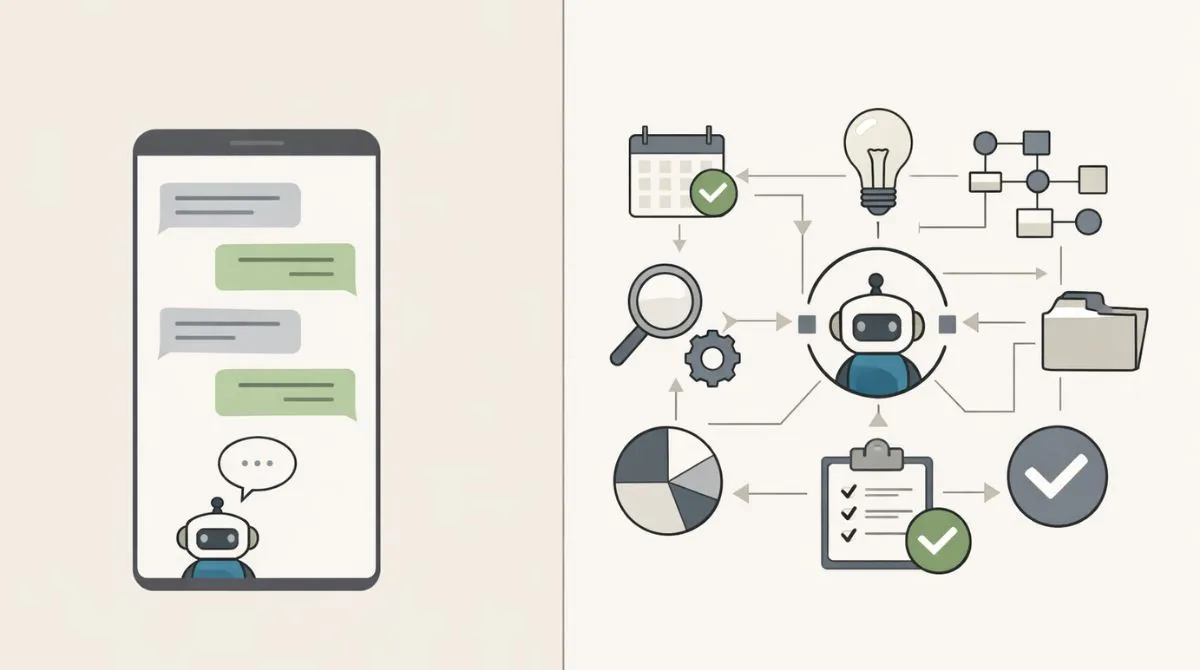
Chatbots are optimized for conversation, support scripts and quick answers. AI agents are optimized for completion, meaning the system is evaluated on whether the task got done correctly and safely.
The difference shows up in architecture, integrations and governance. Agents typically need identity, permissions, logging, and reliable connectors to enterprise systems.
| Capability | Chatbots | AI Agents |
|---|---|---|
| Primary Output | Answers and dialogue | Completed tasks and verified results |
| Tool Integration | Limited or optional | Central design requirement |
| Control And Governance | Conversation moderation | Permissions, approvals, audit logs, policy enforcement |
| Success Measure | Helpful responses | Accuracy, completion rate, safety, time saved |
This comparison highlights why enterprises are investing in agent frameworks, orchestration layers and secure tool access. It also clarifies why the bar for reliability is higher than chat interfaces.
Why Big Tech is Shifting to AI Agents?
The first reason is economic leverage. If a system can execute repetitive knowledge work, it reduces cycle time, increases throughput and improves consistency across teams.
The second reason is product strategy. Agents fit naturally into operating systems, cloud platforms, productivity suites and developer tools, where they can act across many applications rather than staying inside one chat window.
The third reason is data and distribution. Big Tech companies already control identity, search, email, calendars, documents and collaboration graphs, which give agents the context needed to act with precision.
The fourth reason is differentiation. Chatbots quickly become similar, but agent ecosystems reward deeper integrations, better tool reliability and strong governance controls.
How AI Agents Execute Tasks?

Agents execute tasks by turning a goal into a plan, then running actions through tools and finally validating results. The best systems treat task execution as a controlled workflow with checkpoints.
Many agent stacks include an orchestrator that manages state, a model that proposes actions and a tool layer that performs operations. A separate evaluator can monitor quality, safety and policy compliance.
This execution model mirrors how real human work is increasingly used to define reliable baselines, as seen in how human baselines for AI agents are built from real task uploads to ground agent behavior in practical outcomes.
- Goal Interpretation. The agent clarifies intent, constraints and success criteria before acting.
- Planning and Decomposition. It breaks the goal into smaller tasks that you can complete and verify.
- Tool Selection. The agent chooses approved tools such as search, databases, ticketing systems or document APIs.
- Action Execution. It performs operations with scoped permissions and captures outputs for traceability.
- Verification and Correction. The agent checks results against rules and retries safely when outcomes do not match expectations.
- Handoff and Logging. It summarizes what changed, records evidence and requests approval when required.
When this loop is designed well, the agent behaves less like a chat companion and more like a dependable workflow engine. That is the core reason agent adoption is accelerating.
Business Value of AI Agents
AI agents create value by compressing work into fewer clicks and fewer handoffs. They can standardize processes that depend on scattered knowledge, while still supporting exceptions and human review.
In customer operations, agents can resolve requests by reading policies, updating systems and generating compliant responses. In internal operations, they can coordinate scheduling, reporting, procurement and IT service management. This shift is also driving demand for agent first productivity tools, such as AI-powered file organization on the desktop, which lets agents manage documents and workflows directly within everyday work environments.
In software delivery, agents can assist with issue triage, test generation, documentation updates and release notes. These gains are strongest when tools are stable, data is governed and quality checks are enforced.
- Cycle Time Reduction: Faster completion of multi step tasks across tools and teams.
- Higher Consistency: Policy aligned outputs and fewer variations in how work is performed.
- Better Knowledge Access: Retrieval across repositories, wikis and structured systems with context.
- Improved Employee Experience: Less manual coordination and fewer repetitive updates.
These benefits depend on careful scope selection and a mature operating model. Agents are most effective when the target process has clear inputs, clear permissions and clear definition of done.
Security Privacy and Safety Risks
Agents raise the risk profile because they can take actions, not just generate text. A single mistake can create real changes in systems such as sending messages, modifying records or triggering transactions.
Key security risks include over permissioned tools, prompt injection through untrusted content and data leakage from sensitive sources. Privacy risk also increases when agents have broad access to emails, documents and customer data.
Safety risks include harmful recommendations, unauthorized actions and silent failure where an agent reports success without sufficient evidence. Reliability issues can appear as hallucinated steps, partial completion or wrong tool usage.
- Least Privilege Access: Grant only the minimum permissions needed for each task scope.
- Approval Gates: Require human confirmation for irreversible actions and high impact changes.
- Auditability: Log tool calls, inputs, outputs and decision traces for investigation and compliance.
- Data Boundaries: Enforce tenant isolation, retention controls and redaction for regulated data.
Strong governance turns agents into manageable systems rather than unpredictable automation. This is also where trust is earned with stakeholders and regulators.
Impact on Jobs and Productivity
AI agents shift work by automating coordination, documentation and routine analysis. The biggest productivity lift comes from reducing context switching and eliminating manual data movement between tools.
Job impact is uneven across roles. Work that is highly standardized and tool driven is more exposed, while work that relies on judgment, relationship building and accountability becomes more valuable.
Teams also change how they measure performance. Instead of tracking activity volume, organizations can track outcomes such as resolution time, defect rate and throughput with stronger quality controls.
New responsibilities emerge around agent supervision, workflow design, data stewardship and policy management. These roles support responsible scaling while keeping humans in the loop for complex decisions.
How to Adopt AI Agents in 2026?

Adoption works best when it follows a disciplined rollout. The goal is to build trust, prove value and harden controls before expanding autonomy.
Successful programs align IT, security, legal, and business owners early. They also define what the agent is allowed to do, what it must never do, and what requires approval.
- Choose High Value Narrow Workflows. Start with processes that have clear inputs, stable tools and measurable outcomes.
- Map Data and Permissions. Inventory systems, classify data, and implement role based access with least privilege.
- Standardize Tooling and Connectors. Use approved APIs, schema validation and versioned interfaces to reduce breakage.
- Add Verification. Implement checks such as policy rules, output validation and evidence requirements for completion.
- Build Human Oversight. Create review queues, escalation paths and approval gates for sensitive actions.
- Measure and Iterate. Track completion rate, correction rate, time saved and incident trends to guide expansion.
This approach keeps the scope realistic while creating a foundation for broader automation. It also reduces the chance of security incidents and user distrust.
Conclusion of Big Tech’s Shift to AI Agents
Big Tech is shifting from chatbots to AI agents because the market is demanding task completion, not conversational novelty. Agents can plan, use tools and deliver measurable outcomes across business systems. The occasion is significant, but so are the pitfalls. Organizations that win will combine strong governance, secure integrations and rigorous verification with practical human oversight. As agent capabilities mature, the defining advantage will be trust and reliability. The teams that operationalize safety, privacy and accountability will capture the long-term business value of AI agents.