
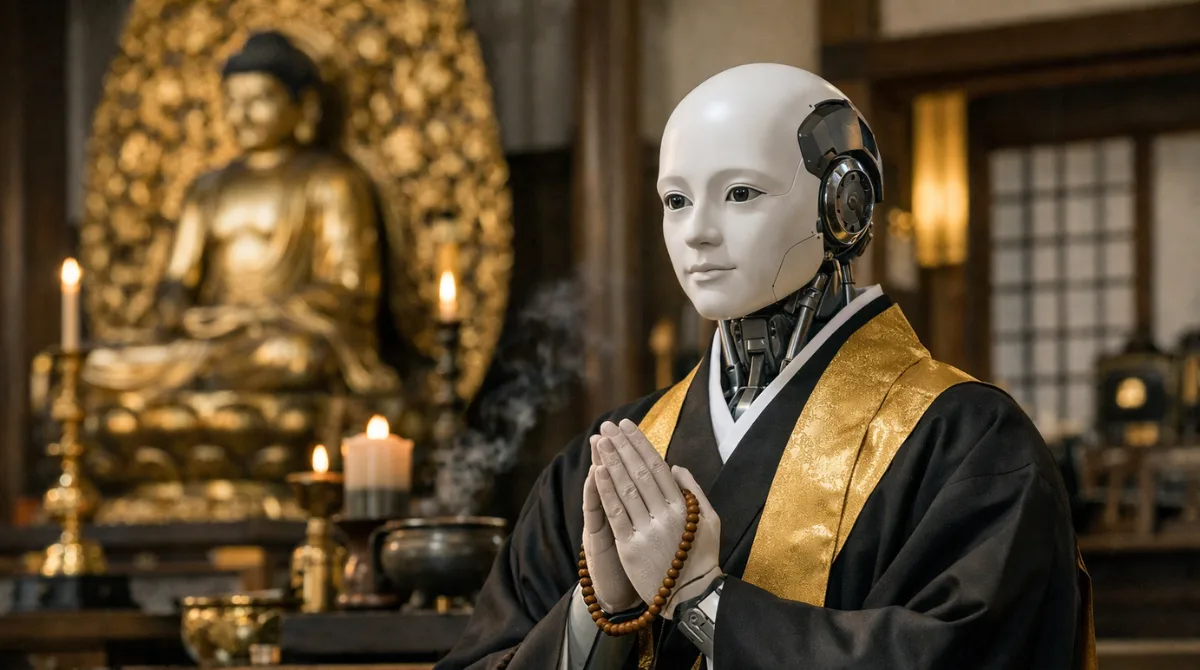
Kyoto University researchers unveiled a Buddhist AI robot monk in Tokyo on February 25, 2026, positioning the humanoid as a new interface between artificial intelligence and spiritual practice. Named Buddharoid, the robot is designed to hold real-time conversations with temple visitors, answer sensitive spiritual questions and perform traditional gestures including the gassho bow and a slow ceremonial walk suited to sacred spaces.
Built on the Unitree G1 platform – a humanoid frame manufactured by Chinese robotics firm Unitree Robotics – the project layers Japanese academic research and OpenAI’s language models to generate responses drawn first from Buddhist scriptures, then expanded through AI interpretation. The system integrates voice recognition, speech synthesis and synchronized physical movement into a single coordinated experience.
Researchers cite Japan’s shrinking population of working-age monks and an aging society as the core practical driver behind the project. Buddharoid is presented as a partial solution to a real workforce gap in religious institutions.
The project, however, carries a structural tension that most coverage has overlooked. While the Kyoto Humanoid Association – a separate Japanese industry coalition – is actively working to build fully domestic humanoid robots by 2027 to reduce reliance on foreign manufacturers, Buddharoid depends on Chinese-made hardware at its core. That dependency raises quiet but substantive questions about technological sovereignty in AI religious applications, even as Japan’s government funds an independent humanoid supply chain push.
Ethical questions around deploying AI robots in religious roles remain officially unresolved, according to Kyoto University.