


2026 is shaping up to be the year when multi-agent systems move from impressive demos to dependable infrastructure. The missing piece has been agreement on how agents talk to each other, share context and act safely across tools and organizations.

AI agent protocols are the practical rules and message formats that make agent collaboration predictable. When protocols are clear, agents can coordinate plans, exchange results and hand off work without fragile, custom integrations.
What Are AI Agent Protocols?
AI agent protocols define how an agent describes its intent, requests capabilities and returns outcomes. They cover message structure, identity, permissions, tool invocation and the lifecycle of a task from request to completion.
Protocols also specify what must be recorded for auditability. That includes inputs used, tools called, data accessed and the reasoning artifacts a system decides to retain for compliance and debugging.
A useful way to think about protocols is as a contract between independently built components. The contract reduces ambiguity so agents can interoperate even when they come from different vendors, teams, or model families.
Why AI Agents Struggle To Work Together Today?
Most agents still rely on one-off connectors, prompt conventions and tool wrappers that are not portable. Small changes to a tool schema or a model’s output style can break downstream agents and create silent failures.

Context handling is another blocker. Agents often pass large text blobs that mix instructions, data and partial results, which leads to drift and misinterpretation as tasks get longer.
Security boundaries are also inconsistent. Without standardized identity, authorization and scoping, an agent can overreach by calling the wrong tool, pulling excess data, or triggering actions without sufficient verification.
Finally, observability is fragmented. Teams struggle to answer basic questions about multi-agent workflows, including which agent made a decision, which resources were touched and where latency or cost spiked.
Key AI Agent Protocols In 2026 A2A MCP And More
Several protocol families are converging on the same goal. They aim to standardize agent-to-agent messaging, tool access and shared context so orchestration becomes less brittle.
A2A is often used as shorthand for agent-to-agent communication patterns. It focuses on how agents negotiate tasks, delegate subgoals and return structured results with clear status and error semantics.
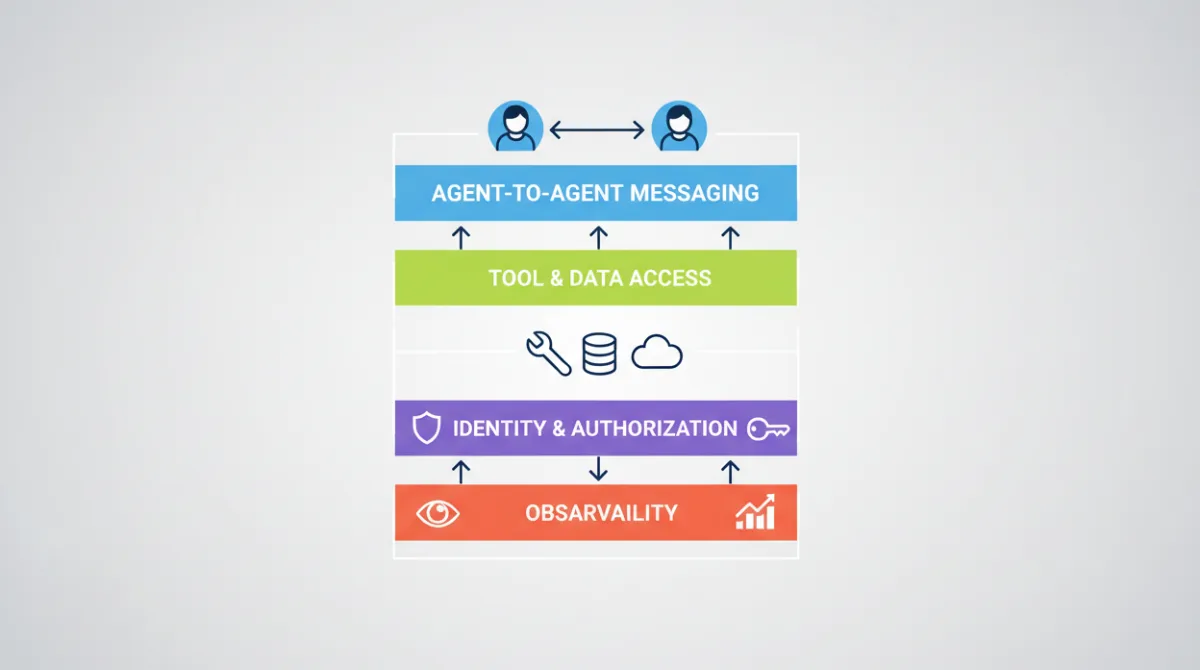
MCP is commonly discussed as a model or agent context interface that connects agents to tools and data sources in a consistent way. It emphasizes predictable tool schemas, scoped permissions and reliable request and response formats.
Other emerging standards revolve around identity, trust and governance. These include signed messages, verifiable credentials, policy enforcement points and standardized event logs for agent actions.
| Protocol Focus | What It Standardizes | Why It Matters For Interoperability |
|---|---|---|
| Agent To Agent Messaging | Task delegation, status updates, result packaging | Reduces ambiguity and prevents brittle handoffs |
| Tool And Data Access | Tool schemas, parameters, responses, error handling | Enables agents to use the same tools reliably across platforms |
| Identity And Authorization | Authentication, scoped tokens, policy checks | Limits over-permissioning and supports least privilege |
| Observability And Audit | Event logs, trace IDs, action records | Makes multi-agent workflows debuggable and compliant |
These categories often appear together in real deployments. A strong ecosystem tends to pair messaging with tool access, then adds identity and audit once agents start touching sensitive systems.
How AI Agent Interoperability Actually Works?
Interoperability begins with shared primitives. Agents need a common representation for tasks, constraints, roles and outputs so that one agent can reliably interpret another agent’s intent.
Messages are typically structured into fields such as goal, context references, required capabilities, expected outputs and acceptance criteria. This reduces the need to infer meaning from freeform text and improves determinism.
Next comes capability discovery. An agent needs a way to learn what another agent or tool can do, what inputs it accepts and what permissions are required.
- Capability Registry: A discoverable catalog that describes available tools, agent skills and supported schemas.
- Schema Validation: A strict check that inputs and outputs match the declared format before a call proceeds.
- Policy Enforcement: A gate that evaluates identity, scope and data rules before any action is executed.
- Trace Correlation: A shared trace ID that ties together calls across agents for debugging and auditing.
Once these foundations exist, orchestration becomes a solvable engineering problem. Teams can reason about workflows as connected components rather than a fragile chain of prompts.
Handoffs also require clear failure semantics. Protocols define how to report partial completion, retryable errors, timeouts and compensating actions when a downstream step fails.
Benefits Of Connected AI Agents For Businesses And Developers
When agents interoperate, organizations can split complex work into specialized roles. A planning agent can define a strategy, a retrieval agent can gather verified data and an execution agent can trigger approved actions.

This separation improves quality and reduces risk. It also supports modular upgrades, since a single agent or tool can be swapped without rewriting the entire system.
- Faster Integration Cycles: Standard interfaces reduce custom glue code and simplify onboarding new tools.
- More Reliable Automation: Structured messages and validation reduce misfires and silent errors.
- Better Governance: Standard audit trails support internal controls, compliance reviews and incident response.
- Lower Operating Costs: Coordinated agents can reuse context, avoid duplicate calls and choose cheaper tools when appropriate.
Developers also gain clearer testing strategies. Protocol-level contracts make it easier to unit test agent behaviors, simulate tool failures and measure end-to-end latency.
Real World Use Cases Of AI Agent Collaboration
Agent collaboration is most valuable when a workflow spans multiple systems, stakeholders, or data types. The strongest candidates have clear acceptance criteria, measurable outputs and well-defined permission boundaries.
- Security Operations Triage: Multi-agent routing can cut mean time to acknowledge alerts by 35 percent through standardized enrichment and escalation messages.
- Enterprise Knowledge Updates: Coordinated agents can reduce policy document review time by 28 percent by separating extraction, verification and publishing tasks.
- Customer Support Resolution: Connected agents can lower ticket reopen rates by 12 percent by validating proposed fixes against account history and product constraints.
- Software Delivery Automation: Multi-agent pipelines can reduce release rollback frequency by 18 percent by enforcing consistent checks across build, test and deployment stages.
These outcomes depend on strong boundaries between suggestion and execution. Protocols help enforce that separation and make approvals explicit.
Challenges And Risks Of AI Agent Integration
Interoperability increases the blast radius of mistakes if it is not governed. When one agent can trigger actions through many tools, authorization and scoping must be precise and consistently enforced.
Data leakage is a common risk. Agents that share context too freely can expose sensitive fields to components that do not need them, especially when workflows cross departments or vendors.
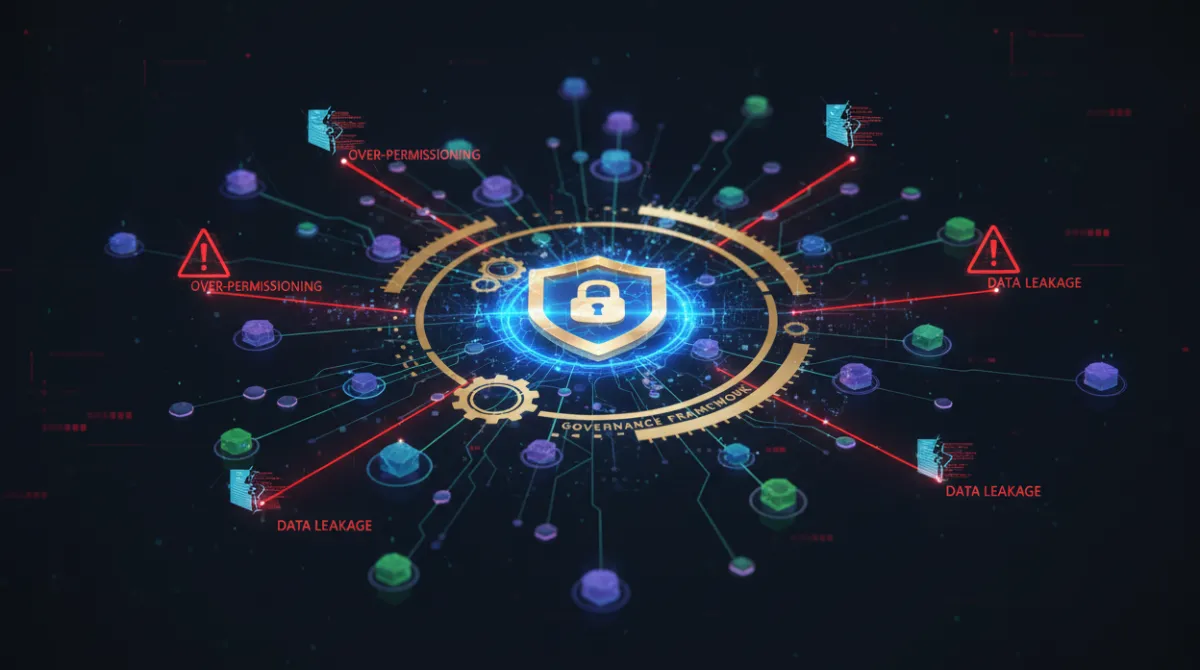
Another challenge is error propagation. A small parsing issue or misclassified status can ripple across a workflow, producing incorrect actions while still looking superficially successful.
- Over-Permissioning: Broad tool access increases risk of unintended actions and data exposure.
- Context Contamination: Mixed instructions and data can cause goal drift and incorrect prioritization.
- Non-Deterministic Outputs: Freeform responses can break downstream automation without strict schemas.
- Vendor Lock-In By Convention: Proprietary message formats can recreate the same integration pain under a new label.
Mitigations usually combine technical controls and process controls. That includes least privilege, structured outputs, approval gates, red teaming and continuous monitoring of agent actions.
Why 2026 Could Be A Turning Point For AI Agents?
The ecosystem is converging on repeatable building blocks that make agent systems easier to deploy and safer to operate. As protocols stabilize, companies can invest in agent workflows with less fear that an integration will collapse during the next model upgrade.
Tooling maturity is also rising. Better tracing, policy engines and evaluation harnesses make it practical to measure reliability, enforce governance and compare agent behaviors across environments.
Organizations are also aligning around operational requirements, including audit readiness and access control. That pressure pushes protocols to include identity, provenance and compliance features rather than treating them as optional add-ons.
The Future Of AI Agent Ecosystems And Standards
Over time, protocols will likely separate into layers. One layer will focus on messaging and task semantics, another on tool access and context interfaces and another on trust, identity and governance.
Interoperable ecosystems will reward modularity. Teams will compose best-in-class components, such as planners, retrievers, verifiers and executors and swap them as needs change.
Standardization will also shift competition to higher levels. Differentiation will come from domain expertise, better evaluation, safer action policies and superior user experience rather than proprietary message formats.
Conclusion
AI agent protocols turn isolated agents into cooperative systems that can share context, delegate tasks and act across tools with stronger safety guarantees. In 2026, the most successful deployments will pair interoperability with strict identity, policy enforcement and observability.
Teams that invest in clean schemas, least-privilege permissions and traceable workflows will see the biggest gains. Protocols are not hype infrastructure, they are the foundation for reliable agent collaboration at scale.