
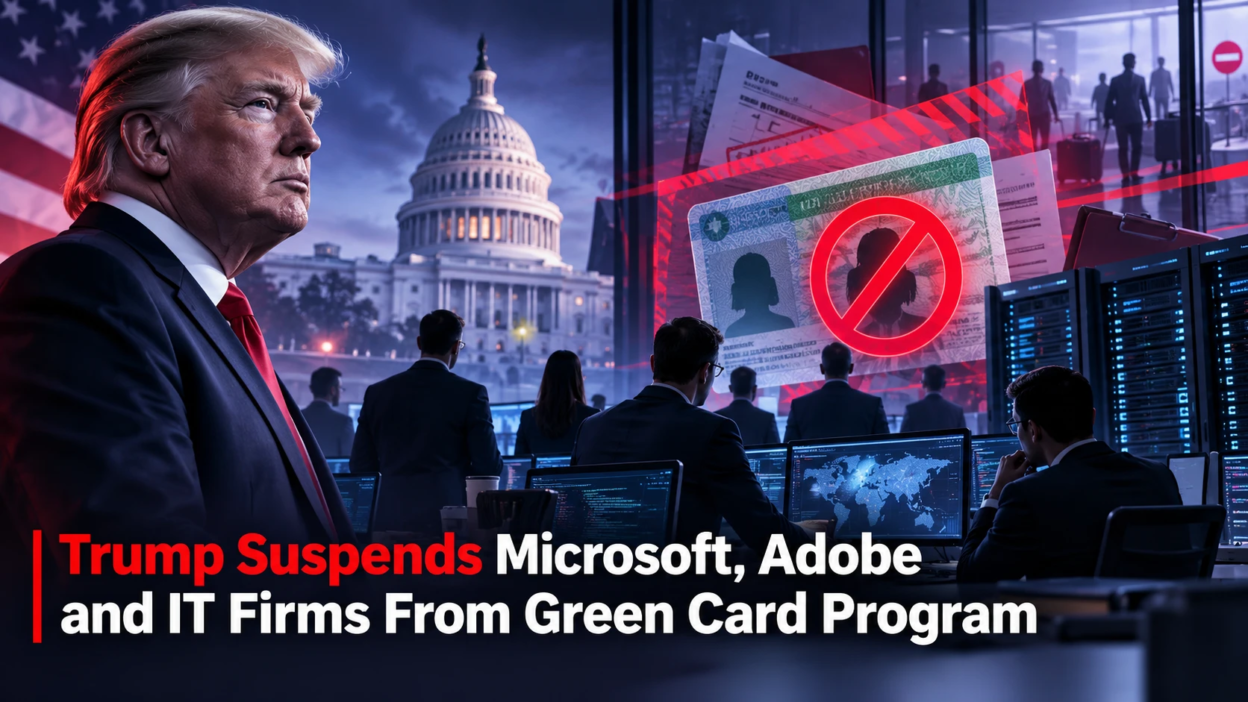
The Trump administration has suspended Microsoft, Adobe, and six other major IT companies from a US program used to sponsor foreign workers for employment-based green cards. The decision, announced on October 8, 2026, could delay permanent residency applications for employees at the affected companies.
US Vice President JD Vance and Labor Secretary Keith Sonderling announced the restrictions as part of a wider effort to investigate alleged misuse of foreign worker programs and give greater priority to American workers.
The restrictions involve the US Permanent Labor Certification program, known as PERM. In many employment-based green card cases, employers must first obtain certification from the Department of Labor. They must demonstrate that there are not enough qualified and available US workers for the job and that hiring a foreign worker will not negatively affect wages or working conditions for comparable American workers.
Under the announced restrictions, the Department of Labor will stop accepting new PERM applications from the eight companies and pause the processing of their pending applications. The action targets an employer-sponsored labor certification process, not every type of US green card application.
The eight companies named in the suspension are Microsoft, Adobe, Cognizant, Infosys, Tata Consultancy Services (TCS), Wipro, HCL Technologies, and Capgemini. They include major software developers and IT services businesses with operations in the United States.
During the October 8 announcement, Vice President JD Vance accused Microsoft of taking advantage of immigration programs while reducing its American workforce. He questioned the company’s use of H-1B visas and employment-based green card sponsorships alongside employee layoffs.
The company had previously announced major workforce reductions, including Microsoft’s layoffs amid its shift toward AI and cloud services. Vance argued that large American technology companies should place greater priority on qualified US workers.
Labor Secretary Keith Sonderling also identified other technology and IT services companies facing suspension. Officials said the restrictions were intended to investigate possible misuse of the labor certification process and protect American job opportunities.
The allegations remain government claims. The announcement does not, by itself, establish that each affected company committed immigration fraud or violated labor laws.
Microsoft rejected the suggestion that its immigration filings were mainly used to bring in new foreign employees. The company said the vast majority of its US workforce consists of American workers.
According to Microsoft, about 80% of the approximately 6,000 H-1B petitions it submitted in the previous fiscal year involved extending or changing the status of existing employees. The remaining petitions for new employees involved people already legally living in the United States and represented around 1% of its US workforce.
Microsoft also said it follows H-1B program requirements and pays sponsored workers wages comparable to those of employees performing similar jobs.
The suspension could delay permanent residency plans for foreign technology professionals, including software engineers, developers, and IT consultants who rely on their employers for green card sponsorship.
The H-1B program allows US companies to temporarily employ eligible foreign professionals in specialty occupations. PERM, by comparison, is a labor certification process required for many employment-based green card applications. The two programs serve different purposes.
Employees whose employers have not yet filed PERM applications may face delays in beginning that stage of the process. Applications already pending with the Department of Labor are also affected by the announced suspension.
Importantly, the decision does not automatically revoke existing H-1B visas or previously issued green cards. Its immediate effect concerns the affected companies’ ability to use the PERM process, although individual immigration circumstances may vary.
The restrictions also affect major Indian IT services companies with large international operations. Infosys, TCS, Wipro, and HCL Technologies provide software development, cloud computing, consulting, and other technology services to businesses in the United States.
On October 10, Infosys said it did not expect the PERM suspension to have a significant effect on its business. The company also expressed its willingness to work with the US Department of Labor and other government agencies to answer questions about its immigration practices.
In a related move, the administration also announced investigations into nine US universities, including Harvard, Yale, Stanford, and the Massachusetts Institute of Technology (MIT). Officials are examining allegations involving the possible misuse of exchange visitor visas and employment practices.
These university investigations are separate from the PERM suspensions affecting technology companies. Both actions are part of the administration’s wider scrutiny of immigration programs.
The decision adds uncertainty for technology companies that recruit international talent in software engineering, artificial intelligence, cybersecurity, and cloud computing.
The administration says stronger oversight is needed to protect US jobs and prevent misuse of immigration programs. Critics argue that restrictions on permanent residency sponsorship could make it harder for technology businesses to retain skilled professionals.
The announcement also comes during a wider period of Big Tech job cuts alongside increased AI investment, raising questions about how companies will manage their future workforce needs.
The administration has not provided a specific date for ending the restrictions. Vice President JD Vance indicated that the suspensions could continue until officials are satisfied with changes to company hiring practices.
For now, the restrictions create uncertainty for the eight affected technology companies and employees seeking permanent residency through employer sponsorship. Further government guidance and responses from the companies will help determine the practical impact.