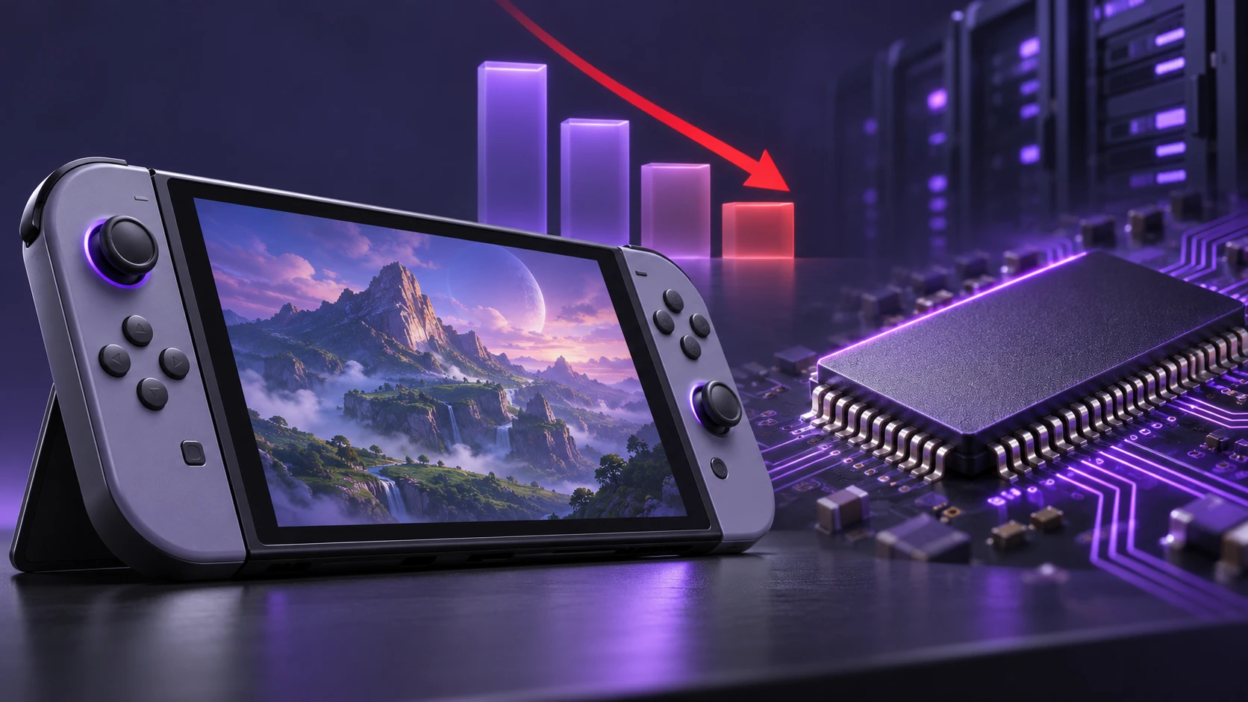
Nintendo Switch 2 hardware sales fell about 41% year over year during the July–September 2026 quarter. Nintendo’s November 5 financial results presentation confirms that Switch 2 sales reached 2.67 million units during the quarter, down from 4.54 million in July–September 2025. These figures represent Nintendo’s sell-in sales, which include units supplied to retail partners and direct customers, rather than only purchases made by shoppers.
Nintendo released its latest financial results on November 5, 2026, showing slower quarterly Switch 2 hardware sales alongside rising costs for memory chips and other components. The company has also increased console prices in several markets. However, Nintendo has not established that higher memory costs directly caused the 41% sales decline, making it important to distinguish between weaker hardware sales and wider manufacturing cost pressures.
Nintendo Switch 2 launched in June 2025 and quickly became one of Nintendo’s fastest-selling consoles. Readers interested in the system’s launch-era hardware and features can explore TechBonafide’s Nintendo Switch 2 console guide. However, the latest quarterly results show a slowdown compared with its successful launch period. Sales also declined from 3.82 million units in the April–June 2026 quarter to 2.67 million units in the following three months. According to Nintendo’s worldwide hardware sales data, Switch 2 had reached 26.35 million cumulative unit sales as of September 30, 2026.
The 41% decline compares two July–September quarters and does not mean Nintendo’s annual Switch 2 sales fell by the same percentage. The console launched in June 2025, so the July–September 2025 period benefited from strong early demand. This unusually high comparison makes the latest quarterly decline look sharper, even though Nintendo continues to sell millions of Switch 2 consoles.
Rising memory prices are an important cost concern for Nintendo and other gaming hardware manufacturers. Consoles use RAM to handle active tasks and storage chips to hold games and other data. Semiconductor research firm TrendForce reports that AI server demand continues to put pressure on memory prices, as suppliers prioritize production capacity for high-performance server products.
Nintendo’s financial forecast for the year ending March 2027 includes approximately 100 billion yen in combined costs from higher component prices, particularly memory, and tariff measures. The company has not presented that entire amount as a memory-only expense. This pressure extends beyond gaming consoles, as TechBonafide has also examined how AI-driven RAM shortages can affect smartphone and computer prices.
Nintendo announced price increases through its official Switch 2 price-revision notice, confirming higher console prices in Japan, the United States, Canada, and Europe during 2026. In Japan, the Japanese-language model increased from 49,980 yen to 59,980 yen on May 25. In the United States, the standard console price rose from $449.99 to $499.99 on September 1, while Canada and Europe also received price increases. Higher prices can influence buying decisions, especially before the holiday shopping season, but Nintendo has not measured how much these changes contributed to its latest quarterly sales decline.
Nintendo’s financial results showed a mixed performance. During the six months ending September 30, 2026, revenue fell 12.1% year over year to approximately 966 billion yen, while operating profit increased 49.1% to 216.5 billion yen. The company said the stronger half-year profit was supported by a larger share of software sales and refunds of previously recorded US tariffs. However, operating profit for the July–September quarter alone fell about 16% to 73.9 billion yen, showing the difference between Nintendo’s quarterly and six-month results.
Nintendo’s software business remained a strong part of its financial performance. The company reported 24.49 million Switch 2 software units sold during April–September 2026, up 18.8% year over year. Nintendo’s wider digital business generated approximately 249.6 billion yen, an increase of 60.5%. This digital revenue includes downloadable games, additional content, and Nintendo Switch Online services, showing that software and digital services continued to support the business despite weaker hardware sales.
Nintendo is now looking to new game releases to attract more players and encourage existing customers to remain active. One important title is The Legend of Zelda: Ocarina of Time, released for Nintendo Switch 2 on November 5, 2026. TechBonafide’s Ocarina of Time trailer coverage explains the game’s updated visuals, improved controls, and new gameplay features. The updated version of the classic adventure game could encourage Zelda fans and new customers to purchase the console during the coming months.
Nintendo also introduced a Zelda 40th Anniversary Edition console in October 2026, giving fans another reason to consider the Switch 2 ahead of the holiday shopping season. These special editions and game releases are part of Nintendo’s efforts to maintain interest in its gaming platform, although their impact on future console sales remains uncertain.
Nintendo maintained its full-year target of selling 16.5 million Switch 2 consoles during the financial year ending March 2027. With 6.49 million units recorded during the first six months, the company would need approximately 10.01 million additional sales in October–March to reach its forecast. According to Reuters’ November 5 earnings report, Nintendo President Shuntaro Furukawa said the company could obtain sufficient memory supplies and was not considering another console price increase at that time. The company will still depend on holiday demand and upcoming games to support its annual sales target.
The coming months will show whether new games and holiday shopping demand can help Nintendo reach its annual Switch 2 sales target. Rising memory costs may continue to pressure gaming hardware manufacturers, but they cannot be treated as the proven cause of Nintendo’s 41% quarterly sales decline. Stronger software and digital revenue give Nintendo additional support as it works to attract more players and expand the Switch 2 platform.