Google has officially introduced two new artificial intelligence (AI) computing systems, TPU 8tx and TPU 8i Max, as it expands its efforts to provide specialized processors for businesses and cloud customers. The announcement, made on November 9, 2026, adds two configurations to Google’s eighth-generation Tensor Processing Unit (TPU) family. According to the company’s official announcement, the systems are designed to improve data security and handle increasingly complex AI workloads.
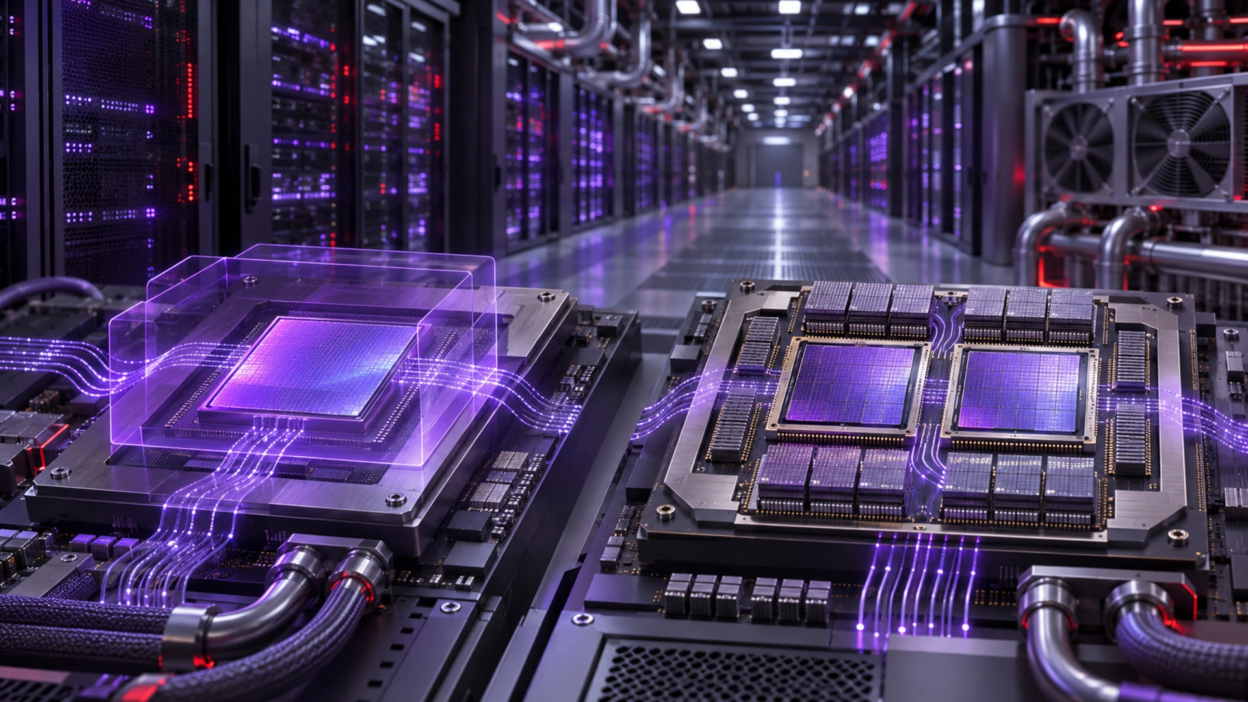
Google’s TPUs are specialized processors built to train and run artificial intelligence models. They power services such as Gemini and support AI workloads for Google Cloud customers. The latest additions are not entirely new chip designs. Instead, Google has changed how existing processors are combined with memory, networking and security technology to meet different computing needs.
The first system, TPU 8tx, focuses on protecting sensitive information while AI models are processing it. This is particularly important for government agencies, financial organizations and other businesses that handle confidential data. The system uses hardware-level security features and works with AMD processors to help protect private information and AI models during operation.
Google says TPU 8tx can also deliver up to two times lower latency than TPU 8t, thanks to changes in its networking design. Lower latency means information can move through the system with less delay, helping AI applications respond more quickly. However, this performance figure is Google’s own claim and should not be treated as an independent comparison with Nvidia hardware.
The second system, TPU 8i Max, targets AI applications that need to process large amounts of information simultaneously. Google has combined two TPU 8i chips into one package, providing twice the computing capacity, on-chip memory and high-bandwidth memory throughput of the original TPU 8i configuration, according to the company. This is intended to help advanced AI systems handle larger workloads without requiring the same increase in physical data center space.
The improvements could be useful for AI coding assistants, systems that analyze lengthy documents and applications that work with extensive video content. These tools often need to remember and process large amounts of information while producing responses. Providing more computing power and faster access to memory could help developers build more capable AI services, although actual performance will depend on the application and its software.
Google previously introduced TPU 8t for large-scale AI training and TPU 8i for faster AI responses in its April 2026 hardware announcement. The new systems expand that family to four configurations. The differences between these computing tasks are important because training an AI model and running it for users require different resources. TechBonafide’s guide to training and inference data centers explains how these workloads affect processor performance, memory, networking and infrastructure design.
The announcement also adds another development to Google’s competition with Nvidia, whose graphics processors remain central to many large AI data centers. Google’s specialized TPUs could provide more options for organizations developing AI applications. However, the announcement does not establish that TPU 8tx or TPU 8i Max performs better than comparable Nvidia systems. Google also continues to offer Nvidia-powered infrastructure through Google Cloud. TechBonafide’s overview of Nvidia’s AI infrastructure explains why hardware performance, software compatibility and networking all matter when selecting AI computing platforms.
Some important questions remain unanswered. Google has not provided detailed public pricing or a complete availability schedule for the two new systems in its announcement. Independent performance comparisons are also needed to determine how their speed, operating costs and efficiency compare with competing AI hardware. The announced improvements should therefore be understood as Google’s product specifications and performance claims, not proven advantages over Nvidia.
For AI developers, cloud providers and organizations working with sensitive information, the announcement shows how AI hardware is becoming more specialized. TPU 8tx addresses the need to protect confidential workloads, while TPU 8i Max focuses on processing larger amounts of information efficiently. Their commercial impact will become clearer as customers gain access to the systems and real-world performance results become available.