

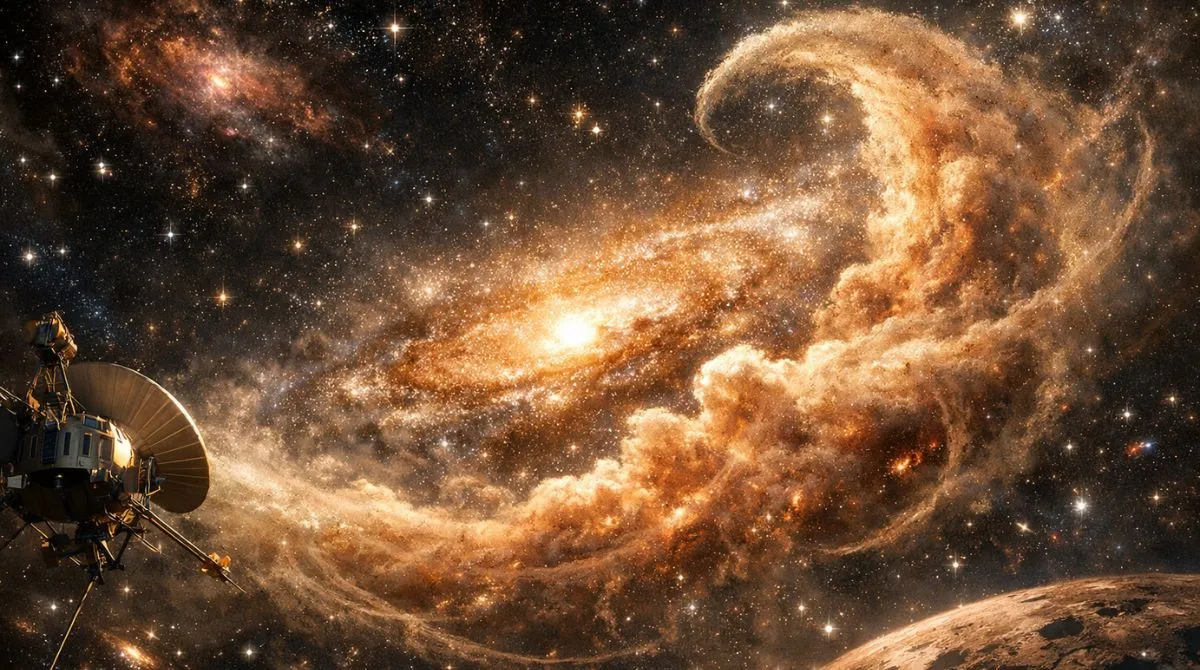
Deep space observations have revealed unexpected chemical activity inside a small, metal-poor galaxy that closely resembles conditions from the early universe. Using the James Webb Space Telescope, astronomers examined Sextans A, a dwarf galaxy containing only 3 to 7 percent of the Sun’s metallicity.
Despite its chemically ancient nature, researchers found that aging stars inside the galaxy actively produce complex dust. This behavior defies long-standing assumptions that heavy elements are required for dust formation.
Key Discoveries From The Observations Include:
- Detection of metallic iron dust and silicon carbide dust
- Dust production traced to Asymptotic Giant Branch stars
- Identification of carbon-based molecules in isolated dense regions
- Evidence of unconventional chemical pathways in low-metal environments
A companion analysis also identified polycyclic aromatic hydrocarbons, or PAHs, forming in small pockets of the galaxy. These molecules are considered essential precursors to more complex organic chemistry, even though Sextans A lacks abundant heavy elements.
“As scientists uncover unexpected chemical activity in ancient galaxies, AI is also reshaping how humans prepare for deep-space missions. From analyzing distant cosmic dust to assisting astronaut healthcare on Mars, artificial intelligence is becoming a core pillar of space exploration.”
What The Findings Reveal:
| Observation | Scientific Insight |
| Iron and SiC dust present | Dust can form without rich metal supplies |
| PAHs in dense regions | Organic molecules emerge in harsh conditions |
| Active AGB stars | Stellar aging fuels early dust creation |
These results suggest that dust formation in the early universe was far more diverse than scientists once believed. The findings also improve understanding of how planetary building blocks may have emerged in the universe’s earliest galaxies.