

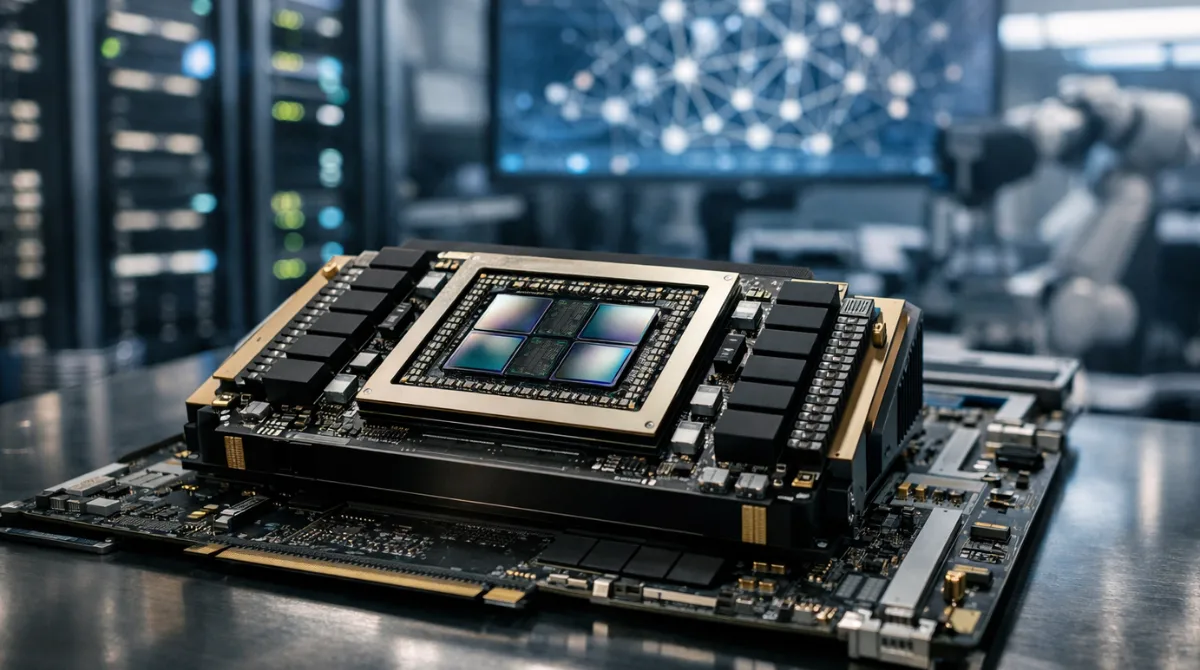
NVIDIA Blackwell Ultra is being positioned as a platform for AI reasoning and agentic inference, where response speed and long-context handling directly affect real-world quality of service. The key story is not only faster chips, but faster delivered outcomes per unit of power and infrastructure.
In production terms, the central NVIDIA Blackwell Ultra claim is economic scale. The GB300 NVL72 configuration is framed around higher throughput per megawatt and lower token cost at low-latency targets, which matters most for interactive assistants, tool-using agents and enterprise copilots.
Blackwell Ultra specifications also reinforce that direction:
- Up to 160 SMs and up to 288GB HBM3E, depending on SKU
- Architecture changes that lift attention-path throughput for reasoning-heavy inference
- Rack-level design with liquid cooling, 36 Grace Blackwell Superchips and NVLink 5 plus NVLink Switching
The broader takeaway is platform co-design. Performance is described as a full-stack effect across kernels, memory, interconnect and serving software, not a silicon-only uplift. Competitive positioning is increasingly measured by efficiency-per-watt and cost-per-token under real latency constraints, where deployment economics can outweigh peak theoretical compute.