


OpenAI has introduced Prism, a purpose-built AI workspace created to support scientific research, academic writing and collaboration. The platform brings drafting, editing and discussion into a single environment, removing friction from traditional research workflows.
Prism embeds an AI assistant directly inside documents, letting researchers ask questions, refine arguments and revise sections without leaving their work. Instead of juggling multiple tools, users can focus on ideas and clarity while the system handles structure and formatting.
The workspace is designed for technical writing and supports LaTeX based documents without requiring any local installation. Researchers can also turn equations, rough notes or visual concepts into clean LaTeX content with AI assistance.
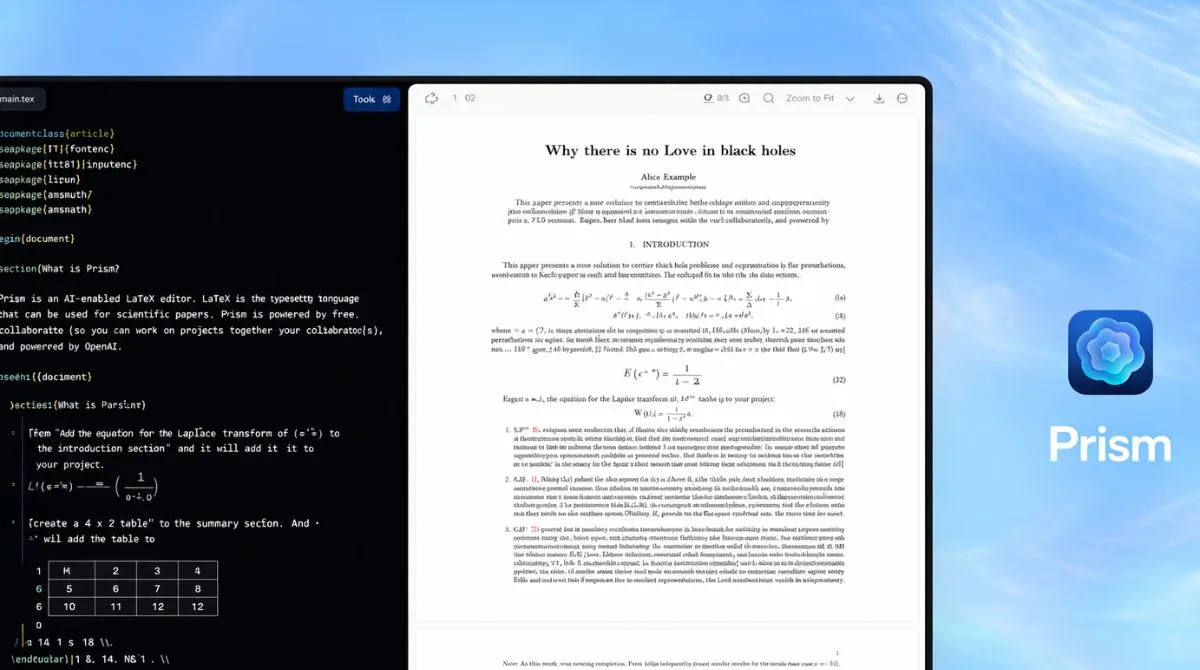
Key Capabilities of OpenAI Prism Include
- In-context AI help for drafting and revision
- Built-in proofreading, rewriting and formatting
- Reference handling within the same workspace
- Real-time collaboration across multiple projects
- Conversion of equations and notes into LaTeX
Prism also encourages collaboration by enabling shared editing in real time, making it easier for teams to co author papers and iterate quickly. Prism’s research first design aligns with OpenAI’s broader effort to ground AI systems in real human work, using authentic research and writing workflows to improve reasoning and collaboration. This direction reflects OpenAI’s push toward incorporating real-world contractor workflows and human baselines to make AI tools more reliable, structured and practical for serious academic use.
| Feature | What it does |
| AI writing support | Improves clarity and structure |
| LaTeX integration | Enables scientific formatting |
| Collaboration tools | Supports team-based research |
| Unified workspace | Reduces tool switching |
Released on January 27, 2026, OpenAI Prism is available at no cost to users with a ChatGPT personal account, with broader access planned for other account types.