

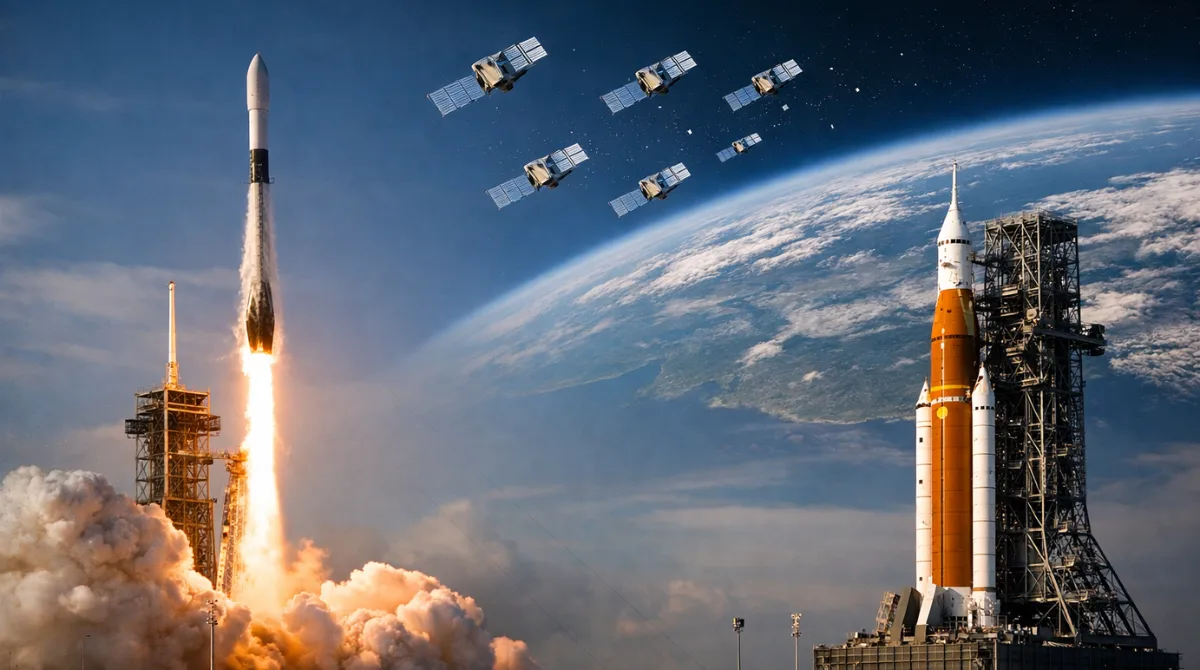
A SpaceX launch from Cape Canaveral kept the Florida range active on Feb. 24, 2026, while NASA delayed its planned Artemis rollback timing. Falcon 9 lifted off from Space Launch Complex 40 at 6:04:10 p.m. EST (2304:10 UTC) and headed onto a south-easterly trajectory after departing Florida’s Space Coast.
The mission, identified as Starlink 6-110, carried 29 Starlink V2 Mini satellites to low Earth orbit. Later the same night, an update confirmed deployment of all 29 satellites. The twilight flight was described as the company’s 18th launch of the year supporting its broadband internet satellite constellation, which was listed at more than 9,700 Starlink satellites in space before liftoff.
Operational details for the SpaceX launch included:
- Forecast: greater than 95% chance of favorable conditions at liftoff with no specific meteorological concerns.
- Booster: B1092 flew its 10th mission, with prior flights including CRS-32, NROL-69 and USSF-36.
- Recovery: the first stage landed on the droneship Just Read the Instructions a little more than eight minutes after liftoff, positioned in the Atlantic Ocean northeast of The Bahamas.
- Milestones: the landing was described as the 151st landing on that droneship and the 576th booster landing for the company to date.