


Elon Musk said SpaceX has shifted its long-term strategy toward building a self-growing lunar city, calling it a more achievable step toward permanent off-world settlement within the next decade. He described the Moon as the most practical proving ground for large-scale human expansion beyond Earth.
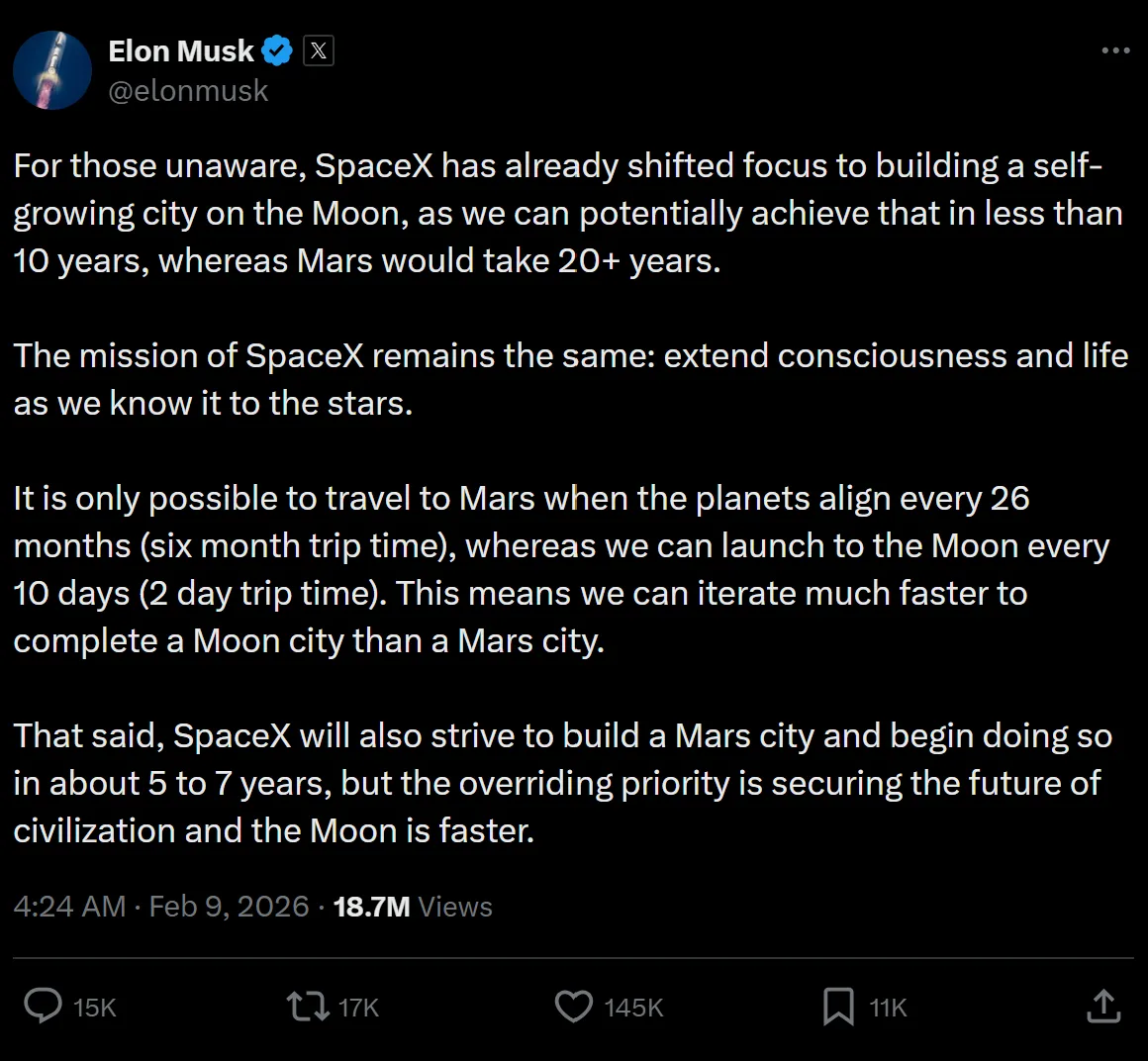
SpaceX still plans to build a city on Mars, but Musk said the Moon now takes priority. Work on Mars could begin in five to seven years, while lunar development is already moving into concrete planning and investor discussions.
Why SpaceX is Prioritizing a Lunar City
- Shorter travel time of about two days compared to months for Mars
- Launch opportunities to the Moon roughly every 10 days
- Faster iteration of habitats, logistics and life-support systems
- Strategic importance as global competition in lunar exploration increases
SpaceX has told investors it is targeting an uncrewed lunar landing by March 2027, laying the groundwork for sustained lunar operations. Musk said frequent missions make the lunar city concept more manageable and scalable.
SpaceX and xAI Merger Overview
| Area | Key Details |
| Combined valuation | About $1.25 trillion |
| SpaceX valuation | About $1 trillion |
| xAI valuation | About $250 billion |
| Integration focus | AI tools, Starlink, space systems |
| IPO outlook | Potential 2026 listing |
The merger brings xAI’s AI capabilities, including Grok and the X platform, into SpaceX’s ecosystem. Musk and Reuters noted that rising AI computing needs could drive future space-based infrastructure, such as orbital data centers, reinforcing the strategic logic behind the lunar city push.