

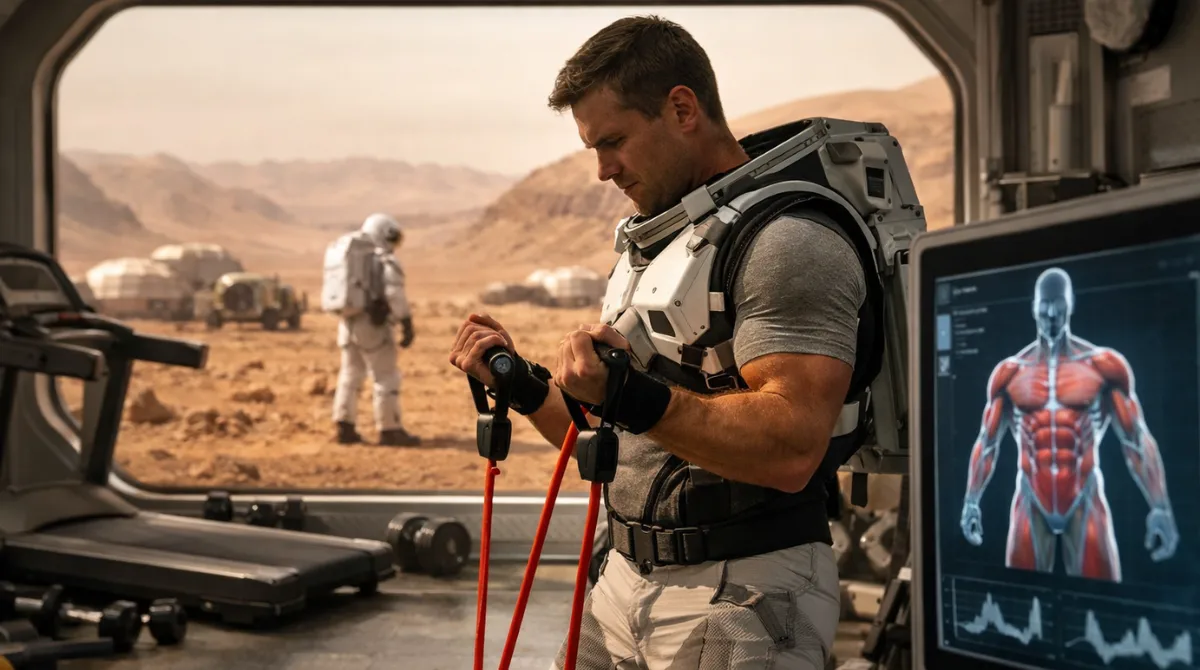
Long duration mission planning is forcing agencies to look more closely at Mars gravity and whether it can do enough to protect the body over time. A new spaceflight study using mice suggests partial gravity may help preserve muscle function, but not all reduced-gravity levels offer the same protection.
Researchers tested 24 mice in orbit for roughly four weeks under microgravity, 0.33 g, 0.67 g and 1 g conditions using JAXA’s MARS centrifuge system. The results showed that mice at 0.33 g had weaker grip strength and changes in muscle fibers, even without full muscle deterioration.
By contrast, mice exposed to 0.67 g showed no measurable muscle decline, no strength loss and no major muscle fiber disruption compared with full gravity conditions. That finding points to a possible gravity threshold for protecting muscle health during long stays away from Earth.
This matters because Mars gravity is about 0.38 g, which is well below the stronger protective level identified in the experiment. The study does not prove how humans would respond, but it sharpens an important question for mission designers, doctors and habitat engineers.
The bigger takeaway is that partial gravity is not automatically enough. Future Mars missions may need artificial gravity, exercise systems and other countermeasures if long-term crews are expected to maintain muscle performance during settlement or extended surface operations.