
Esports scholarships are available at some colleges and universities, but eligibility requirements, award amounts, covered expenses, and renewal conditions differ by institution. Students should review each offer as part of their complete financial aid package while checking competitive team commitments separately. This guide uses examples from U.S. colleges, where scholarship rules and financial aid policies can vary significantly between institutions.
Students and parents often focus on the dollar amount and miss the fine print around eligibility, renewal terms, and team expectations. A clear checklist helps you compare schools and avoid surprises after enrollment.
Where Students Can Find Esports Scholarships?
Colleges may offer scholarships specifically for esports participation, while others provide broader academic, merit-based, or need-based financial aid. Esports-specific awards can be administered through university departments, institutional scholarship programs, or dedicated varsity esports teams. General academic scholarships should be considered separately unless the institution explicitly connects them to esports participation.
Scholarship availability depends on each institution’s funding, eligibility requirements, and esports program policies. A larger university does not necessarily provide a bigger esports scholarship than a smaller institution. Students should compare official award amounts, supported game titles, application deadlines, and renewal conditions before deciding where to apply.
For a real-world example, Carroll University’s esports scholarship lists awards ranging from $500 to $2,500 for selected incoming students during its 2026–27 application cycle. The university also identifies supported esports titles, application deadlines, and renewal conditions. This example shows why students should review the details of individual university programs instead of assuming that all esports scholarships offer the same financial support.
How Esports Scholarships are Funded and Awarded?
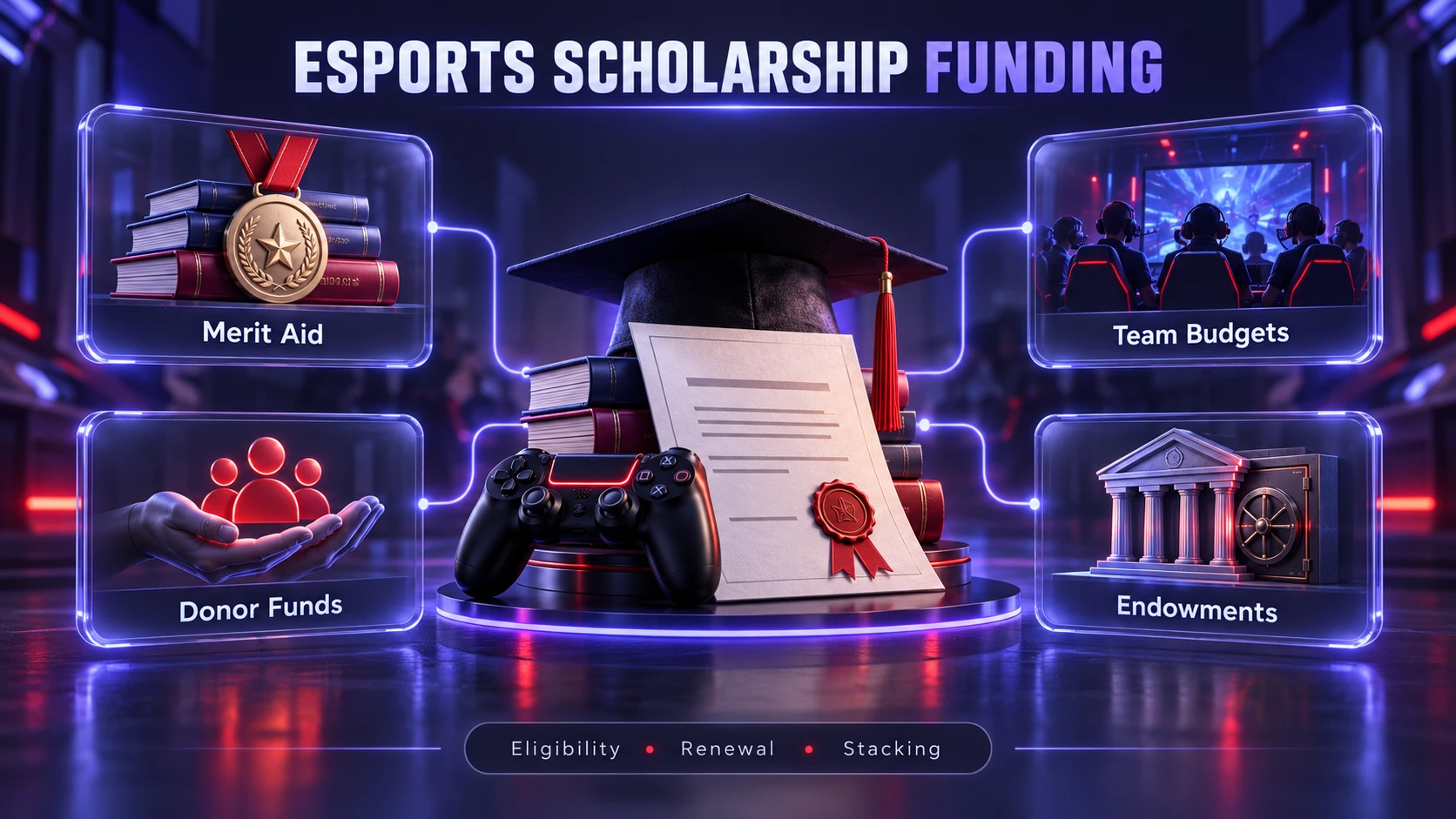
Funding sources influence how formal the process is and how reliably awards renew. Ask where the money comes from and which office controls it, because that determines who can change the terms.
- Institutional Merit Aid: Academic scholarships may be based on GPA, achievements, or other university-specific criteria. Students should confirm whether these awards can be combined with esports scholarships and whether any maximum award limits apply.
- Team or Department Budgets: Managed by athletics or student life, typically tied to roster status and coach evaluation.
- Donor and Foundation Funds: May require extra paperwork and can carry specific eligibility rules set by the donor.
- Endowed Scholarships: Awards supported by an established endowment may have specific eligibility conditions, funding restrictions, or annual award limits. Students should verify whether an esports-related award is available and whether continued funding is guaranteed.
Once you know the funding path, it becomes easier to understand what can change and what must be honored.
Oklahoma City University’s esports scholarship provides an example of how scholarship stacking works. The university offers tryout-based esports awards that may be combined with other institutional merit scholarships, subject to a tuition limit. Its published policy also connects scholarship renewal to academic standing, team participation, and student performance. These conditions demonstrate why families should verify stacking and renewal rules directly with each institution.
Common Types of Esports Scholarship Offers
Esports scholarship packages may include tuition assistance and, depending on the institution, additional financial support for eligible educational expenses. Some esports programs also provide gaming equipment, training facilities, or team travel arrangements. However, these program benefits should not automatically be counted as scholarship money unless the university identifies them as part of the financial aid award.
- Tuition Reduction: A percentage discount or fixed amount applied directly to tuition charges.
- Room and Board Support: Aid applied to housing or meal plans, sometimes limited to campus residence halls.
- Stipends: Cash payments or scholarship funds used for living expenses may have tax implications. Under the IRS scholarship tax rules, scholarship amounts used for expenses such as room, board, or travel are generally taxable. Students should confirm how payments are classified and seek appropriate tax guidance when necessary.
- Program Benefits: Gaming equipment, practice facilities, coaching, and covered team travel may reduce certain expenses, but they are not necessarily cash scholarships or discounts on university tuition.
Ask for a full cost of attendance view so you can compare schools fairly, not just the headline number.
Eligibility Requirements Students Should Expect
Esports scholarship eligibility is determined by each institution and may involve academic performance, enrollment status, team participation, competitive ability, or student conduct. Some programs offer talent-based scholarships through tryouts, while others place greater emphasis on participation and academic standing.
Expect requirements around GPA, enrollment status, and conduct, plus game specific performance expectations. Some teams use tryouts, ranked thresholds, or coach evaluation rather than a single cut off number.
- Academic Standing: Minimum GPA and progress toward degree requirements, often reviewed each term.
- Roster Status: Being on the active roster may be required for the award to continue.
- Code of Conduct: Rules for sportsmanship, online behavior, and campus conduct with clear disciplinary consequences.
- Participation Expectations: Practice hours, meetings, and match participation that can affect renewal.
Get clarity on what is mandatory versus recommended, since time demands can impact grades and wellbeing.
Students should also confirm which university or collegiate esports association rules apply to their award. Esports scholarships should not automatically be treated as equivalent to NCAA athletic scholarships, because financial aid agreements, eligibility requirements, and renewal procedures may follow different institutional or competition-specific policies.
The University of Nebraska–Lincoln provides a useful example in its 2026–27 esports scholarship guidelines. The published requirements include full-time enrollment, maintaining a 3.0 cumulative GPA, completing a specified number of academic credits, and remaining in good standing with the varsity esports team. Students should use such institutional policies as examples while checking the exact requirements of the universities where they intend to apply.
What Parents and Students Should Check Before Accepting?
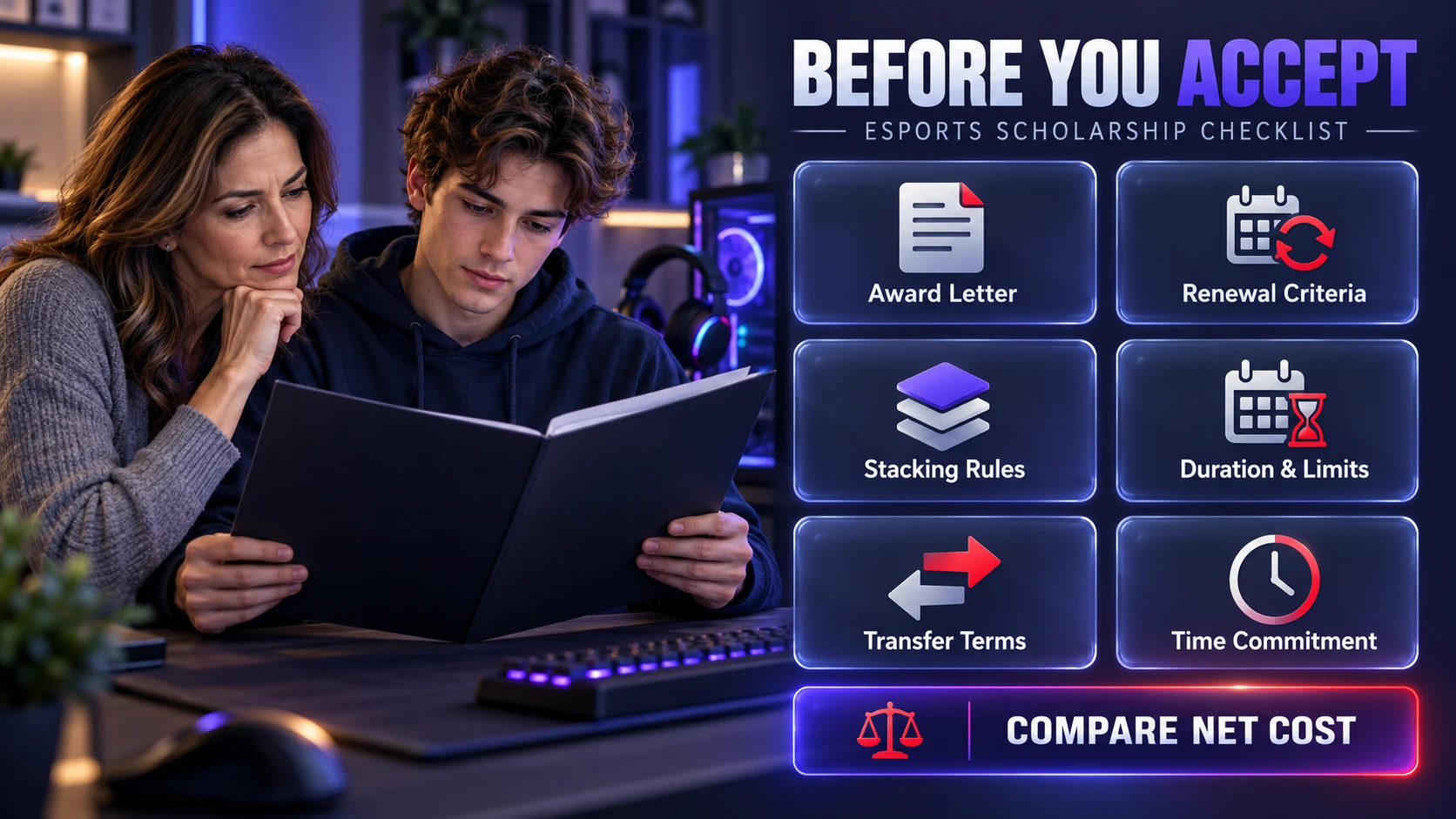
A written offer is not enough if it lacks terms, timelines, and renewal language. You want documentation that explains exactly what the school is promising and what the student must do to keep it.
- Written Award Letter: Confirm the amount, what it applies to, and which semesters are covered.
- Renewal Criteria: Verify the GPA requirement, roster expectations, and whether renewal is automatic or discretionary.
- Stacking Rules: Ask how the esports award interacts with merit aid, need based aid, and outside scholarships.
- Duration and Limits: Confirm whether the award is one year, multi year, or capped at a number of semesters.
- Withdrawal and Transfer Terms: Understand what happens if the student changes majors, leaves the team, or transfers.
- Time Commitment Policy: Request typical weekly hours and how travel affects class attendance.
After you collect these details, compare offers using net cost, not just scholarship labels.
Questions to Ask the Esports Coach and Financial Aid Office
Coaches can explain competitive expectations, but financial aid offices control billing, disbursement, and stacking. You need answers from both sides so the offer is consistent across departments.
- Coach Controlled Details: Practice schedule, roster selection, starting roles, and performance reviews.
- Financial Aid Controlled Details: Disbursement dates, refund rules, and whether the award reduces other grants.
- Academic Support Details: Tutoring, study halls, and advising support if practice conflicts with coursework.
- Health and Wellness Details: Policies for burnout, breaks, and support if gaming affects sleep or mental health.
Keep notes, and request follow up in writing when a policy affects money or eligibility.
Beyond financial considerations, students and parents should evaluate how competitive gaming may affect academics, teamwork, social development, and personal wellbeing. TechBonafide’s guide on how esports affect society explores the potential benefits and challenges of competitive gaming, helping families consider the broader experience of joining a college esports program.
Esports Scholarships and the Total Cost of College
An esports scholarship can reduce college expenses while leaving a substantial amount for students and families to pay. Compare each institution’s cost of attendance, including tuition, fees, housing, meals, books, and other necessary expenses. Subtract confirmed grants and scholarships to estimate net price, and evaluate student loans separately because borrowed money must generally be repaid.
A larger esports scholarship does not necessarily mean a college will be more affordable. Total attendance costs and other financial aid can change the final amount a student must pay. Use the following table as a checklist when reviewing scholarship offers.
| Item to Verify | What to Look for | Why It Matters |
|---|---|---|
| Award Coverage | Tuition only or tuition plus fees and housing | Determines your true out of pocket cost |
| Renewal Terms | GPA, roster status, conduct rules, review timing | Protects against losing aid after one term |
| Stacking Policy | Whether esports aid reduces other grants | Prevents overestimating total aid |
| Time Commitment | Weekly practice hours, travel days, offseason plan | Helps balance academics, health, and team duties |
For example, imagine College A has an annual cost of attendance of $40,000 and provides $12,000 in confirmed grants and scholarships. Its estimated net price is $28,000. College B costs $30,000 annually and provides $8,000 in grants and scholarships, leaving an estimated net price of $22,000. Even if College A offers the larger esports scholarship, College B may still be the more affordable choice. These figures are hypothetical and do not represent actual university offers.
Students comparing multiple universities can also follow the U.S. Department of Education’s guidance on how to evaluate your aid offers. The guidance explains how to compare college expenses, scholarships, grants, and loans when estimating out-of-pocket costs. Reviewing the complete financial aid package can help families make a more informed decision than comparing scholarship amounts alone.
Use this checklist style comparison during admissions season, then confirm the final numbers on the official financial aid portal.
Risks and Red Flags to Watch for
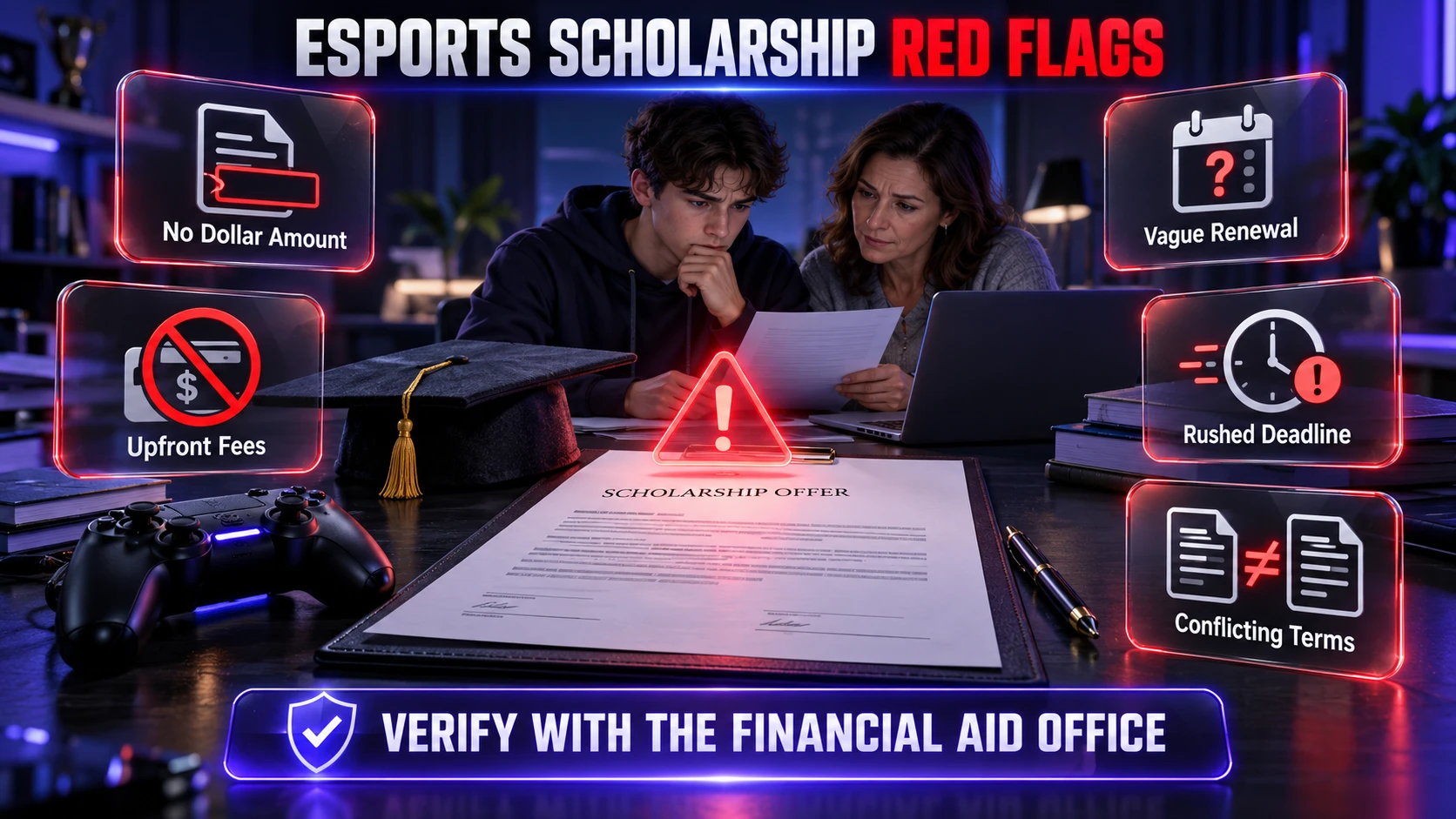
Even a legitimate esports scholarship offer can lead to misunderstandings when its amount, renewal conditions, or eligibility requirements are unclear. Students should verify scholarship information directly with the institution’s admissions or financial aid office. They should also be cautious of unofficial scholarship advertisements, unexpected payment requests, and promises that cannot be confirmed through university documentation.
- No Specific Dollar Amount: If the offer is described as potential or estimated, ask for an official figure.
- Unclear Renewal Language: Discretionary renewal without criteria can change based on coaching decisions.
- Pressure to Commit Quickly: High pressure timelines can prevent careful review of net costs and policies.
- Unexpected Payment Requests: Be cautious of unofficial scholarship services that demand processing fees, credit card information, or upfront payments to release a supposed award. The Federal Trade Commission’s scholarship scam warning explains common warning signs. Students should verify scholarship offers through the university’s official financial aid office before providing sensitive information.
- Mismatch Between Coach and Aid Office: If departments describe different terms, pause until aligned.
When something feels inconsistent, request the policy in writing and take time to compare alternatives.
Building A Strong Application for Esports Scholarship Consideration
Scholarship selection criteria vary by institution. Depending on the program, evaluators may consider competitive gaming performance, academic results, financial need, participation, community involvement, and a student’s ability to contribute positively to the esports team.
Prepare materials that show performance, consistency, and professionalism. Keep everything organized so coaches and admissions can review quickly.
- Competitive Profile: Current rank, main roles, and match history presented clearly and accurately.
- Academic Readiness: Strong transcripts and evidence of reliable study habits.
- Team Mindset: Communication skills, leadership, and sportsmanship shown through references and conduct.
- Schedule Planning: A realistic view of how practice fits with the intended major and course load.
Good preparation reduces back and forth and helps the school justify awarding limited funds.
Students who include tournament participation in their esports scholarship applications should maintain accurate records of competitions, results, and team achievements. It is also important to confirm that the events have identifiable organizers and published rules. TechBonafide’s guide to verifying esports event rules and registration details explains useful verification practices using PBLGamevent as an example. These checks can help students organize their competitive history more carefully.
Conclusion
Esports scholarships exist, and they can reduce college costs when the terms are clear and sustainable for the student. The best outcomes come from verifying coverage, renewal rules, stacking policies, and time commitments with both the coach and the financial aid office.
Approach every offer as a full package decision that includes academics, wellbeing, and long term career goals. A careful review upfront protects the student and makes the scholarship a genuine advantage.
Frequently Asked Questions
Are Esports Scholarships Only for Top Ranked Players?
No. Some programs prioritize high competitive rank, but others value consistency, coachability, leadership, and academic strength. Schools often build rosters with a mix of roles and skill levels, so fit matters as much as raw rank.
Can An Esports Scholarship Be Taken Away After the First Semester?
Yes, depending on the renewal terms. Common triggers include falling below GPA requirements, conduct violations, or losing roster eligibility. Always confirm the renewal criteria and who makes renewal decisions.
Do Esports Scholarships Affect Other Financial Aid?
Yes, an esports scholarship may affect other financial aid depending on the institution’s policies and the student’s existing awards. Some universities permit esports scholarships to be combined with merit-based aid, subject to stated limits. Students should ask the financial aid office to explain in writing whether an esports award changes their grants, other scholarships, or overall aid package before accepting it.