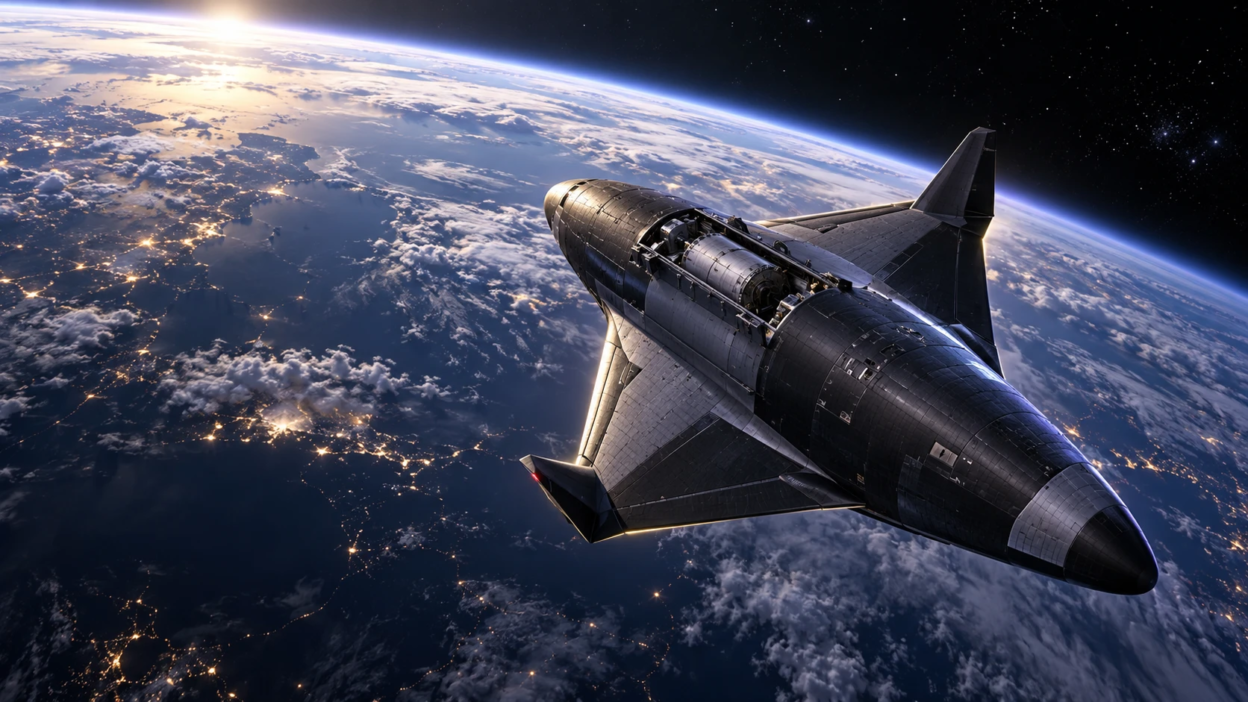
A rare photograph of a Chinese reusable space plane, widely believed to be Shenlong, has been made public in a U.S. intelligence report. The U.S. Defense Intelligence Agency (DIA) released the image on October 26, 2026, although it was captured in 2024. The picture offers one of the clearest publicly available views of the spacecraft, whose design and missions remain largely undisclosed.
The photograph shows a small, uncrewed spacecraft in orbit, with triangular wings, a dark underside, and what appear to be open payload-bay doors. A structure attached at the rear has extended solar arrays. These details offer a clearer look at the vehicle’s design than earlier public images, although the photograph alone cannot confirm the exact purpose of its equipment or activities in space.
The photograph was captured in 2024 by an imaging satellite operated by Maxar Technologies, now known as Vantor. It appeared on page 53 of the DIA’s 2026 Challenges to Security in Space report. The report identifies the vehicle as a Chinese space plane but does not explicitly name it Shenlong. The spacecraft is widely believed to be Shenlong, meaning “Divine Dragon” in Chinese, although the identification is not confirmed by the photograph’s official caption.
Shenlong is widely described as an experimental, uncrewed spacecraft designed to launch aboard a rocket and return to Earth using a runway landing. Unlike most traditional satellites, which are not built to be recovered and flown again, reusable spacecraft can bring equipment back to Earth and potentially support additional missions. This approach is also used in civilian space programs, including SpaceX’s reusable Dragon cargo spacecraft, which transports supplies and scientific equipment to the International Space Station. Reusing spacecraft may reduce the need to build replacement vehicles, although Shenlong’s actual operating costs have not been publicly disclosed.
China first launched its reusable experimental spacecraft in September 2020. That mission lasted about two days before the vehicle returned to Earth. A second mission began in August 2022 and continued for approximately 276 days. The third mission started in December 2023 and ended in September 2024 after spending 268 days in orbit.
The spacecraft began its fourth known orbital mission on February 7, 2026, aboard a Long March 2F rocket from the Jiuquan Satellite Launch Center, as described in China’s February 2026 launch announcement. Independent orbital observations have also indicated that the Chinese space plane has released smaller objects and carried out movements near other objects during its missions. However, these observations do not establish the purpose of the activities or confirm whether they are connected to scientific experiments, spacecraft testing, or military operations.
China’s reusable space plane is often compared with the U.S. Space Force’s X-37B orbital test vehicle. Both are uncrewed, winged spacecraft designed to launch aboard rockets, operate in orbit, and return to Earth for potential reuse. Although their designs appear similar, this does not mean they carry the same equipment or perform identical missions. Many technical details about China’s spacecraft remain undisclosed.
The photograph has also raised questions about China’s future space operations. Reusable spacecraft may support satellite inspections, equipment testing, scientific research, and other activities in low Earth orbit. Some of these capabilities could also have military applications, raising wider questions about competition in space. Separately, TechBonafide has examined China’s reported plans to counter Starlink satellites, highlighting the strategic importance of satellite technology. However, the newly released photograph does not establish that Shenlong carries weapons or has been used to attack other spacecraft.
Despite growing international interest, China has not publicly released detailed information about Shenlong’s size, onboard equipment, or complete mission objectives. Much of the spacecraft’s technology remains unknown, making the newly revealed photograph especially important for researchers studying reusable space systems.
The newly released photograph gives the public a rare look at the design of China’s reusable orbital spacecraft. However, it does not reveal the vehicle’s complete mission objectives, onboard equipment, or intended uses. With China continuing its orbital testing program, researchers will be watching for further official details and independently verified observations that could explain more about the spacecraft’s capabilities.