

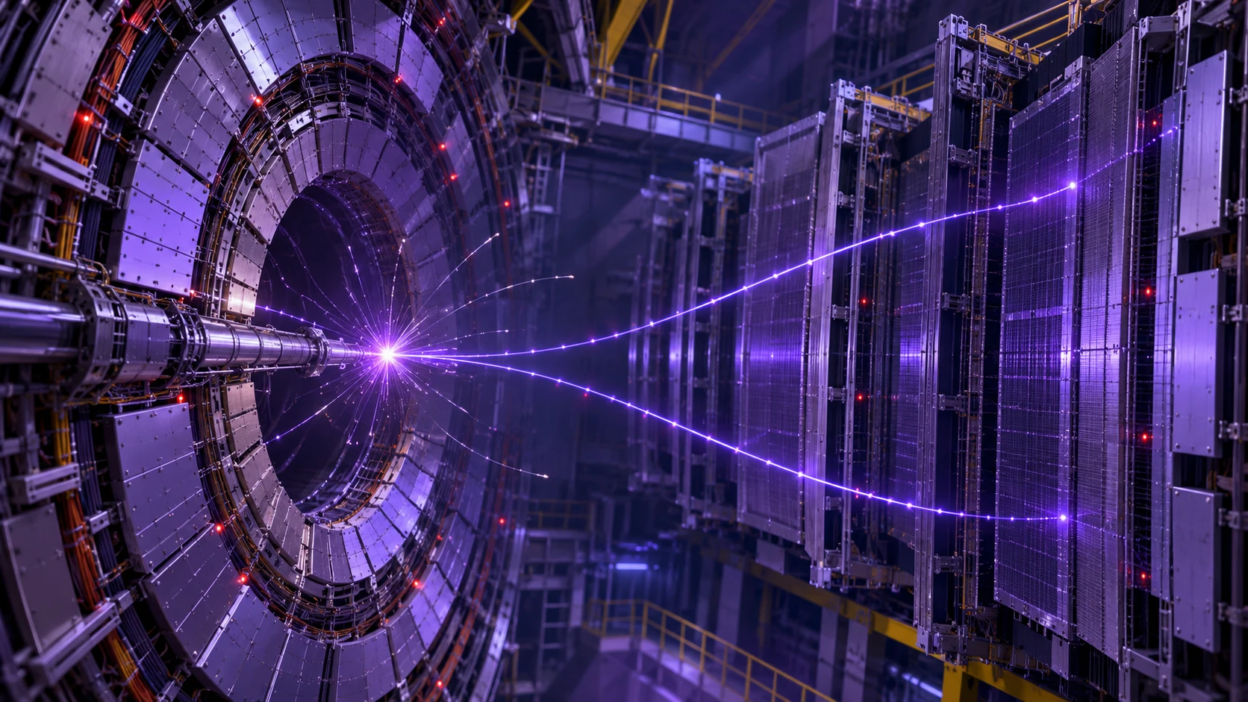
Scientists working with CERN’s Large Hadron Collider (LHC) have found the first evidence from a single experiment of an extremely rare particle decay after more than four decades of research. The result reached a statistical significance of 3.2 sigma, making it an important scientific finding but not yet a confirmed discovery. The research could help physicists explore the zeptoverse, a term used to describe incredibly small distances where unknown particles or forces might influence the behavior of matter.
The University of Cambridge announced the result on November 3, 2026, following work by researchers in the international LHCb collaboration, including teams from Cambridge and Manchester. The rare decay is expected to happen in approximately one out of every 10 billion beauty particles. The results were presented at CERN, but they had not yet undergone peer review at the time of the announcement.
The term zeptoverse describes an extraordinarily small scale of nature. One zeptometre equals 0.000000000000000000001 metres, or one billionth of a trillionth of a metre. Scientists are not directly observing this hidden world in the latest experiment. Instead, they are studying extremely rare particle decays that could reveal indirect signs of particles or forces beyond current scientific theories.
The latest research focused on particles containing beauty quarks, which are heavier relatives of the quarks found inside ordinary matter. These particles are created during powerful collisions inside the Large Hadron Collider and survive for only a tiny fraction of a second before breaking down into other particles.
Researchers identified evidence of an extremely rare particle decay known as B⁰ → μ⁺μ⁻, also called Bd to mu mu. During this process, a neutral B meson, a particle made from a quark and an antiquark, decays into a muon and an antimuon. Scientists have investigated this process for more than four decades. Although researchers previously observed a related decay involving a different B meson, the latest finding provides the first evidence of this rarer process from a single experiment.
Detecting this rare signal became possible after major upgrades to CERN’s LHCb experiment, which began collecting improved measurements in 2024. The upgraded detectors allowed researchers to gather more detailed information about particle collisions and identify rare events that were previously difficult to distinguish from background activity.
Researchers also used machine learning technology to separate meaningful particle signals from large amounts of background data. By combining information collected during 2024 and 2025 with earlier measurements from 2011 to 2018, the team identified evidence of the rare decay.
The analysis found a signal with a statistical significance of 3.2 sigma. In particle physics, this level is strong enough for researchers to report evidence of a process, but it is not sufficient to declare a confirmed discovery. Scientists generally require a significance of five sigma before making a discovery claim. Additional measurements and scientific scrutiny will be needed to establish the result more firmly.
Researchers study rare particle decays because unknown particles or forces could subtly change how often these events occur. Such measurements may eventually help physicists investigate unanswered questions, including the nature of dark matter. However, the latest experiment has not detected dark matter or identified any new particle. So far, the measurements agree with the Standard Model, the scientific theory describing known fundamental particles and their interactions.
This agreement is still valuable because it allows researchers to test their predictions with greater accuracy. If future experiments detect differences between expected and observed particle behavior, those differences could point toward physics that scientists have not yet discovered.
The research also demonstrates how advanced computing and highly sensitive detectors are changing modern scientific experiments. Machine learning allows researchers to analyze enormous datasets and identify unusual patterns, while improved instruments help capture signals that were previously difficult to measure. Similar technologies are supporting other breakthroughs in science and physics by allowing scientists to study phenomena that once remained beyond their reach.
CERN’s Large Hadron Collider entered a scheduled shutdown in 2026 for major upgrades, but researchers can continue studying previously collected data. The LHCb collaboration expects to gather a much larger dataset after operations resume, with additional measurements extending into the early 2030s. Further planned improvements could increase the rate of data collection and help scientists test rare particle decays with greater precision.
The latest findings represent an important step toward understanding the zeptoverse. Although scientists have not yet uncovered a new hidden world of particles, the results show how modern technology is helping them investigate some of the deepest mysteries of nature. Future measurements will help determine whether this rare decay continues to match existing scientific predictions or reveals unexpected behavior that could point toward new physics.


