

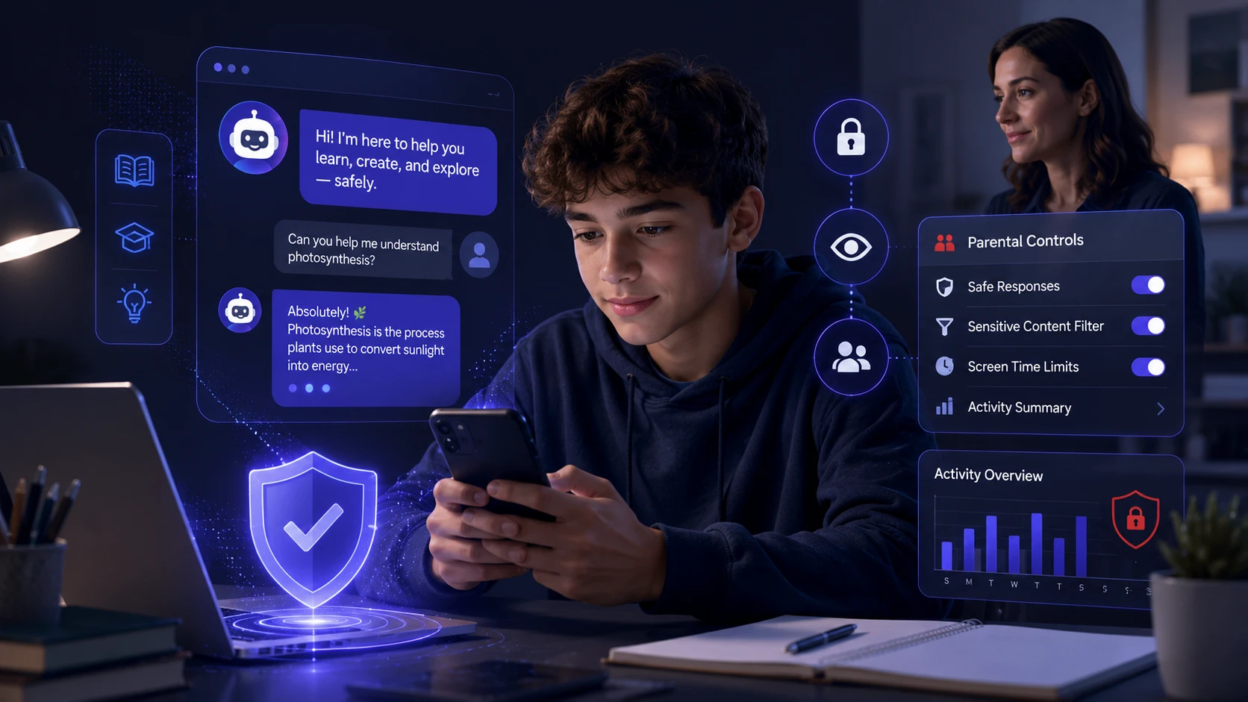
OpenAI has launched ChatGPT for Teens, a new version of its AI experience designed specifically for younger users. The service focuses on learning while adding stronger safety protections, healthier-use features and more control for parents.
ChatGPT for Teens is designed for users between the ages of 13 and 17. When ChatGPT identifies an account as belonging to someone under 18, the teen experience can be applied automatically. Users who provide an age between 13 and 17 are also placed into the teen-focused version.
One of the biggest changes is stronger protection against content that may not be suitable for younger users. ChatGPT for Teens includes additional safeguards around self-harm, violence, eating disorders, dangerous activities, explicit sexual material and graphic content.
OpenAI is also placing a stronger focus on education. The teen experience includes Study Mode, which encourages students to understand a problem step by step instead of simply giving them an answer.
A new Responsible Homework Reminder can identify situations where a student may be trying to use ChatGPT to quickly complete an assignment without learning the subject. In these cases, the system can guide the teen toward Study Mode and help them work through the problem.
Teens also have access to quizzes and learning visualizations that can make difficult topics easier to understand. Another feature called Study Hours allows teens or their parents to choose certain times when Study Mode will automatically become the default.
Parental controls are an important part of the experience. Parents who link their account with a teen account can set Quiet Hours, manage selected ChatGPT settings and receive notifications in limited situations where the system detects a serious safety concern.
OpenAI is also expanding these safety notifications to cover concerns related to eating disorders. The company says the system is designed to limit the information shared with parents while helping families respond when offline support may be important.
ChatGPT for Teens also includes features aimed at creating healthier AI habits. Teen users may receive reminders to take breaks after spending extended periods of time using ChatGPT.
The service also tries to keep a clear difference between an AI assistant and a real person. ChatGPT is designed not to encourage emotional dependence among teen users or suggest that the AI has human feelings or consciousness. Romantic or sexualized interactions are also more strongly restricted.
Another protection warns teens before they upload potentially sensitive or private images. Teen-specific onboarding explains the learning tools and safety features when younger users begin using the experience.
The launch reflects a wider push to make generative AI safer for younger audiences while still allowing teenagers to use the technology for education, creativity and skill development.
Rather than creating an AI service that simply gives students fast answers, OpenAI is positioning ChatGPT for Teens as a learning-focused assistant that encourages users to think through problems and understand what they are studying.
The new experience could also increase pressure on other AI companies to introduce stronger age-based controls as chatbots become increasingly common among students. Parents, schools and technology companies are paying closer attention to how young people interact with powerful AI systems and what protections should be built into those products.
For OpenAI, ChatGPT for Teens represents another step toward making AI available to younger users while giving families more ways to control how the technology is used.