
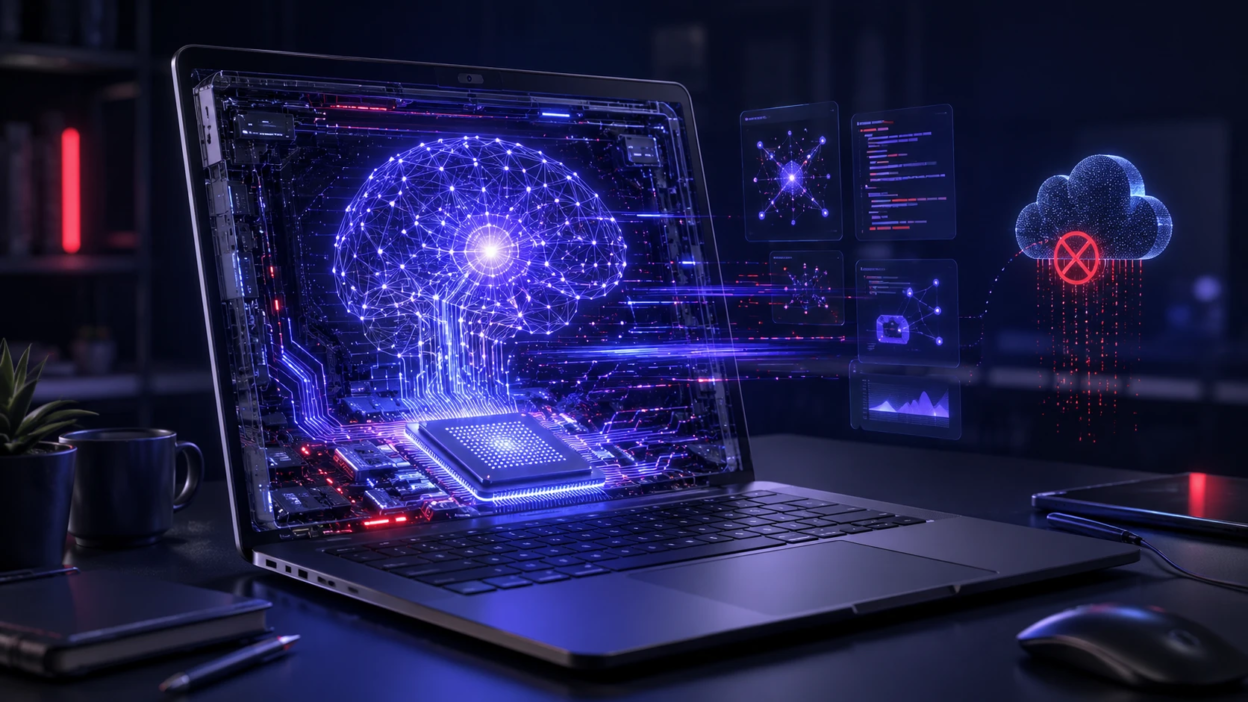
Meta has released a new artificial intelligence model called Muse Glimmer, designed to run directly on personal computers instead of depending completely on cloud-based AI services. The move could make powerful AI tools more accessible to developers and users who want to run AI locally on their own hardware.
Muse Glimmer is a 30-billion-parameter open-weight AI model developed by Meta Superintelligence Labs. Despite its size, Meta has optimized the model so it can run on a Mac or PC equipped with a single consumer graphics card. This makes it different from many advanced AI models that normally require large data centers and expensive cloud computing systems.
One of the main goals behind Muse Glimmer is to support AI agents that work directly on a user’s device. These agents could perform tasks such as working with files, assisting with coding, calling software tools, handling multi-step instructions and helping automate everyday computer activities. The model can also process both text and images, allowing AI applications to understand screenshots, documents, charts and other visual information.
Running AI locally can have several practical advantages. Users may be able to use some AI features without a constant internet connection, while developers can build applications that do not need to send every request to a remote server. Local processing can also give developers more control over how their AI applications work and how information is handled.
Meta has used several techniques to make the model practical for personal computers. A normal 30-billion-parameter model at full precision could require more than 55GB of memory. Muse Glimmer uses quantization to reduce the size of its language model to under 20GB, helping it operate within the memory limits of high-end consumer hardware. Meta says configurations can work within roughly 24GB or 32GB memory environments while still supporting other parts of the AI system.
The model was also trained using knowledge from Meta’s larger Muse Spark model. Through a process known as distillation, a smaller AI model can learn from the outputs and reasoning abilities of a larger model. Meta used this approach along with additional training for reasoning, coding and agent-based tasks to improve Muse Glimmer while keeping its hardware requirements relatively manageable.
Muse Glimmer is being released with open model weights under the Apache 2.0 license, giving developers more freedom to download, experiment with and customize the technology. Meta is also preparing integrations with popular tools and frameworks used for running AI models locally, including llama.cpp, MLX and ExecuTorch.
The launch also highlights growing competition around open-weight AI. Instead of keeping the core model completely behind a company-controlled service, open-weight models allow developers to access the model files and adapt them for their own applications. Meta has been pushing this approach as it looks to expand its position in the rapidly developing AI market.
Muse Glimmer could be especially interesting for developers building personal AI assistants, coding tools and automated computer agents. The ability to operate locally means some future AI applications may become less dependent on large cloud platforms and more closely integrated with individual computers.
For everyday PC users, running a 30-billion-parameter model will still require capable hardware, so Muse Glimmer is not likely to run smoothly on every basic laptop. However, its release shows how quickly advanced AI models are becoming smaller and more efficient.
As AI companies continue improving model efficiency, local AI could become a bigger part of personal computing. Muse Glimmer gives Meta another way to compete in that direction, combining open access, agent capabilities and local processing in a model designed for consumer devices.