

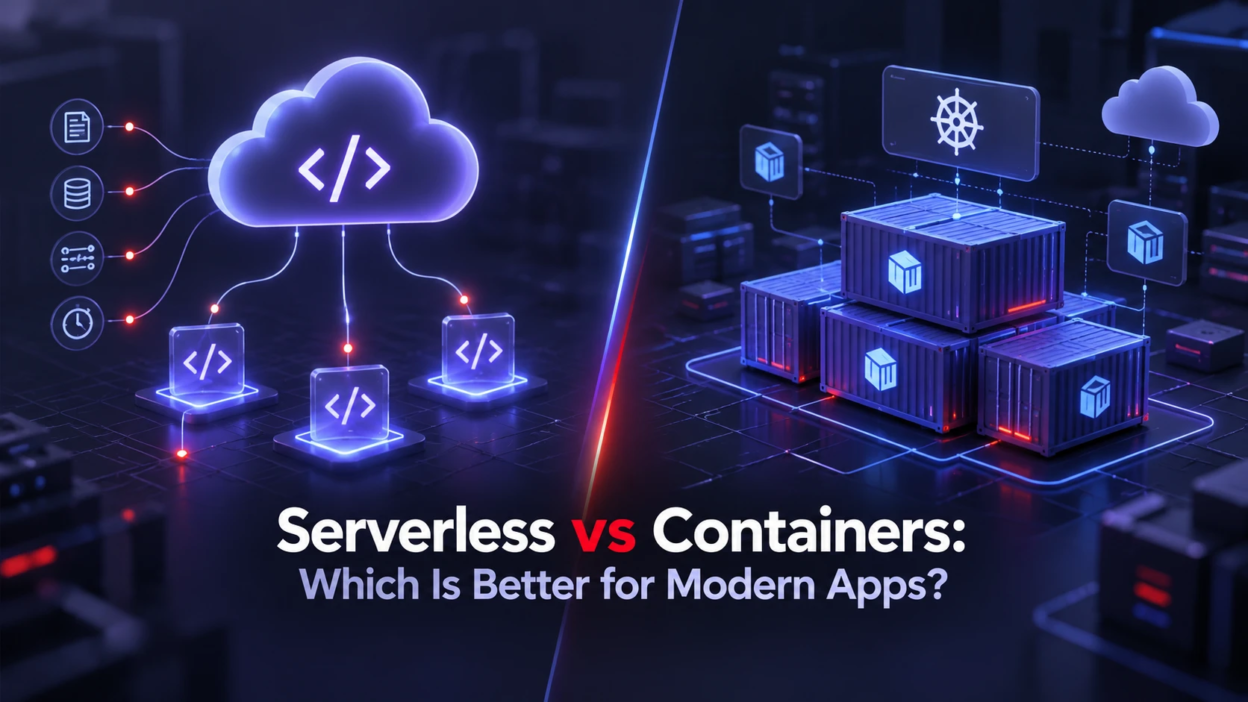
Choosing between serverless and containers shapes how fast you ship, what you pay, and how much operational work your team carries. Both approaches can run modern apps well, but they optimize for different tradeoffs around control, portability, and scaling behavior.
What Serverless Means In Practice?
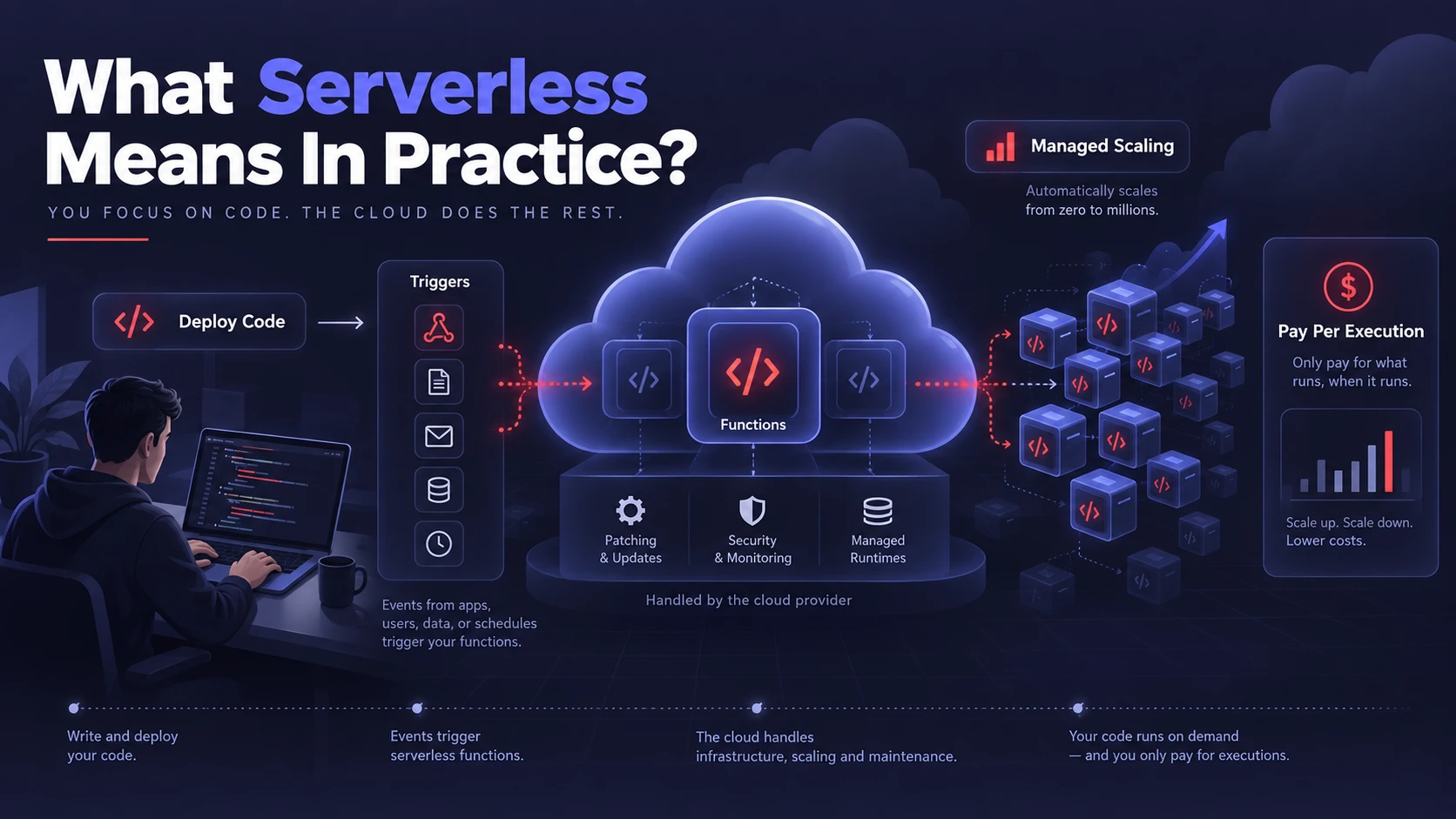
Serverless usually means functions or managed runtimes where the cloud provider handles servers, patching, and much of the scaling. You deploy code, define triggers, and pay primarily for execution time and requests.
This model fits event driven workloads, bursty traffic, and teams that want to reduce infrastructure management. It can also simplify availability by pushing resiliency work into managed services.
What Containers Mean In Practice?
Containers package an application with its dependencies into a consistent unit that runs the same across environments. You still choose how the container runs, such as on Kubernetes, a managed container service, or a simpler orchestrator.
This model suits long running services, complex networking, and workloads that need predictable performance. It also supports polyglot architectures and fine control over runtime configuration.
Serverless Vs Containers Key Differences
The best choice depends on constraints such as latency, compliance, portability, and the skills available on the team. A clear comparison helps avoid architecture decisions that create hidden cost or lock in.
| Decision Area | Serverless | Containers |
|---|---|---|
| Scaling Model | Auto scales per request or event with minimal tuning | Scales by replicas and resources with more tuning options |
| Cost Pattern | Strong for spiky workloads and low idle time | Strong for steady workloads and reserved capacity |
| Portability | Often tied to provider runtimes and triggers | High portability across clouds and on premises |
| Operational Control | Less control over runtime and networking details | More control over OS, libraries, and network policies |
Use this matrix as a starting point, then validate it against your application profile and non functional requirements.
Performance And Latency Considerations
Serverless can introduce cold starts, which add latency when a function has to initialize. This impact varies by language runtime, memory size, dependency weight, and traffic patterns.
Containers typically deliver steadier response times for always on services. With proper autoscaling and resource limits, they can maintain predictable performance under sustained load.
Cost And FinOps Reality
Serverless pricing aligns with usage, which can be cost efficient for irregular demand. It can become expensive when requests are constant, payloads are large, or downstream services dominate costs.
Containers shift cost management toward capacity planning and right sizing. Savings often come from reserved instances, bin packing, and steady utilization, but waste appears when clusters are overprovisioned.
- Track Unit Economics: Monitor cost per request, per job, and per customer segment to prevent surprises.
- Limit Concurrency And Timeouts: Use sensible limits so runaway calls do not inflate bills or exhaust quotas.
- Optimize Data Transfer: Reduce cross zone traffic and excessive egress since network charges can dominate both models.
Cost is rarely decided by compute alone, so include storage, managed databases, queues, observability, and network charges in estimates.
Security And Compliance Tradeoffs
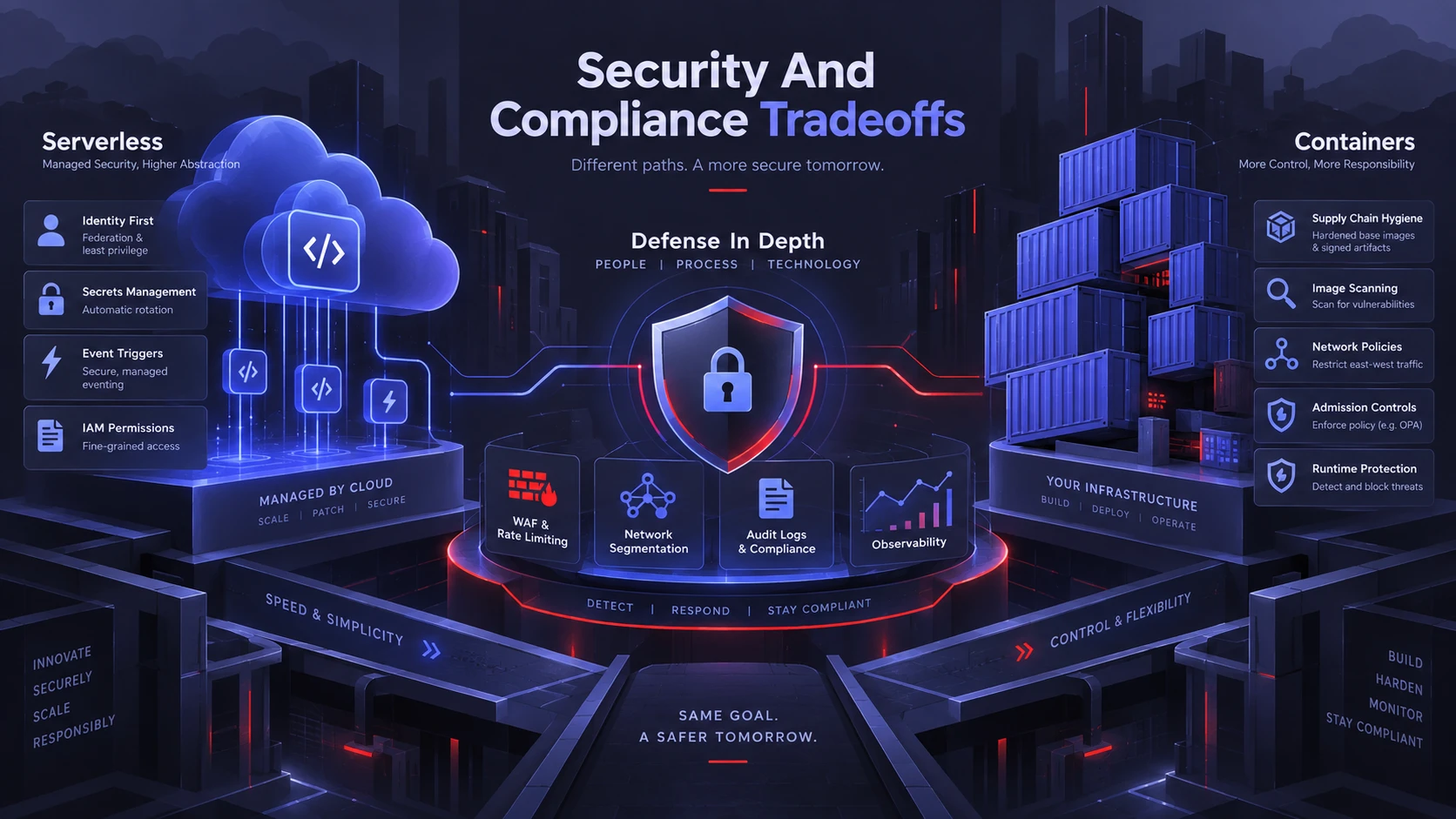
Serverless reduces the surface area you maintain because the provider manages host patching and many platform controls. However, you must secure identities, secrets, event sources, and permissions carefully since misconfigured IAM is a common failure point.
Containers give deeper control over hardening, base images, and network policies. That control comes with responsibility for patch cadence, image scanning, admission policies, and runtime protection.
- Identity First Design: Use least privilege roles and short lived credentials across both approaches.
- Supply Chain Hygiene: Pin dependencies, scan images or artifacts, and sign builds to reduce tampering risk.
- Defense In Depth: Combine WAF, rate limiting, network segmentation, and audit logging to meet compliance expectations.
Strong governance is achievable in either model, but it requires consistent policy, automation, and observability.
Developer Experience And Release Velocity
Serverless can speed up delivery when the platform removes infrastructure tickets and simplifies scaling. Local testing and debugging can be harder because managed triggers and cloud permissions are part of the execution path.
Containers provide a consistent environment from laptop to production, which can improve reliability across teams. Release velocity depends on how streamlined your build pipeline, registry practices, and orchestration workflows are.
Techbonafide typically recommends standardizing CI CD, secrets management, and environment promotion early, whether you pick serverless or containers. A clean delivery pipeline matters more than the runtime when teams grow.
Observability And Troubleshooting
Serverless makes distributed tracing essential since requests often hop across functions, queues, and managed services. You also need structured logging and correlation IDs because ephemeral instances can disappear quickly.
Containers allow more control over agents, sidecars, and network telemetry, but you must manage those components. Kubernetes adds its own layer of events, metrics, and failure modes that teams need to learn.
- Unified Telemetry: Collect logs, metrics, and traces in one place with consistent service naming.
- Error Budgets: Define SLOs and alert on user impact rather than raw resource signals.
- Runbooks And Ownership: Document top incidents and assign clear service owners to reduce recovery time.
Better observability shortens debugging loops and lowers mean time to recovery for both models.
When Serverless Is Usually A Better Fit?
Serverless tends to win when workloads are event driven, bursty, and modular. It also helps when the team wants to focus on business logic and offload scaling and server management.
- Event Processing Pipelines: Triggered by queues, streams, or object storage events with fast autoscaling.
- Spiky Public APIs: Traffic that swings dramatically where paying for idle capacity feels wasteful.
- Automation And Integrations: Glue code that connects SaaS tools, webhooks, and internal systems.
- Batch Jobs With Clear Limits: Short tasks with predictable timeouts and bounded resource needs.
These patterns benefit from the pay per use model and the managed nature of the platform.
When Containers Are Usually A Better Fit?
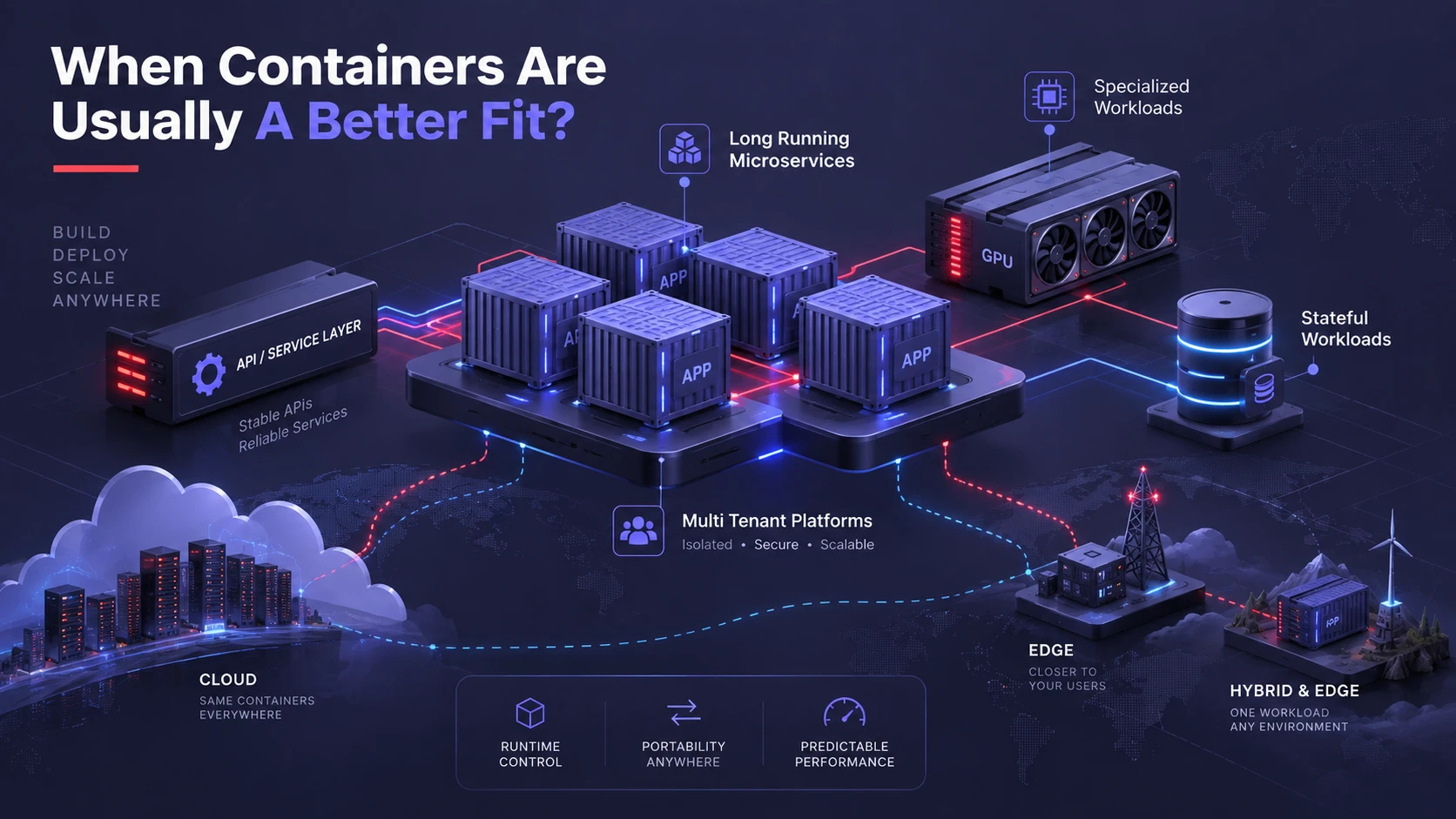
Containers are often the stronger choice for always on services, complex runtimes, and workloads that need more control. They also help when portability across clouds or hybrid environments is a priority.
- Long Running Microservices: Stable APIs that require consistent latency and custom networking.
- Stateful Or Specialized Workloads: Services that depend on native libraries, GPU support, or custom agents.
- Multi Tenant Platforms: Systems that need fine tuned resource isolation and predictable throughput.
- Hybrid And Edge Deployments: Environments where the same container image must run outside one cloud.
These cases benefit from strong runtime control and the broad ecosystem of container tooling.
How To Choose Without Regret?
A clear decision process prevents teams from defaulting to a favorite tool. Start with the operational realities of your app and work backward to the simplest platform that meets requirements.
- Define Workload Shape: Document request rate patterns, burst behavior, background jobs, and latency targets.
- List Non Functional Needs: Capture compliance, data residency, encryption, audit logs, and isolation requirements.
- Map Dependencies: Identify databases, queues, third party APIs, and VPC needs that affect networking and security.
- Model Total Cost: Estimate compute, storage, observability, and data transfer under realistic traffic and growth.
- Validate Operability: Confirm monitoring, on call readiness, and deployment rollback meet your incident response goals.
If you want a pragmatic architecture review, Techbonafide can help assess these factors and recommend a runtime strategy that aligns with your delivery pace and risk tolerance.
Hybrid Approaches For Modern Apps
Many modern apps use both models, placing each workload where it fits best. Containers often run core APIs and background workers, while serverless handles event triggers, lightweight endpoints, and integration tasks.
This approach can reduce cost and complexity when boundaries are clear. Keep interfaces stable and use shared observability standards so the system remains maintainable.
Conclusion
Serverless is best when you want minimal ops, automatic scaling, and pay per use economics for event driven or spiky workloads. Containers are best when you need portability, steady performance, and deep control over runtime, networking, and deployment patterns.
The right answer is the one that meets your latency, security, and cost goals while staying operable for your team. When in doubt, choose the simplest model that supports your current needs and leaves room for change.
Frequently Asked Questions
Is Serverless Always Cheaper Than Containers?
No, serverless can cost more when traffic is constant, execution time is long, or downstream services dominate. Containers can be cheaper for steady workloads when you right size capacity and use reservations. A total cost model that includes networking and observability is the safest way to decide.
Do Containers Replace Kubernetes?
Containers are the packaging format, while Kubernetes is one orchestration option. Many teams run containers on managed container platforms without operating Kubernetes directly. The best choice depends on how much scheduling, networking, and policy control you need.
Can I Use Both Serverless And Containers In One Architecture?
Yes, combining them is common when boundaries are clear and each workload uses the best runtime. Keep shared standards for logging, tracing, and IAM so troubleshooting stays consistent. A small set of platform patterns prevents fragmented tooling across teams.