

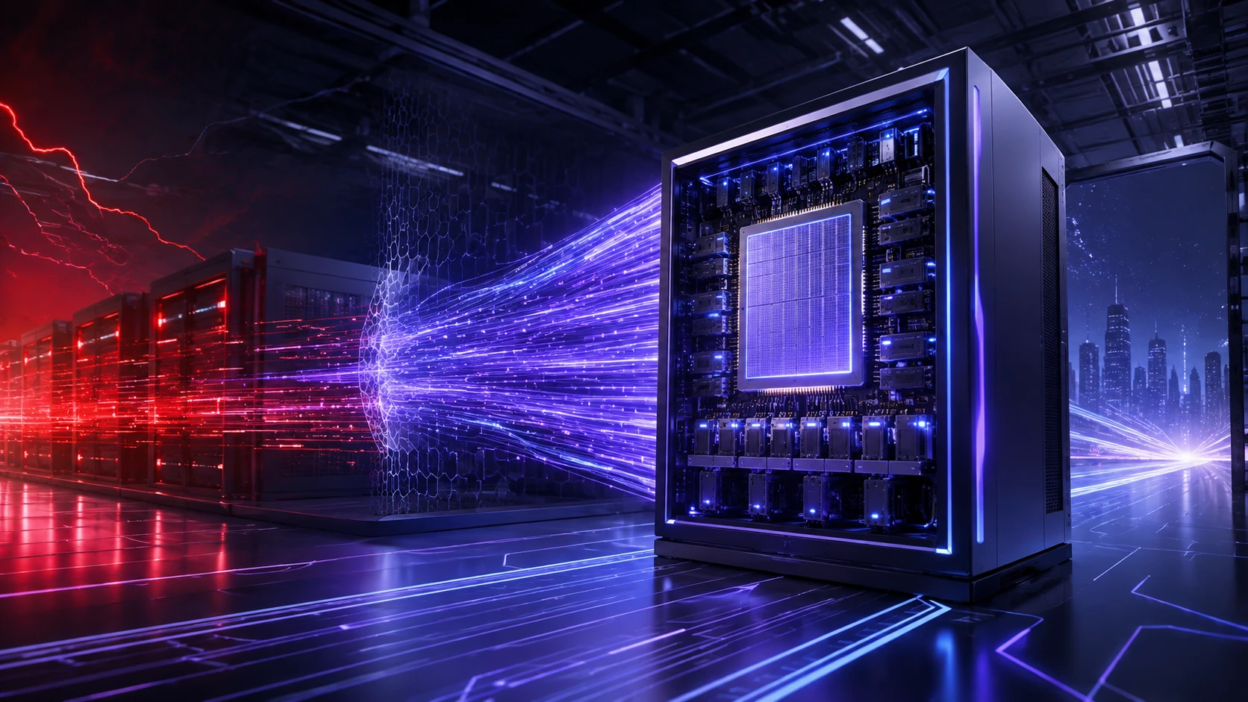
Cerebras Systems has launched its new CS-4 AI system, stepping up its challenge to Nvidia in the fast-growing market for artificial intelligence inference. The new system is designed to generate responses from large AI models at very high speeds, an area that is becoming increasingly important as companies build AI assistants, coding tools, reasoning systems and autonomous AI agents.
The CS-4 is the fourth generation of Cerebras’ AI computing system. It is built around three WSE-3 Turbo Wafer Scale Engine processors and uses a redesigned rack architecture called Nexus. Unlike traditional AI servers that rely on large numbers of smaller GPUs connected together, Cerebras uses extremely large wafer-scale processors to keep more computing and data movement inside a single piece of silicon.
Cerebras says the CS-4 can deliver AI inference speeds of up to 30 times faster than GPU-based systems for some tested workloads. The company says this advantage could help AI applications produce answers much faster, particularly when running advanced reasoning models where users may otherwise have to wait while the system generates a response. Actual performance can vary depending on the AI model, workload and system configuration.
Inference has become one of the most important areas of the AI infrastructure market. Training an AI model requires large amounts of computing power, but inference happens every time a trained model answers a question, generates code, creates content or performs an automated task. As AI services reach more users, companies need infrastructure that can handle millions of requests quickly while keeping power and operating costs under control.
The CS-4 is designed specifically around this demand. Cerebras says its new system can deliver up to twice the inference performance of the previous CS-3, while providing as much as 10 times more throughput per watt. This focus on performance and power efficiency could become important for data-center operators facing rising electricity and cooling requirements from large AI deployments.
Cerebras has also improved communication between its wafer-scale processors. The company says wafer-to-wafer connection latency can fall as low as two microseconds. This is intended to allow multiple systems to work together on extremely large AI models without creating the communication delays commonly associated with spreading a workload across many separate processors. Cerebras says the architecture can support more than 1,000 generated tokens per second on models exceeding 10 trillion parameters, although that figure is based on company testing and projections.
Another major change is the new Nexus rack design. The system has around 50% fewer components than the previous architecture and uses modular assemblies for computing, power and networking. Cerebras says this design can make the hardware easier to manufacture, install, upgrade and expand inside large AI data centers.
The CS-4 also supports disaggregated inference, where different hardware can handle different parts of an AI request. For example, another GPU or specialized processor can process the initial prompt, while the Cerebras system handles the response-generation stage. Cerebras says the platform can work alongside infrastructure including AMD Helios and AWS Trainium, giving cloud providers more flexibility when designing AI systems.
The launch puts Cerebras more directly against Nvidia, which remains a major supplier of computing hardware used for generative AI. Cerebras is taking a different technical approach, betting that its wafer-scale chips and low-latency architecture can provide an advantage for workloads where fast response generation is especially valuable.
For businesses building AI agents, real-time assistants and other interactive applications, faster inference could mean shorter waiting times and the ability to serve more users from the same amount of data-center power. That makes inference speed, efficiency and infrastructure cost an increasingly important competitive area for AI chip companies.
Cerebras says the first CS-4 systems will begin shipping during the third quarter of 2026. As AI companies continue spending heavily on computing infrastructure, the CS-4 gives customers another option beyond conventional GPU-based systems and adds more competition to the market for hardware powering the next generation of AI services.