

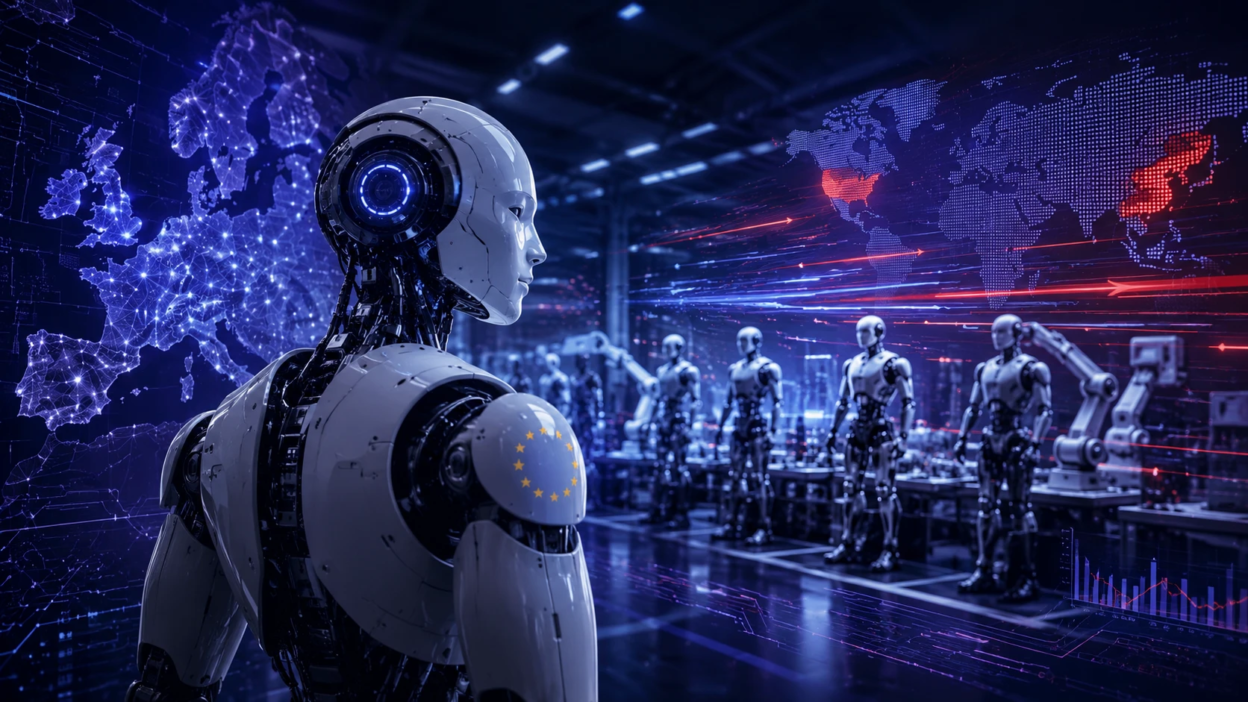
Europe is being urged to move faster in humanoid robotics as competition grows between major technology markets, especially China and the United States. Germany’s VDMA engineering association says humanoid robots and “physical AI” should become a major priority for European policymakers.
Humanoid robots are machines designed to move and work in ways similar to people. With the help of artificial intelligence, sensors, cameras and advanced software, these robots can learn to walk, carry objects and perform tasks in factories, warehouses and other workplaces.
The technology is developing quickly. Global shipments of humanoid robots reached about 19,100 units during the first half of 2026, nearly four times the level recorded a year earlier. Chinese manufacturers accounted for a large share of this growth, showing how quickly China is building its position in the emerging industry.
China’s progress became even more visible as Unitree Robotics made a strong stock market debut in Shanghai. The Chinese company has become one of the best-known names in humanoid and four-legged robots, while the country continues to invest heavily in robotics manufacturing, research and commercial deployment.
For Europe, the concern is not only about developing advanced robots. The bigger challenge is producing them at a large scale and building a reliable supply chain for important parts.
VDMA has called for Germany and the wider European region to develop a more complete domestic robotics supply chain. This would include stronger local production of important components used in humanoid machines, reducing dependence on suppliers outside Europe. The association believes scaling production will be one of the most important challenges as the global market grows.
Europe already has strong experience in mechanical engineering, industrial automation, manufacturing and artificial intelligence. However, having good research alone may not be enough. Companies will also need investment, manufacturing capacity, testing facilities and customers willing to use humanoid robots in real workplaces.
Humanoid robots could eventually be used for repetitive, physically demanding or dangerous jobs. Possible applications include factories, logistics centers, construction, healthcare support and other industrial environments. However, the technology is still developing, and many humanoid robots remain in testing, research or limited commercial use.
VDMA has also been studying how humanoid robotics could change mechanical and plant engineering in the coming years. Its work highlights that the industry is not only a technology issue but also a strategic question for companies deciding how they will compete as robotics becomes more important.
The growing competition suggests humanoid robotics could become another important part of the global AI race. China is pushing quickly toward large-scale manufacturing, while companies in the United States are developing their own advanced robots and AI systems. Europe now faces pressure to turn its engineering strengths into commercially competitive humanoid machines before the gap becomes harder to close.
For European governments and businesses, the message is becoming clearer: humanoid robotics is moving from experimental technology toward a potentially important industry. Faster investment, stronger supply chains and closer cooperation between robotics companies, manufacturers and policymakers could determine whether Europe becomes a major player in the next generation of intelligent machines.