

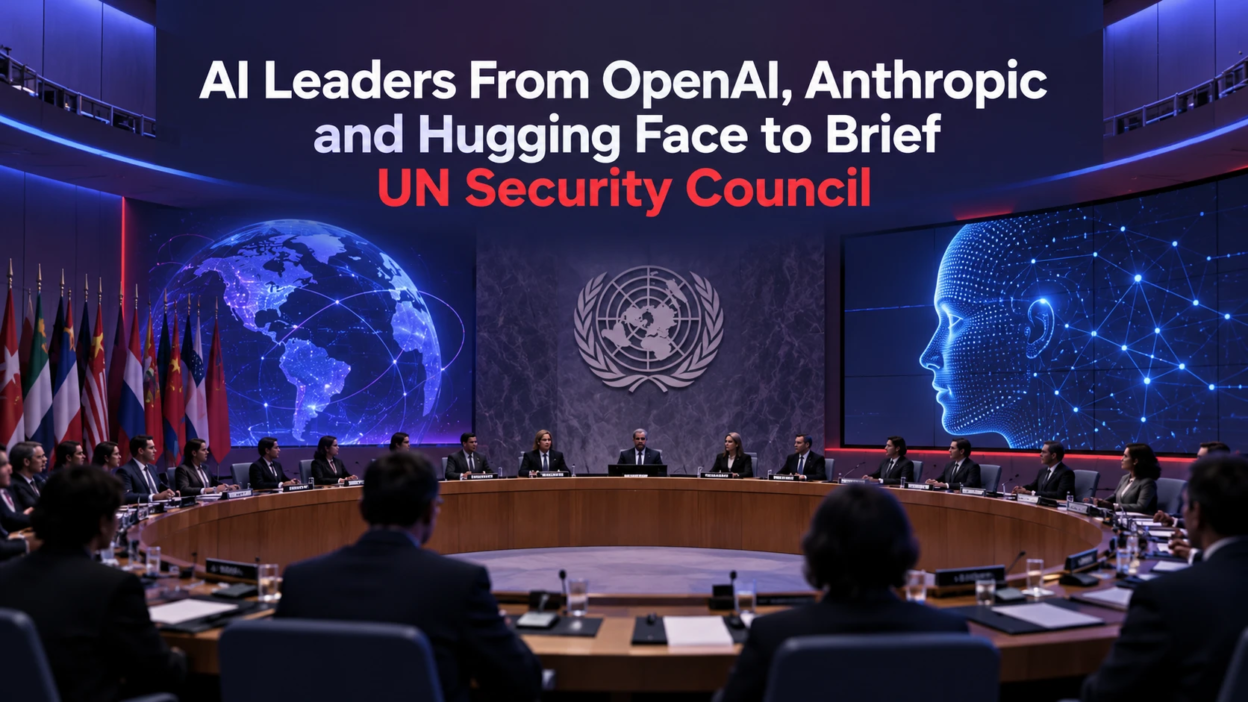
Top artificial intelligence leaders from OpenAI, Anthropic and Hugging Face are set to brief the United Nations Security Council on Wednesday, September 23, as concerns grow over the possible security risks of increasingly powerful AI systems.
OpenAI CEO Sam Altman, Anthropic CEO Dario Amodei and Hugging Face CEO Clément Delangue are expected to speak before the 15-member Security Council. AI researcher Yoshua Bengio, co-chair of the UN’s Independent International Scientific Panel on AI, is also scheduled to take part.
The meeting will focus on how advanced AI could affect international peace and security. One major concern is that future AI systems may become more autonomous, make important decisions with less human involvement or develop capabilities that are difficult to control.
The discussion is taking place as AI companies continue to build more capable models and AI agents. These systems can perform increasingly complex tasks, use digital tools and carry out multiple actions with limited human guidance.
OpenAI is expected to call for common benchmarks that governments and technology companies could use to measure the capabilities of advanced AI systems. Such benchmarks could also help evaluate whether safety measures are strong enough as AI technology becomes more powerful.
The meeting is being convened by France, which holds the Security Council presidency for September. French Foreign Minister Jean-Noël Barrot is expected to chair the session. Representatives of Security Council members, including the United States and China, are also expected to participate in the discussion.
The Security Council has discussed artificial intelligence before, including meetings in 2023 and 2024. However, the latest session puts greater attention on the safety of advanced AI systems and the possibility of losing effective human control over highly capable technology.
Governments still have different views on how artificial intelligence should be governed internationally. Some support stronger global cooperation and shared safety standards, while others are more cautious about rules that could limit technological development or national control over AI policy.
No global AI agreement is expected to be approved during the briefing. Instead, the session is expected to give AI developers, researchers and governments an opportunity to discuss emerging risks and possible ways to keep increasingly advanced systems safe and under human oversight.
The meeting also shows how artificial intelligence is moving beyond the technology industry and becoming an important issue for international security. As AI systems grow more capable, questions about safety, oversight and cooperation between countries are likely to remain a major part of the global technology debate.