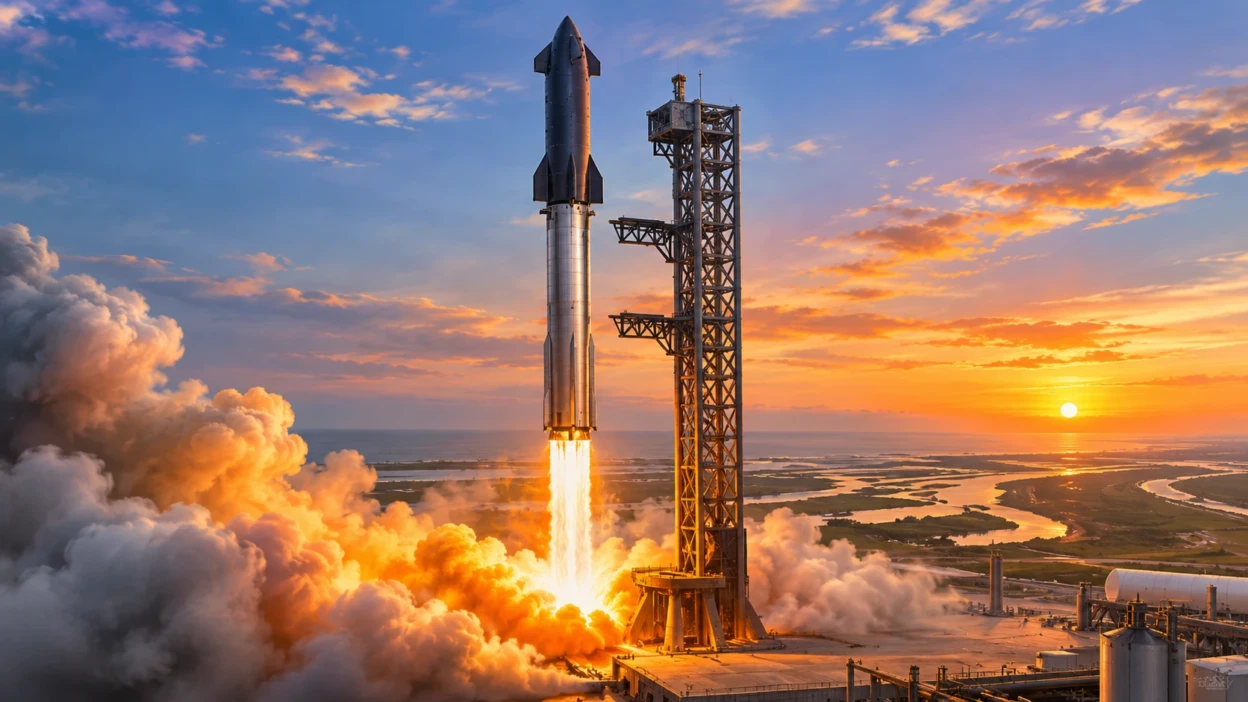
SpaceX’s Starship reached orbit during its 15th flight test on November 13, 2026, but the company called off an attempt to catch its returning Super Heavy booster at the launch site in Texas. Instead, the booster was diverted into the Gulf of Mexico, ending the plan to recover both rocket stages during the same mission.
The rocket lifted off from SpaceX’s Starbase facility at approximately 4:47 p.m. Central Standard Time (22:47 UTC). According to Space.com’s reporting from the launch site, the two stages separated successfully about two and a half minutes after liftoff. The Starship upper stage continued toward orbit while the booster began its return toward the Texas coast.
SpaceX originally planned to capture the returning booster using large mechanical arms attached to its launch tower. However, flight controllers canceled the catch and directed the booster toward an offshore splashdown. The Associated Press reported that the booster exploded after being diverted into the Gulf of Mexico.
The exact reason for the aborted catch has not been publicly established. During the live launch coverage, SpaceX commentator Dan Huot said the company would investigate what caused the decision to divert the booster. Without a confirmed technical explanation, it is not clear whether the problem involved the rocket itself, the recovery system or another condition affecting the planned landing.
Despite the booster setback, the Starship upper stage, known as Ship 42, successfully entered orbit. The spacecraft also deployed all 26 Starlink V3 satellites carried on the mission, achieving a separate objective of the test flight. Deployment does not mean the satellites are already providing internet service, because they must complete additional checks and orbital operations.
SpaceX’s official Flight 15 mission plan identifies satellite deployment and the first attempted return of the Starship upper stage to its launch site as major objectives. The company says three of the deployed Starlink satellites carry cameras designed to examine Starship’s heat shield and provide information about its condition in space.
The upper stage was scheduled to remain in space for more than 22 hours, completing approximately 14 orbits at an altitude of around 275 kilometers. Its planned return to Starbase on Saturday, November 14, would involve another attempt to capture a rocket stage using the launch tower’s mechanical arms. Unlike the booster catch, this maneuver would involve returning the spacecraft from orbit.
SpaceX has made clear that the upper-stage catch depends on the spacecraft remaining healthy. Flight controllers must confirm that critical systems are ready for atmospheric reentry, the final landing burn and the approach to the tower. If those conditions are not met, the mission includes alternative ocean-return options rather than requiring a catch attempt.
The company has previously caught three Super Heavy boosters during earlier Starship flight tests, but Flight 15 involved an upgraded Version 3 booster. A successful catch would have demonstrated that the newer hardware could also return to the launch tower. The aborted attempt means SpaceX has not yet achieved that particular recovery objective with Flight 15.
The mission follows Starship Flight 14, which reached orbit for the first time in September 2026. That flight deployed 26 Starlink V3 satellites despite an engine problem that shortened the planned mission. Flight 15 continued the orbital testing program while adding more ambitious recovery objectives.
The recovery work is important because SpaceX wants to reuse both major stages of Starship instead of discarding them after launches. The vehicle is intended to support large satellite deployments, while a separate Starship-based lunar lander is being developed for NASA’s Artemis program. NASA’s updated lunar lander plans continue to include SpaceX alongside Blue Origin.
Flight 15 therefore delivered a mixed result. Starship reached orbit and released its satellite payload, but the planned booster recovery did not succeed. The main unanswered questions are what caused the booster diversion and whether the upper stage can complete its planned return. Those results will determine how much progress SpaceX can claim toward recovering and reusing the complete Starship launch system.

Tech Bonafide is the editorial identity of TechBonafide, an independent technology publication covering AI, software, cybersecurity, gadgets, and emerging technology.