

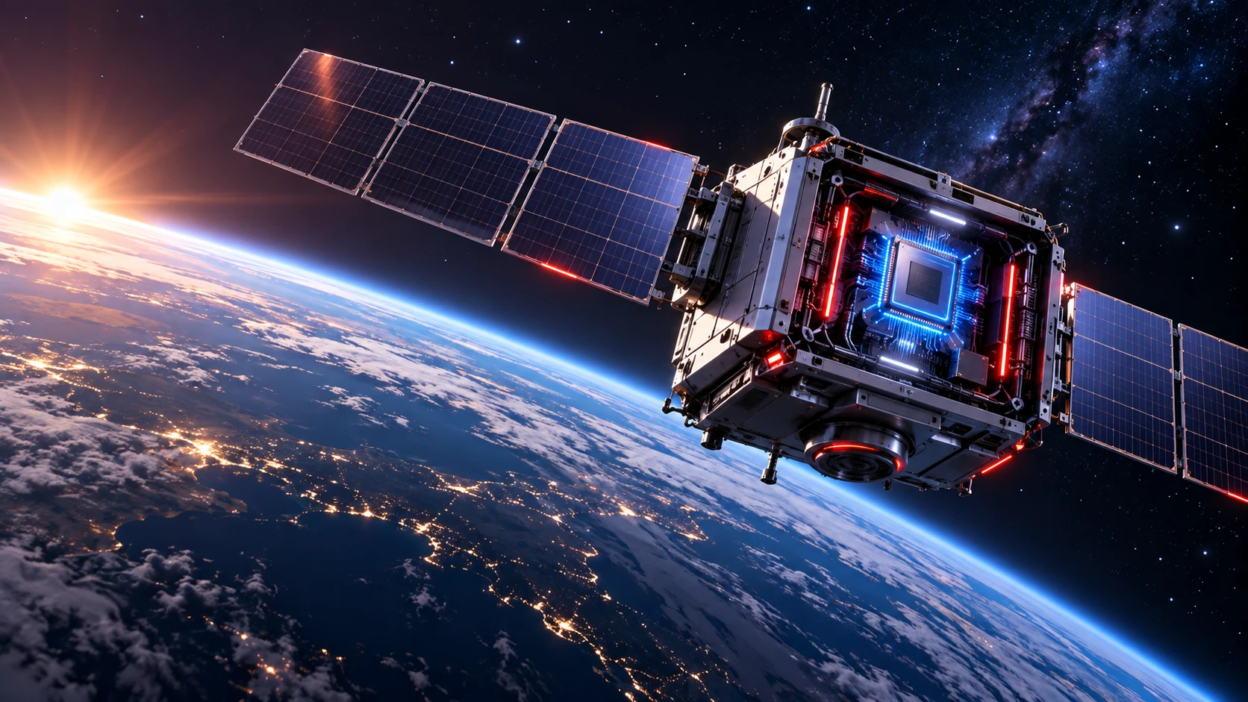
Google is preparing to take its artificial intelligence hardware beyond Earth with the first in-orbit test of Project Suncatcher. The experimental project explores whether powerful AI computing systems could one day operate in space using satellites powered by solar energy.
As part of the first test, Google plans to send a prototype satellite carrying its Tensor Processing Units, or TPUs, into low Earth orbit. TPUs are specialized chips designed by Google to handle demanding artificial intelligence and machine learning tasks.
The prototype is expected to launch aboard SpaceX’s Transporter-18 rideshare mission. Google has developed the space test in partnership with satellite company Planet.
The main purpose of the mission is not to build a complete data center in space yet. Instead, Google wants to understand whether its AI hardware can survive and work reliably in the difficult conditions found outside Earth.
One major challenge is the launch itself. Satellites and their components face strong vibrations and forces while traveling into orbit. Google has already carried out ground tests to see how its hardware handles these conditions, but an actual space mission will provide more realistic information.
Radiation is another important issue. Electronics in space are exposed to higher levels of radiation than devices operating on Earth. This radiation can sometimes cause errors in computer chips or damage their components.
Google has tested its Trillium TPUs under radiation while the chips were running AI workloads. Early results were encouraging, but the company says testing the processors in orbit is necessary to understand their performance in a real space environment.
Keeping the chips cool will also be a major part of the experiment. AI processors generate a significant amount of heat, and normal data centers use advanced cooling systems to keep their hardware operating safely.
Space creates a different problem because there is no normal airflow in a vacuum. Google is experimenting with heat pipes and radiators that can move heat away from the AI chips without depending on traditional air cooling.
Project Suncatcher is based on the idea that space could provide an enormous source of solar energy for future computing systems. Satellites in suitable orbits can receive sunlight for long periods, potentially giving large computing systems access to more consistent renewable power.
If the technology becomes practical, future satellite networks could contain many AI chips working together to process demanding machine learning workloads. Such a system would require extremely fast communication between satellites.
Google plans to explore this challenge further in 2027 by testing high-bandwidth laser connections between two satellites. These optical links could eventually allow groups of satellites to work together like parts of a much larger computing system.
However, space-based AI computing remains an early research idea. Launch costs, satellite manufacturing, cooling systems, radiation protection and reliable communication still present major engineering challenges.
The first Project Suncatcher mission is therefore focused on learning rather than immediately creating a working orbital data center. The results could help Google understand what works, what fails and what must be improved before larger AI computing systems can be placed in orbit.
Project Suncatcher shows how the growing demand for AI computing is pushing technology companies to explore new approaches to energy and infrastructure. If future tests succeed, running powerful AI hardware in space could become another option for expanding computing capacity beyond traditional data centers on Earth.