
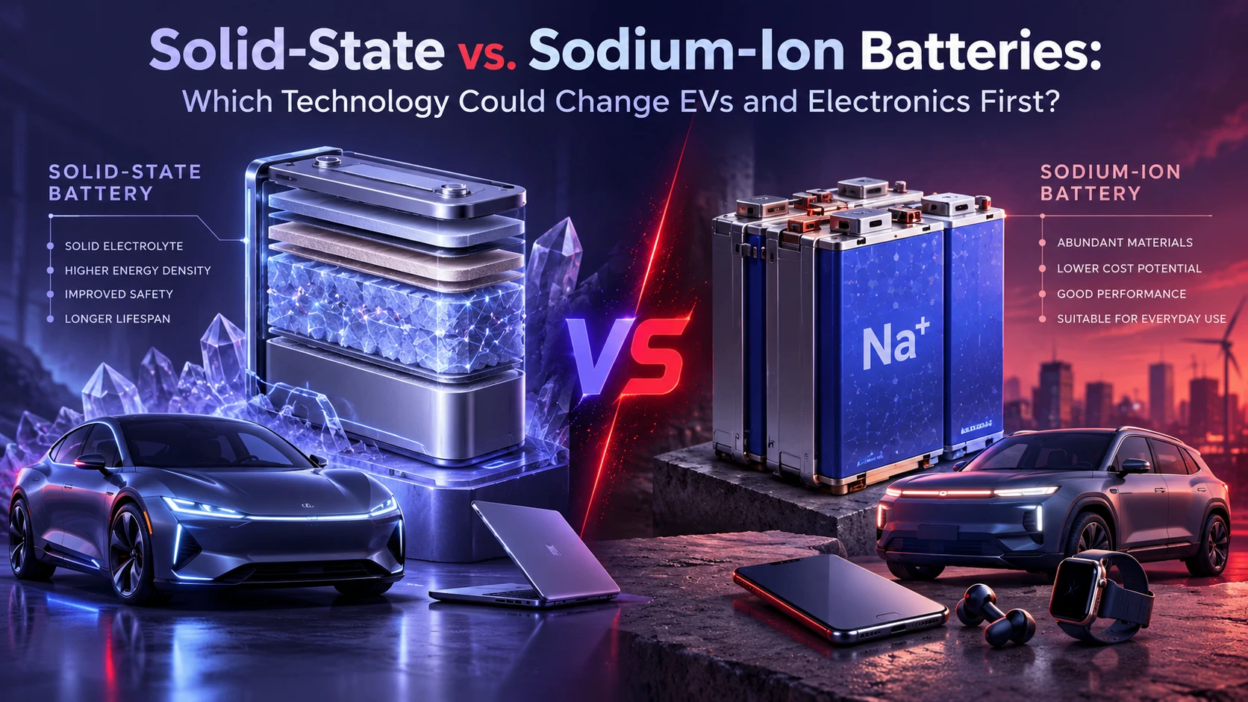
Battery innovation is moving along two distinct paths: sodium-ion batteries are entering commercial passenger vehicles, while all-solid-state batteries remain on later-decade commercialization roadmaps. The two technologies solve different constraints—sodium-ion emphasizes cost and supply resilience, while solid-state targets higher energy density and reduced reliance on flammable liquid electrolytes. The practical question is not which technology is universally better, but which one fits a product’s performance, manufacturing, safety, and supply-chain requirements.
What are Solid-State Batteries?
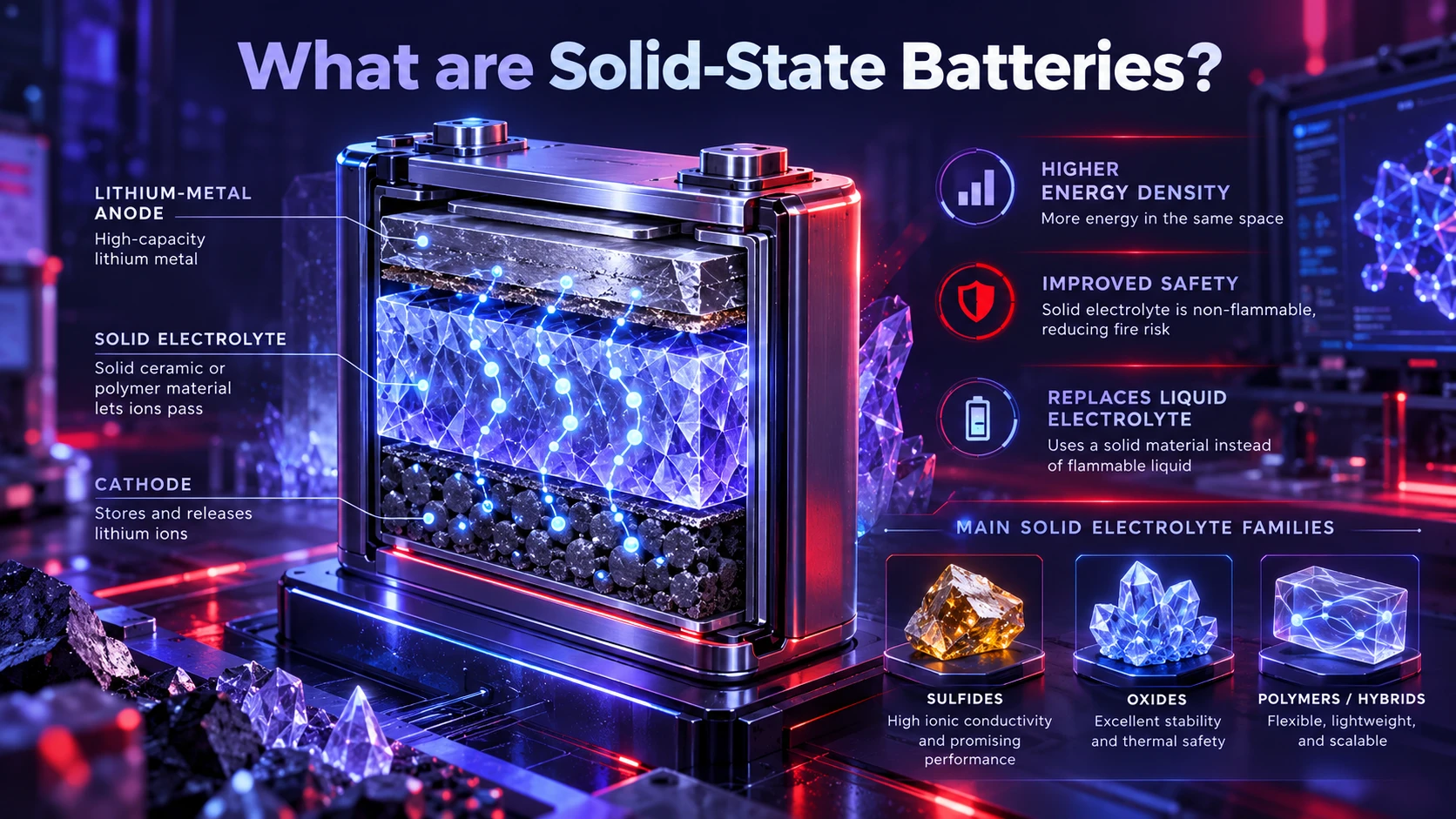
Solid-state batteries replace the liquid electrolyte found in most lithium-ion cells with a solid electrolyte. That change aims to reduce flammability risk while enabling cell designs that pack more energy into the same space. Many solid-state roadmaps also pair the solid electrolyte with lithium metal anodes to push energy density higher.
In practice, solid-state is a family of approaches rather than one single technology. Different solid electrolytes behave differently in terms of ion conductivity, moisture sensitivity, and how well they interface with electrodes. Those differences decide whether a concept stays in the lab or scales to gigawatt-hour production.
Common Solid Electrolyte Families
Most development clusters around sulfides, oxides, and polymers. Sulfides can offer high conductivity but can be sensitive to moisture and processing conditions. Oxides are often more stable but can be harder to manufacture with low resistance interfaces.
- Sulfide Solid Electrolytes: High conductivity potential and promising power output, with strict handling needs during manufacturing.
- Oxide Solid Electrolytes: Strong stability and safety profile, often requiring higher pressure or temperature processes to keep interfaces efficient.
- Polymer and Hybrid Electrolytes: Easier processing pathways, with performance that can depend heavily on operating temperature and formulation.
These categories explain why timelines vary so widely between companies and research groups.
What Are Sodium-Ion Batteries?
Sodium-ion batteries use sodium as the charge carrier rather than lithium, with cell architectures that resemble lithium-ion manufacturing in many cases. The appeal is that sodium is abundant and widely distributed, easing exposure to lithium price swings and some supply bottlenecks. Sodium-ion also opens more flexibility in cathode and anode material choices, depending on performance targets.
Sodium-ion tends to have lower energy density than leading lithium-ion chemistries, which can limit range in space-constrained vehicles and ultra-thin devices. Even so, for cost-driven markets or where size and weight are less critical, sodium-ion can be a strong fit. It can also perform well at lower temperatures compared with some lithium-ion options, depending on cell design.
Where Sodium-Ion Fits Best Today
As of 2026, sodium-ion is moving beyond pilot-scale discussion. CATL and CHANGAN have launched a mass-production sodium-ion passenger vehicle using CATL’s Naxtra chemistry, while stationary storage and short-range mobility remain natural fits because they can tolerate lower energy density in exchange for cost and supply-chain advantages. Sodium-ion could also suit electronics where weight and thickness are less critical.
Performance Differences That Matter in Real Products
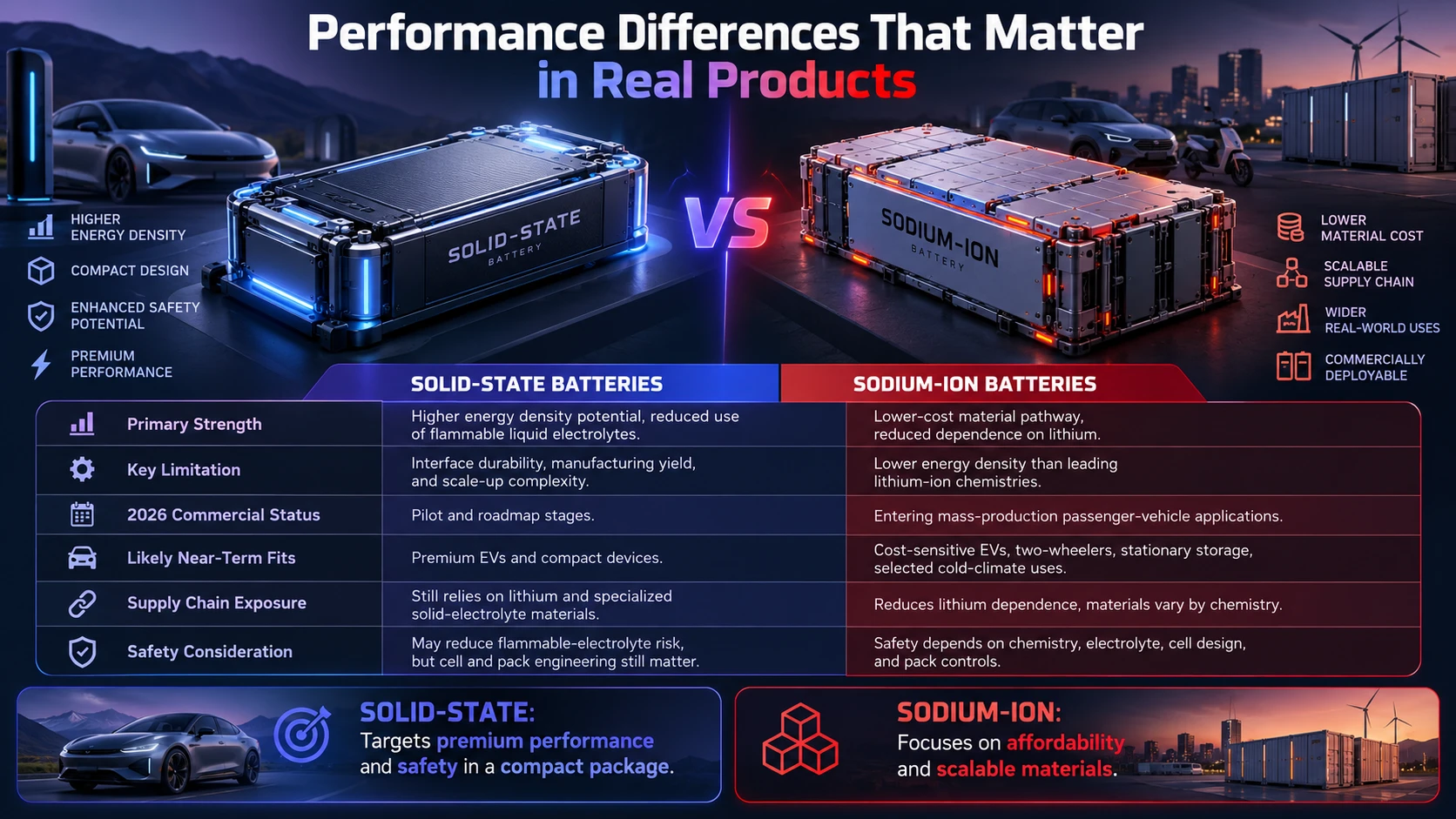
Most buyers care about a small set of outcomes range or runtime, charge speed, safety, lifespan, and cost. Solid-state targets premium performance and safety in a compact package, while sodium-ion focuses on affordability and scalable materials. The tradeoff is that one is more manufacturing-constrained, and the other is more energy-density-constrained.
Another practical difference is how each technology behaves across temperature and charging conditions. Solid-state designs may enable faster charging if interfaces and dendrite control are solved at scale. Sodium-ion can tolerate certain cold conditions well, but fast charging and long cycle life still depend on specific cathode and electrolyte choices.
For comparison with the lithium-ion batteries already used in mainstream EVs, our guide to Tesla battery life explains how charging habits, temperature, battery management, and degradation affect current electric-vehicle packs.
| Factor | Solid-State Batteries | Sodium-Ion Batteries |
|---|---|---|
| Primary Strength | Higher energy density potential and reduced use of flammable liquid electrolytes | Lower-cost material pathway and reduced dependence on lithium |
| Key Limitation | Interface durability, manufacturing yield, and scale-up complexity | Lower energy density than leading lithium-ion chemistries |
| 2026 Commercial Status | Automotive commercialization remains in pilot and roadmap stages | Entering mass-production passenger-vehicle applications |
| Likely Near-Term Fits | Premium EVs and compact devices if cost and yield targets are met | Cost-sensitive EVs, two-wheelers, stationary storage, and selected cold-climate applications |
| Supply Chain Exposure | Often still relies on lithium and specialized solid-electrolyte materials | Reduces lithium dependence, while other material needs vary by chemistry |
| Safety Consideration | May reduce flammable-electrolyte risk, but cell and pack engineering still matter | Safety depends on the specific chemistry, electrolyte, cell design, and pack controls |
This comparison makes it easier to match the chemistry to the product constraints rather than chasing a single winner.
Safety and Reliability Expectations
Solid-state is often framed as safer because it removes flammable liquid electrolytes. That is directionally true, but safety also depends on cell design, packaging, separators, and failure modes under abuse. A solid electrolyte can still crack, develop internal resistance, or allow lithium dendrites if the system is not engineered correctly.
Sodium-ion safety varies by chemistry and pack design. Some formulations can reduce reliance on highly reactive materials or use nonflammable electrolytes, but those advantages should not be generalized to every sodium-ion cell. Safety should be evaluated at both the cell and pack level using abuse, thermal-propagation, impact, and fast-charging tests.
What Manufacturers Must Prove
To qualify for automotive and consumer use, both technologies must demonstrate repeatable performance at production scale. That includes abuse testing, cycle life under realistic duty cycles, predictable aging across temperature ranges, and consistent manufacturing quality. Solid-state batteries also need to show that interface degradation, cracking, and lithium-metal failure modes can be controlled over a long service life.
Manufacturing Reality and Scale-Up Challenges
Scaling a battery chemistry is less about a single breakthrough and more about repeatable production with high yield. Solid-state manufacturing may require new equipment, new process controls, and tighter tolerances at interfaces. Even when a cell works, ramping to high-volume output without defect-driven failures is a separate hurdle.
Sodium-ion benefits from familiarity because parts of the production flow can align with existing lithium-ion lines. That can shorten time to scale in factories already skilled in coating electrodes, assembling cells, and running formation cycles. The remaining work is optimizing materials and ensuring long-term performance meets warranty targets.
- Yield Sensitivity: Solid-state cells can be less forgiving of minor manufacturing defects that increase resistance or create hotspots.
- Equipment Compatibility: Sodium-ion can often reuse more of the lithium-ion toolchain, reducing capex friction.
- Quality Control: Both need tight process monitoring, but solid-state may demand more advanced inspection of interfaces and uniformity.
These factors help explain why sodium-ion can enter markets sooner even with lower headline energy density.
Which Technology is Scaling Into EVs First?
By 2026, sodium-ion has already moved into passenger-vehicle commercialization. CATL and CHANGAN announced what they describe as the world’s first mass-production sodium-ion passenger vehicle using Naxtra cells, which CATL reports can reach an energy density of up to 175 Wh/kg. That gives sodium-ion a head start in commercial EV deployment, particularly where cost, supply diversification, and lower energy-density requirements align with the vehicle design.
All-solid-state BEV programs remain closer to pilot and pre-commercial scale. Toyota and its battery-material partners continue to target 2027–2028 for market introduction, while wider adoption will depend on durable interfaces, high manufacturing yield, reliable cycle life, and competitive costs. That makes all-solid-state batteries more likely to begin in limited or performance-focused applications before broader deployment.
For broader context on where batteries fit into modern vehicle platforms, our guide to electric and hybrid vehicle technology explains battery systems, regenerative braking, hybrid powertrains, and other technologies shaping electrified vehicles.
Key Decision Variables for Automakers
Automakers will choose based on total pack cost, warranty risk, and manufacturing readiness. They will also consider platform design, since pack volume and weight constraints vary by vehicle class. A chemistry that fits a compact city car may not fit a long-range SUV without major compromises.
Which Technology Could Change Electronics First
Consumer electronics reward high energy density, thin form factors, long cycle life, and fast charging, which could favor solid-state designs if they meet cost and manufacturing targets. Higher energy density could enable slimmer devices or longer runtime without increasing battery volume, while reduced use of flammable liquid electrolytes may offer safety-design advantages. Those benefits still depend on cell chemistry, packaging, thermal management, and production quality.
Sodium-ion could still influence electronics, but it will likely show up first in products where thickness and weight are less critical. That includes certain home electronics, backup power products, and rugged devices designed for durability and broader temperature tolerance. The biggest barrier is that many electronics categories have little room to trade energy density for lower cost.
For context on how batteries behave in today’s portable electronics, our laptop battery health guide explains capacity loss, charge cycles, degradation, and the factors that shorten the useful life of current lithium-ion batteries.
Materials and Supply Chain Pressure
The battery industry is constrained by mining capacity, refining, and geopolitics as much as chemistry. Solid-state does not automatically eliminate lithium dependence, and many designs still need lithium metal or lithium-rich materials. Some solid-state concepts also rely on specialized powders and processing that must scale reliably.
Sodium-ion reduces pressure on lithium supply and can ease reliance on certain constrained metals depending on cathode selection. That can make planning easier for manufacturers targeting stable long-term costs. Still, sodium-ion has its own supply considerations such as scaling cathode materials, ensuring electrolyte availability, and building qualification data across cell formats.
How to Evaluate Claims Without Getting Misled?
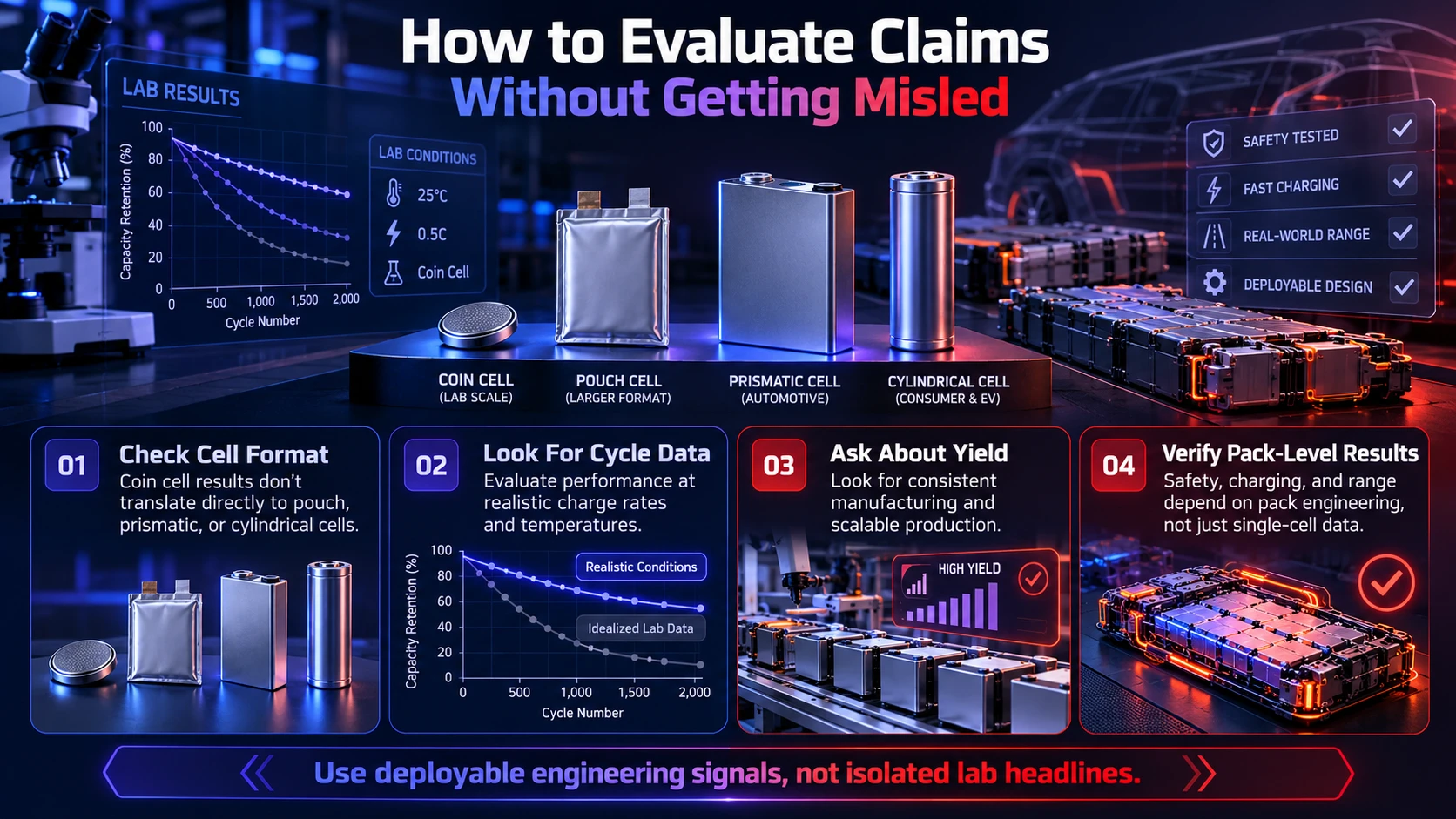
Headlines often highlight a single metric, but real products require balanced performance across many metrics at once. A lab result at low current and ideal temperature does not guarantee fast charging in a mass-produced pouch or cylindrical cell. The most reliable signals are repeated third-party validations, clear operating windows, and transparent cycle-life data at relevant conditions.
- Check Cell Format: Performance demonstrated in small laboratory coin cells does not automatically translate to large pouch, prismatic, or cylindrical automotive cells because thermal, interface, packaging, and manufacturing constraints change with scale.
- Look For Cycle Data: Long cycle life at realistic charge rates and temperatures matters more than peak energy density.
- Ask About Yield: A chemistry that cannot be made consistently will not reach mainstream products quickly.
- Verify Pack-Level Results: Safety, fast charging, and range depend on pack engineering, not only the cell.
Using these filters keeps comparisons grounded in deployable engineering.
Conclusion
Sodium-ion has already taken the lead in early passenger-vehicle commercialization, particularly where cost and supply resilience matter. All-solid-state batteries remain on later-decade roadmaps aimed at higher energy density and faster charging, but their wider impact depends on interface durability, manufacturing yield, cycle life, and cost. The market is therefore more likely to split by use case than produce a single winner: sodium-ion can serve value-focused and resource-resilient applications, while solid-state targets performance-sensitive EVs and compact electronics.
For teams tracking these shifts, TechBonafide covers battery technology trends, electronics engineering, and practical decision factors that help connect research progress to real product roadmaps. Staying focused on manufacturability, safety validation, and supply chain readiness will make it clearer which chemistry is truly ready to ship.
Frequently Asked Questions
Are Solid-State Batteries Guaranteed to Be Safer Than Lithium-Ion?
They can reduce certain fire risks because they avoid flammable liquid electrolytes, but safety depends on the full cell and pack design. Solid electrolytes can still crack or form high-resistance regions, and improper designs can still fail under abuse. Look for pack-level test results and clear operating limits.
Will Sodium-Ion Batteries Replace Lithium-Ion in Most EVs?
Probably not. Sodium-ion is already entering passenger vehicles, but its lower energy density means it is better suited to cost-sensitive, shorter-range, or less space-constrained applications. Higher-energy-density lithium-ion chemistries are still likely to remain important for long-range EVs, so automakers may use multiple battery chemistries depending on vehicle class, climate, cost targets, and region.
Which Battery Type Will Improve Charging Speed the Most?
Solid-state has strong potential for faster charging if interfacial resistance and dendrite control are solved at scale. Sodium-ion can also charge quickly in some designs, but results vary by materials and thermal management. The charging experience ultimately depends on the pack, cooling system, and charging protocols.
To compare these future chemistry claims with today’s real-world EV charging experience, see our guide to Tesla charging times and the differences between home and fast charging.