

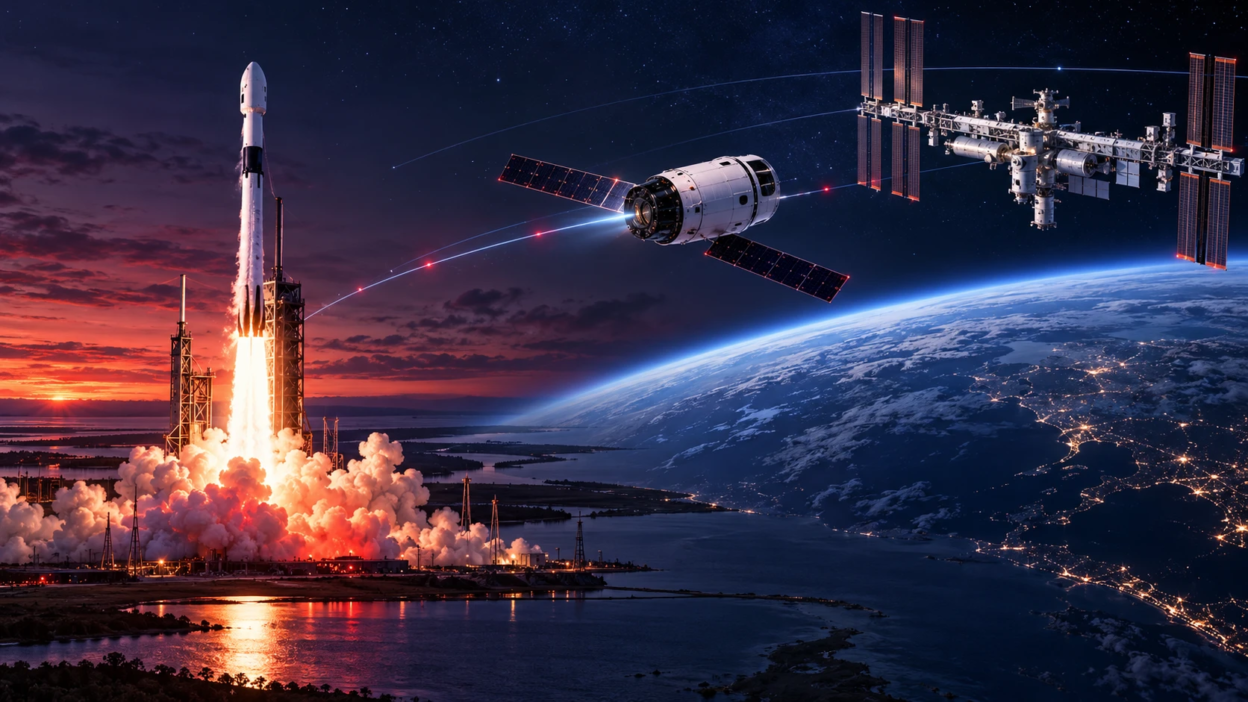
SpaceX successfully launched its Falcon 9 rocket on October 13, 2026, sending a Dragon cargo spacecraft toward the International Space Station (ISS). The rocket lifted off at 6:33 a.m. EDT from Space Launch Complex 40 at Cape Canaveral Space Force Station in Florida.
The mission, called CRS-35, is SpaceX’s 35th commercial resupply flight for NASA. Dragon is carrying more than 6,300 pounds of scientific equipment, station hardware, and supplies, including the final pair of upgraded solar arrays for the ISS.
Following liftoff, Falcon 9’s first and second stages separated, allowing the upper stage to continue carrying Dragon toward orbit. The spacecraft separated from the rocket’s second stage approximately nine minutes after launch and began its journey toward the space station.
Dragon is scheduled to dock automatically at approximately 11 a.m. EDT on Thursday, October 15, 2026. It will connect to the space-facing port of the station’s Harmony module, where astronauts will later unload the supplies and scientific equipment.
One of the mission’s main deliveries is the final pair of International Space Station Roll-Out Solar Arrays, known as iROSAs. These panels are designed to increase the station’s available electricity and support its scientific equipment and daily operations.
Astronauts are expected to install the panels during spacewalks later in 2026. Once installed, they will complete an important upgrade to the station’s power system, supporting research and operations as the ISS approaches the final years of its planned service.
The CRS-35 mission also carries scientific experiments focused on health, medicine, and advanced materials. One project will test hardware for manufacturing artificial retinas in microgravity, which could help researchers develop new approaches to treating vision problems on Earth.
Other experiments include three-dimensional heart tissue models for studying drug effects and materials for testing how a new type of glass forms in space. Researchers are also sending brain organoids, which are small laboratory-grown models of brain tissue, to investigate conditions such as Alzheimer’s, Parkinson’s, and multiple sclerosis.
These studies take advantage of microgravity, where objects and materials behave differently than they do on Earth. Scientists hope the results will support medical research, improve manufacturing methods, and provide information useful for future space missions.
SpaceX’s Dragon spacecraft is designed to transport cargo to the ISS and return scientific samples and equipment safely to Earth. Unlike cargo spacecraft that are destroyed during reentry, Dragon can be recovered and flown again.
The Dragon spacecraft used for CRS-35 previously flew on CRS-26, CRS-29, and CRS-33. The Falcon 9 first-stage booster assigned to the latest launch was also making its eighth flight, demonstrating the company’s continued use of reusable launch technology.
SpaceX’s use of reusable launch technology allows it to recover important spacecraft and rocket components, reducing the need to manufacture entirely new hardware for every mission.
The CRS-35 mission is part of NASA’s Commercial Resupply Services program, which uses private companies to deliver equipment, experiments, and essential supplies to the International Space Station.
SpaceX’s regular launch operations help NASA maintain cargo deliveries while giving scientists opportunities to test technologies in microgravity. Some of these experiments could provide information useful for future missions beyond low Earth orbit.
Dragon is expected to remain docked at the International Space Station until mid-November 2026. After completing its cargo delivery mission, the spacecraft is scheduled to return to Earth with scientific samples and other equipment. Its return is planned to end with a splashdown off the coast of California.
With the Falcon 9 launch completed, the next major step is Dragon’s planned docking with the ISS on October 15. Once the spacecraft arrives, astronauts can begin transferring the equipment and preparing the new experiments for use.
The mission highlights the role of reusable spacecraft in keeping the International Space Station supplied and supporting scientific research that could benefit people on Earth.