

If you are exploring DevOps learning resources associated with Droven.io, start by checking which technical tutorials and practical exercises are currently available. Droven.io publishes content about technology, artificial intelligence, and digital transformation, although a complete DevOps tutorial curriculum could not be independently confirmed during this review. Before choosing any learning resource, examine the topics it covers, the quality of its examples, and whether it provides enough practical guidance to develop useful technical skills.
This guide explains the essential skills commonly covered in DevOps education, how to evaluate the quality of practical tutorials, and which advanced topics may require additional training. It also shows readers how to assess Droven.io’s learning resources without assuming that every DevOps topic is covered. By the end, you will have a clearer learning roadmap and a practical checklist for evaluating your progress.
What Droven.io DevOps Tutorials Help You Learn?
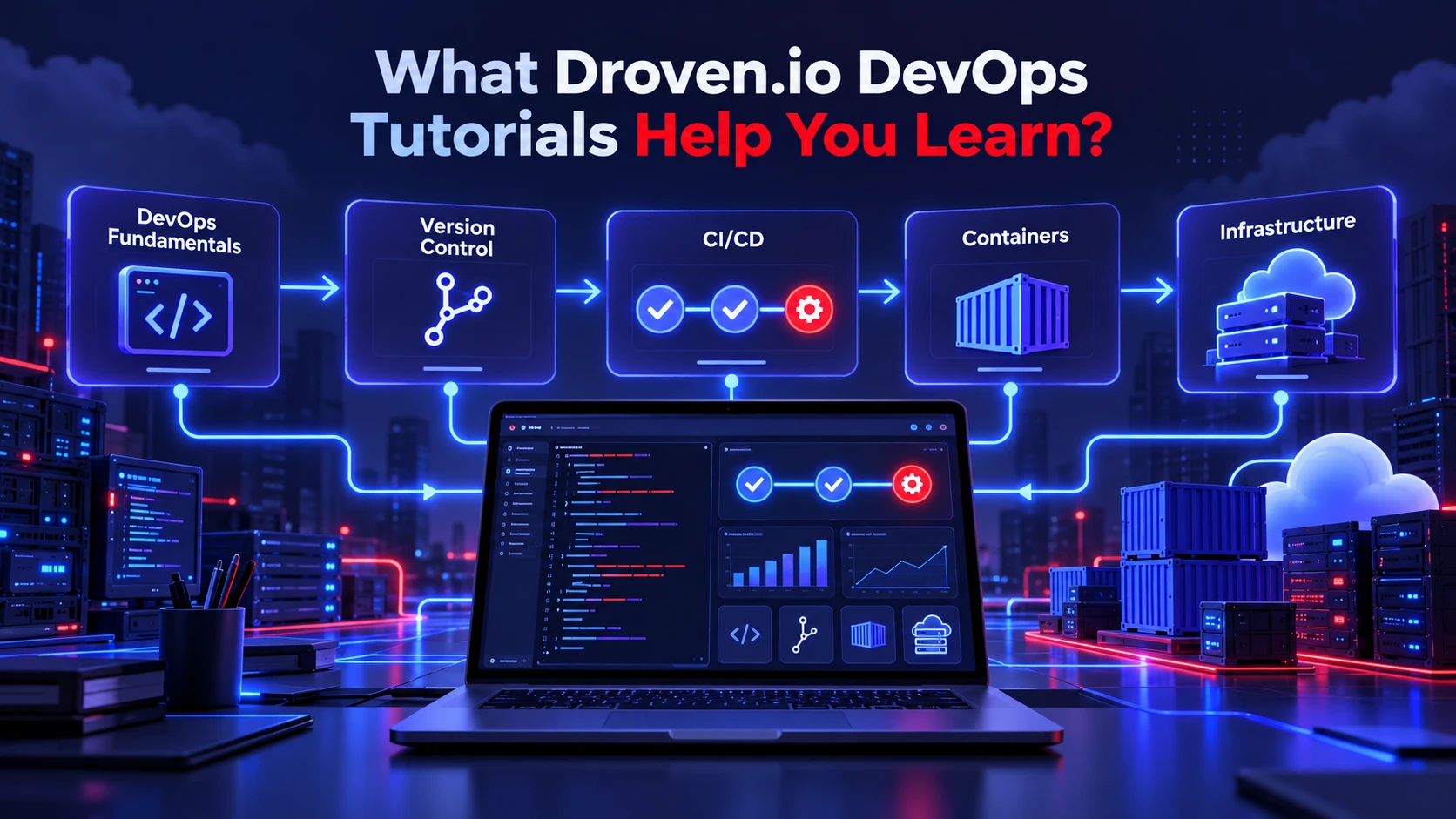
A useful DevOps learning resource should explain how development, testing, deployment, and infrastructure management work together. Instead of teaching tools as isolated subjects, effective tutorials connect them through practical software delivery workflows.
When evaluating Droven.io DevOps tutorials, check whether the available lessons provide explanations, working examples, exercises, and clear learning objectives. Beginners should prioritize Linux fundamentals, version control, CI/CD, containers, and infrastructure automation before progressing to advanced cloud operations or site reliability engineering (SRE).
The following learning areas provide a useful checklist for assessing DevOps tutorial coverage. They represent important DevOps competencies rather than a confirmed list of courses available on Droven.io.
- DevOps Fundamentals: Core ideas such as collaboration between development and operations, feedback loops, and automation as a default approach.
- Version Control Workflows: Practical habits around branching, pull requests, and review norms that support continuous delivery.
- CI/CD Basics: Learn how automated pipelines build, test, and prepare software for deployment. The GitHub Actions documentation explains how workflows, jobs, and automated checks support continuous integration and continuous delivery. Beginners should understand how a code change triggers testing and how deployment safeguards reduce the risk of releasing faulty software.
- Containers and Delivery Concepts: Understand how containers package applications with their dependencies and help teams maintain more consistent deployment environments. Learn about container images, registries, and the differences between container-based and virtual machine-based deployment. TechBonafide’s comparison of containers and virtual machines explains how these technologies differ in architecture, management, isolation, and operational requirements.
- Infrastructure Thinking: A shift from manual server setup to declarative configuration and repeatable environments.
These learning areas matter because DevOps is about building reliable development and operations workflows, not simply memorizing technical tools. Understanding collaboration, automation, continuous integration, and infrastructure management provides a foundation for learning more advanced platforms. For additional background, explore TechBonafide’s guide to the principles and practices of DevOps, which explains the fundamental ideas behind modern DevOps workflows.
Tool Coverage and Practical Skill Development
Practical DevOps skills develop through repeated exercises rather than reading technical explanations alone. A useful tutorial should allow learners to build, test, deploy, and troubleshoot a working application. For example, a beginner might create a Git repository, configure an automated testing pipeline, package an application in a container, and deploy it to a test environment.
When reviewing Droven.io’s available material, check whether each lesson includes working configurations, expected results, troubleshooting guidance, and exercises that can be repeated independently. A tutorial that only describes a technology may be useful for understanding concepts, but it should not be treated as proof of practical proficiency.
To judge practical value, look for lessons that connect a tool to a measurable goal such as faster build feedback, fewer deployment failures, or simpler environment setup. When a tutorial explains what to click but not why it matters, you risk learning shallow habits.
- Pipeline Construction Skills: Setting up automated checks and making them reliable enough to run on every change.
- Release Discipline: Promoting builds through environments with consistent approvals and traceability.
- Artifact Management: Storing build outputs in a way that supports rollbacks and repeatability.
- Environment Consistency: Keeping local, staging, and production close enough to avoid surprise failures.
If you are using TechBonafide to guide internal team enablement, pairing tutorials with a lightweight skills checklist can help confirm actual competency rather than passive reading.
Where DevOps Tutorial Coverage May Be Incomplete
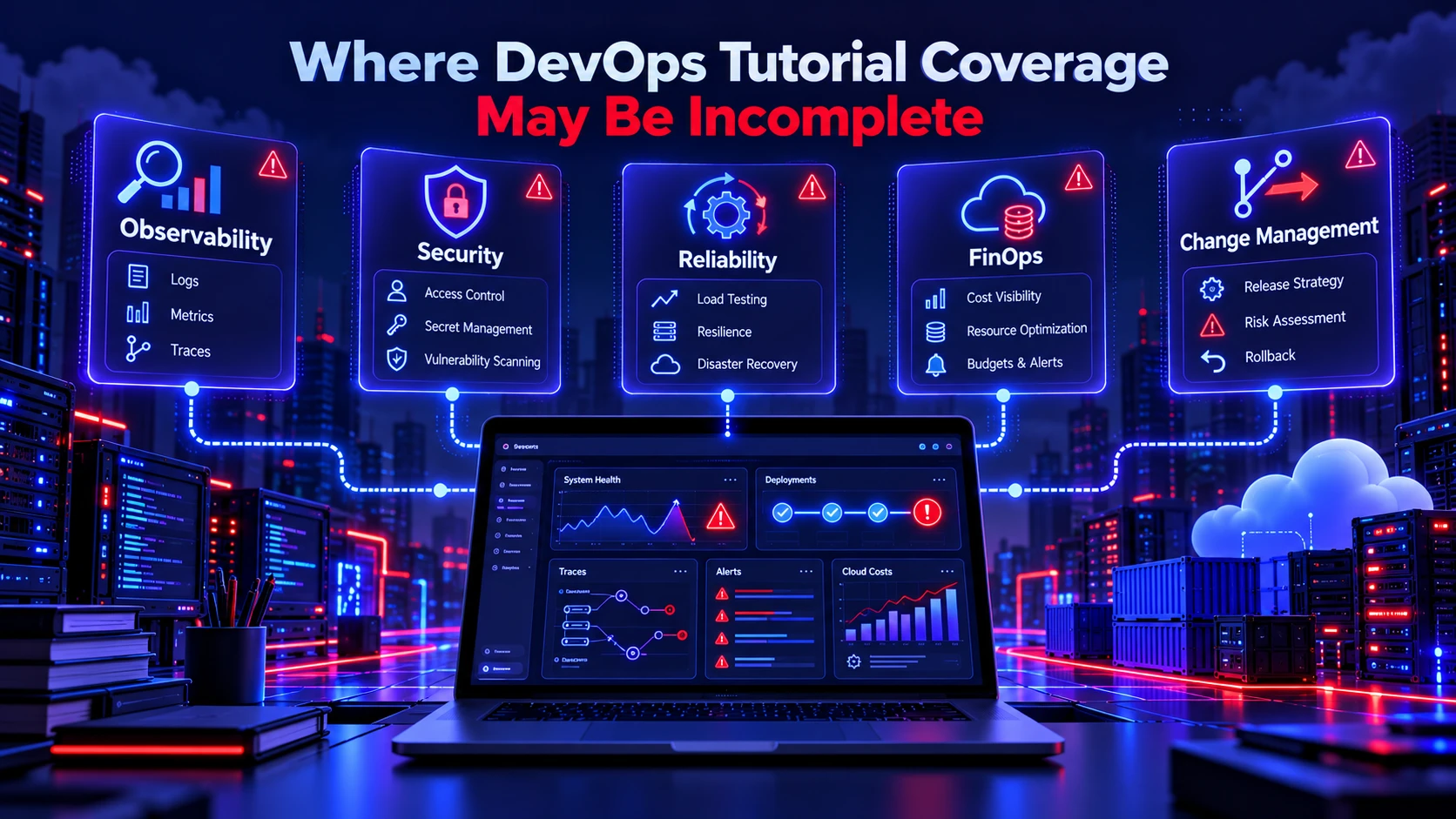
Beginner-focused DevOps tutorials often introduce software deployment and automation before exploring the challenges of operating applications in production. However, completing introductory exercises does not automatically prepare learners for system failures, security incidents, infrastructure scaling, or cloud cost management.
When evaluating Droven.io or another DevOps learning platform, check whether advanced operational topics receive sufficient explanation and hands-on coverage. The areas below should be treated as subjects to investigate, not as confirmed weaknesses of a particular website.
A tutorial can still be valuable even when it does not cover every advanced topic. The important question is whether learners understand which skills they have developed and what additional practice they need before managing production systems.
- Observability Depth: Check whether tutorials explain how application logs, performance metrics, and distributed traces help teams understand system behavior. Advanced learning should also cover alert design, service-level objectives (SLOs), and incident response. The
- provides technical guidance on collecting and working with telemetry data across modern applications.
- Security by Design: Evaluate whether the tutorials cover secure credential storage, dependency scanning, least-privilege access, and software supply chain protection. These practices help reduce risks throughout automated software delivery. The OWASP CI/CD Security Cheat Sheet provides practical guidance for securing pipelines, protecting sensitive credentials, and reducing common deployment security risks.
- Reliability Engineering: Capacity planning, load testing, failure modes, and resilience patterns are commonly underrepresented.
- Cost and FinOps Basics: Cloud cost drivers, tagging discipline, and cost-aware architecture are often missing.
- Production Change Management: Safe deployments, rollback strategy, and change risk assessment may not be covered thoroughly.
Use these potential gaps as a guide for planning further study. For example, beginners who understand basic deployment automation should also learn how sensitive credentials are protected during development and deployment. TechBonafide’s article on automated secrets management in DevOps explains approaches to credential storage, access controls, and secrets rotation. Identifying these advanced requirements early can help learners prepare for the security responsibilities involved in production systems.
What A Well Rounded DevOps Learning Path Should Include?
A balanced DevOps skill set includes delivery, infrastructure, operations, and governance. Tutorial collections sometimes overweight tooling and underweight systems thinking. A better learning path connects concepts across the software lifecycle.
A well-rounded DevOps learning roadmap should focus on transferable technical skills rather than any single cloud provider or software brand. Understanding automation, deployment, monitoring, and infrastructure management helps learners apply similar concepts across AWS, Azure, Google Cloud, and on-premises environments. Cloud cost awareness is another useful skill because infrastructure choices affect operational spending. TechBonafide’s guide to FinOps and cloud cost management explains how teams monitor spending, assign cost ownership, and improve resource efficiency.
- Foundational Practices: Master Git habits, code review discipline, and basic automation so you can work effectively in any engineering team.
- CI/CD and Testing: Learn pipelines plus test strategy, flaky test control, and pipeline performance tuning.
- Infrastructure as Code(IAC): Learn to define and manage infrastructure through version-controlled configuration files instead of relying entirely on manual setup. Understand declarative provisioning, state management, reusable configurations, and infrastructure changes. HashiCorp’s Terraform infrastructure as code guide explains how Terraform helps teams build, modify, and manage infrastructure consistently across environments.
- Observability and Incident Response: Build the habit of measuring service health and responding consistently to failures.
- Security and Compliance: Apply secure defaults, dependency hygiene, and secrets management from the start.
- Platform and Scaling: Learn orchestration, service discovery, traffic management, and resilience patterns for real production loads.
This sequence keeps you progressing in a way that mirrors how modern teams deliver and operate software.
Quick Comparison of Strengths and Missing Areas
When evaluating Droven.io DevOps tutorials, compare the practical skills demonstrated in each available lesson with the additional knowledge required for production environments. The following table provides a learning checklist rather than claiming that particular topics are present or missing from Droven.io.
| Learning Area | Beginner Skills to Look for | Advanced Skills to Check |
|---|---|---|
| CI/CD Pipelines | Automated builds, testing, and deployment | Secure pipelines, rollback procedures, and release approvals |
| Containers | Building images and running containers | Image scanning, networking, and runtime security |
| Infrastructure as Code | Creating repeatable infrastructure configurations | State management, reusable modules, and drift detection |
| Observability | Basic logs, metrics, and monitoring | Distributed tracing, SLOs, and incident alerting |
| Security | Access controls and basic vulnerability scanning | Secrets management, least privilege, and supply chain security |
| Cloud Cost Management | Basic resource tracking and cost awareness | Cost allocation, budgets, and FinOps governance |
Use this as a guide for planning what to learn next, especially if you are preparing for a role that includes on-call or production ownership.
How to Validate Your Learning Without Guesswork?
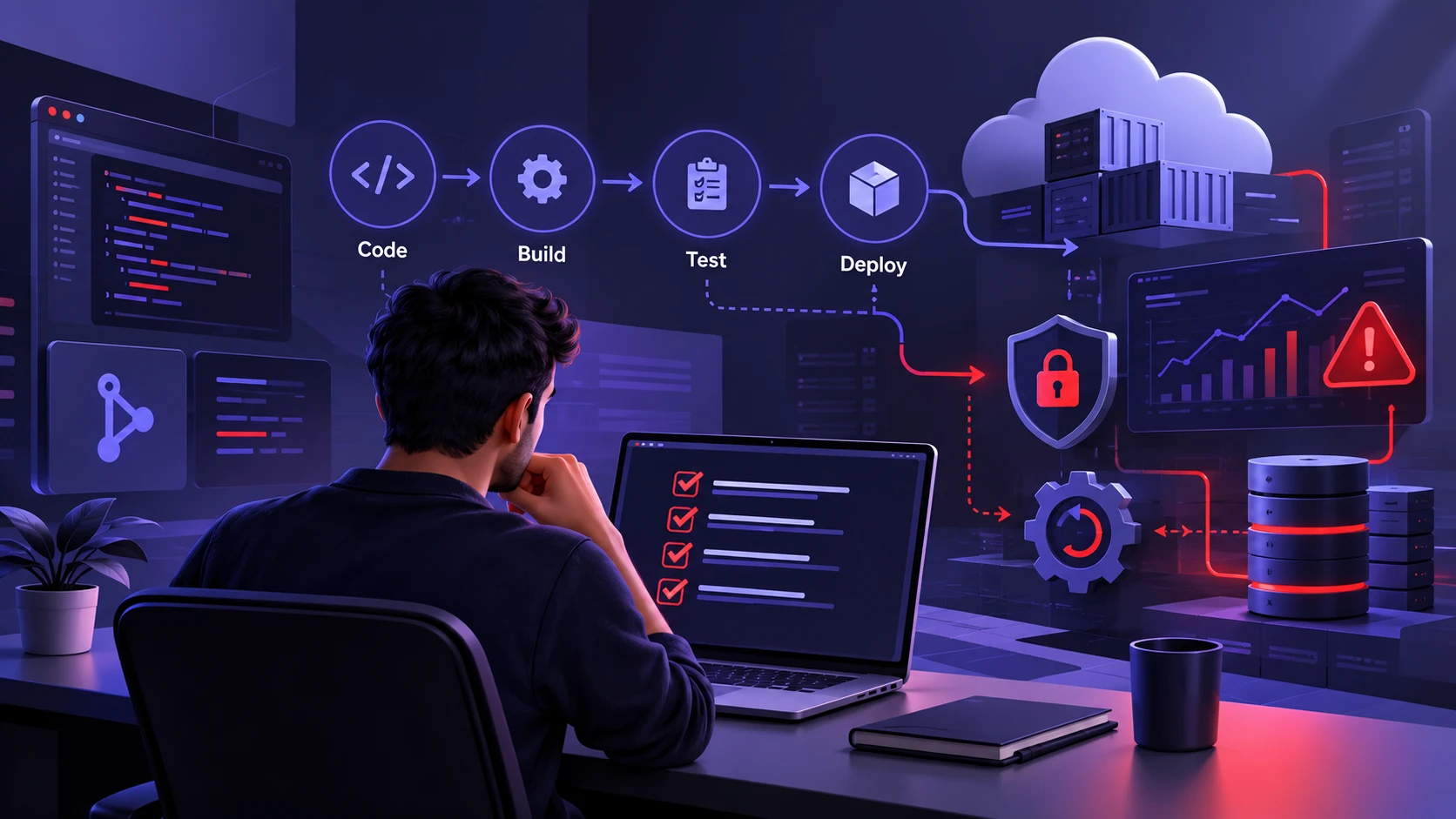
DevOps learning can feel complete even when it is not. Validation requires a consistent way to prove you can apply skills under constraints. A good approach is to measure your ability to produce stable outcomes rather than finish lessons.
These checks help learners demonstrate practical DevOps capabilities rather than relying only on completed courses or certificates. It is also useful to understand how engineering teams measure software delivery performance. DORA’s software delivery performance metrics explain how organizations evaluate delivery throughput and stability through indicators such as deployment frequency, change lead time, and change failure rate. Learners can use these concepts to understand how successful software delivery is assessed in real working environments.
- Rebuild From Scratch: Repeat a workflow without referencing notes and confirm you can reproduce the outcome reliably.
- Explain Tradeoffs: Describe why one approach is safer or simpler than another, especially around deployment and rollback.
- Operate What You Deploy: Add basic dashboards and alerting, then verify you can detect and respond to failures.
- Harden the Default: Apply least privilege, secrets hygiene, and dependency scanning to reduce common risks.
To evaluate DevOps skills consistently, create a practical assessment checklist covering automated deployments, infrastructure management, monitoring, security, and troubleshooting. For every skill, record the completed exercise, the tools used, and evidence that the process works reliably. This approach helps learners identify gaps and gives technical teams a clearer way to assess operational readiness.
Common Pitfalls When Using Tutorial Sites
Tutorials are designed to be approachable, but that can create blind spots. The most common issues come from treating a lesson as a complete standard for production. A second problem is assuming a tool choice is the same as a system design decision.
Watch for patterns that cause fragile implementations. Fixing them early saves time and reduces frustration later.
- Copying Commands Without Context: You may get the output once, but you will struggle when conditions change.
- Skipping Failure Handling: If a guide does not cover rollback, retries, or idempotency, add those pieces yourself.
- Ignoring Access Control: Permissions and secrets often get simplified in tutorials and must be tightened for real use.
- Not Measuring Outcomes: Without metrics, you cannot tell whether automation improved quality or just added complexity.
These pitfalls are avoidable when you keep a production mindset and treat each tutorial as a starting point.
Conclusion
Droven.io DevOps tutorials are worth evaluating alongside established DevOps learning resources, but their usefulness depends on the subjects, examples, and practical exercises actually available. A strong learning path should introduce version control, CI/CD, containers, infrastructure automation, and monitoring while also identifying the additional skills needed for production systems. Readers should verify tutorial coverage before relying on any single website as a complete DevOps training program.
If you want to accelerate beyond basics, build your plan around competencies, validate skills through repeatable outcomes, and focus on operating what you deploy. That approach turns tutorials into real capability and prepares you for production ownership.
Frequently Asked Questions
Are Droven.io DevOps Tutorials Enough to Become Job-Ready?
No single tutorial website can guarantee job readiness. When evaluating Droven.io, check whether its available lessons cover essential DevOps concepts and provide opportunities for hands-on practice. Employers may also expect practical experience with Linux, Git, CI/CD pipelines, containers, cloud infrastructure, monitoring, and troubleshooting. Building and documenting working projects can help learners demonstrate their skills beyond completing tutorials.
What Should I Learn Next After Finishing a DevOps Tutorial Series?
Prioritize observability, infrastructure as code depth, and secure delivery practices so you can support production systems. Focus on SLOs, alert quality, and rollback strategy rather than only learning new tools. This sequence reduces gaps that commonly show up on real teams.
How Do I Know If My CI CD Pipeline knowledge is Production Grade?
Production-grade knowledge includes repeatability, strong test signals, and safe deployment controls such as approvals and rollbacks. You should also know how to secure credentials, manage artifacts, and monitor pipeline health. If you can explain tradeoffs and handle failure cases confidently, you are close to production readiness.