

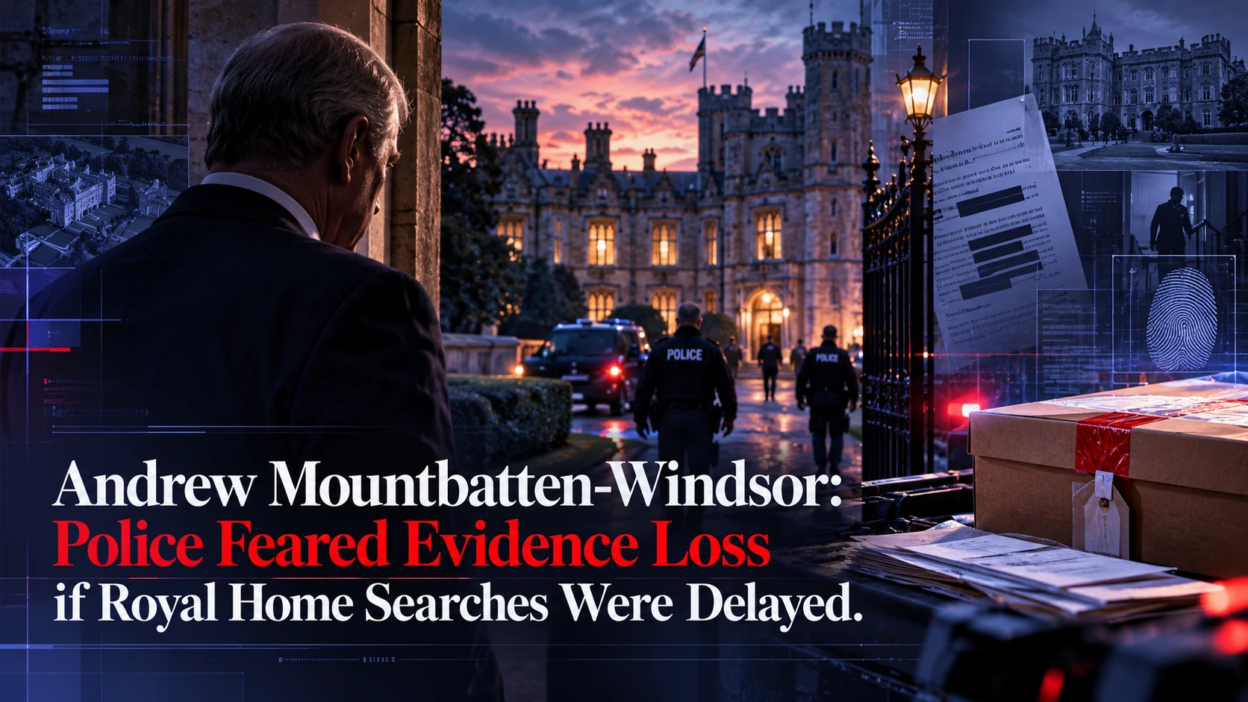
Newly released court documents have revealed why British police feared delays while searching properties linked to Andrew Mountbatten-Windsor, formerly known as Prince Andrew. Investigators were concerned that questions over permission to enter the properties could prevent officers from securing potential evidence during an ongoing criminal investigation.
According to an October 16 report on newly released court documents, Thames Valley Police feared Andrew or his lawyers might argue that officers needed permission from King Charles III before entering a property owned by the King. Investigators believed seeking separate permission could delay the searches and increase the risk of losing important evidence.
Andrew’s lawyers disputed the reasoning behind the warrant applications. They argued that police had not contacted Andrew or his legal representatives to ask whether they would voluntarily allow access to the properties or relevant evidence. They also questioned whether officers had provided sufficient reasons for believing that seeking permission would jeopardize the investigation.
Andrew’s lawyers disputed the reasoning behind the warrant applications. They argued that police had not contacted Andrew or his legal representatives to ask whether they would voluntarily allow access to the properties or relevant evidence. They also questioned whether officers had provided sufficient reasons for believing that seeking permission would jeopardize the investigation.
The searches took place in February 2026 at Andrew’s residence on the Sandringham Estate and his former home, Royal Lodge in Windsor. Police were investigating allegations that he shared sensitive government information with Jeffrey Epstein while working as the United Kingdom’s special representative for trade and investment.
Court documents show that investigators were seeking official paperwork, diaries, business records and other materials connected to Andrew’s former role as the UK’s trade representative. The investigation concerns allegations that government reports linked to overseas trade visits were forwarded to Jeffrey Epstein. Reporting on the court proceedings also confirmed that officers seized documentary material and electronic devices during the February searches. These allegations remain under investigation and have not been established as findings of guilt.
Andrew Mountbatten-Windsor, the younger brother of King Charles III, was arrested on February 19, 2026, on suspicion of misconduct in public office. He was interviewed under caution and later released under investigation. As of October 17, 2026, no criminal charge in this case had been announced, and Andrew continued to deny wrongdoing.
On October 8, 2026, the High Court quashed the search warrants after Thames Valley Police accepted that the wrong legal procedure had been used to obtain them. The official High Court case record identifies the proceedings involving Andrew Mountbatten-Windsor, the Central Criminal Court and Thames Valley Police. The warrants were requested under Section 8 of the Police and Criminal Evidence Act 1984, even though the material being sought could include records subject to special legal protections. The court explained that the appropriate process for accessing special procedure material was provided under Section 9 of the Police and Criminal Evidence Act 1984. The ruling concerned how the searches were authorized, not whether Andrew was guilty of the allegations.
The High Court also made clear that quashing the search warrants did not automatically end the criminal investigation or mean that the entire inquiry was unlawful. Thames Valley Police confirmed that it would continue investigating the alleged misconduct in public office.
Thames Valley Police has separately asked the court for permission to retain materials seized during the February searches, while Andrew opposes that request. A private court hearing is expected in 2027 to consider the evidence-retention dispute. This proceeding is separate from the October 8 ruling that quashed the original search warrants, and a final decision on retention has not yet been announced.
Beyond the legal dispute, the case highlights the importance of securely preserving sensitive records and electronic evidence. Investigators handling confidential documents must follow the law while protecting the accuracy and integrity of collected materials. These principles also connect with the wider importance of data integrity in cybersecurity, although the court proceedings have not established that anyone destroyed or altered the seized evidence.
Andrew Mountbatten-Windsor remains under investigation, and the dispute over the seized materials has not yet been resolved. The next court hearing could determine whether police can lawfully retain the items collected during the searches. For now, the criminal investigation continues, and no finding of guilt has been made.
For broader background on the responsible handling of confidential information, readers can explore TechBonafide’s guide to data privacy and the principles of protecting sensitive records.