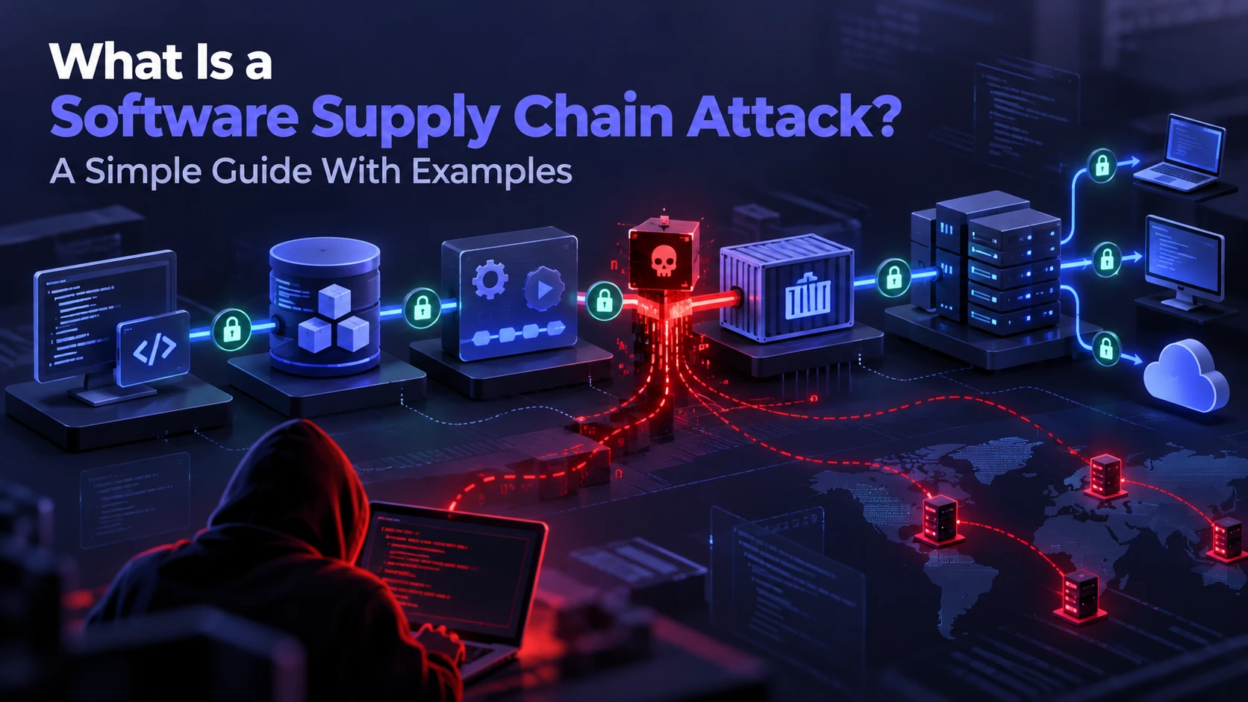
A software supply chain attack occurs when attackers tamper with software, third-party dependencies, or the systems used to build and distribute applications. Because organizations often trust these components, malicious changes can enter their systems through normal software updates, package installations, or deployment processes.
These attacks can expose sensitive data, compromise business systems, and affect multiple organizations through a single trusted software component. This guide explains how software supply chain attacks work, highlights real-world examples, and outlines practical ways to reduce the risks.
What A Software Supply Chain Attack Means?
Modern applications are assembled from many parts, including third-party libraries, open-source packages, container images, build tools, and cloud services. A supply chain attack targets any of those parts or the processes that deliver them. The goal is to insert malicious code, weaken security controls, or steal secrets without triggering immediate alarms.
Software supply chain attacks exploit trust between software developers, third-party suppliers, and organizations that use their products. A compromised library, malicious software update, or tampered build process can introduce harmful code into an otherwise legitimate application.
The important difference is that an attacker manipulates a trusted part of the software delivery process rather than necessarily attacking every affected organization directly. The consequences depend on what was compromised, how the software is used, and which security controls are in place.
Reducing these risks requires security practices throughout software development and delivery. The NIST Secure Software Development Framework provides guidance for integrating security into development workflows and reducing vulnerabilities in released software.
Why Attackers Target the Software Supply Chain?
Software supply chain attacks can provide attackers with access to many targets through a single compromised component. For example, if a widely used software library or update mechanism is tampered with, organizations that install or deploy the affected software may unknowingly introduce malicious code into their systems.
The number of affected users depends on how widely the compromised component is distributed and whether its malicious functionality reaches downstream environments.
They also offer stealth. Malicious changes can look like routine updates, and attackers can hide in build tooling or dependency trees where security visibility is weaker. When detection is delayed, the blast radius grows.
Common Entry Points in the Supply Chain
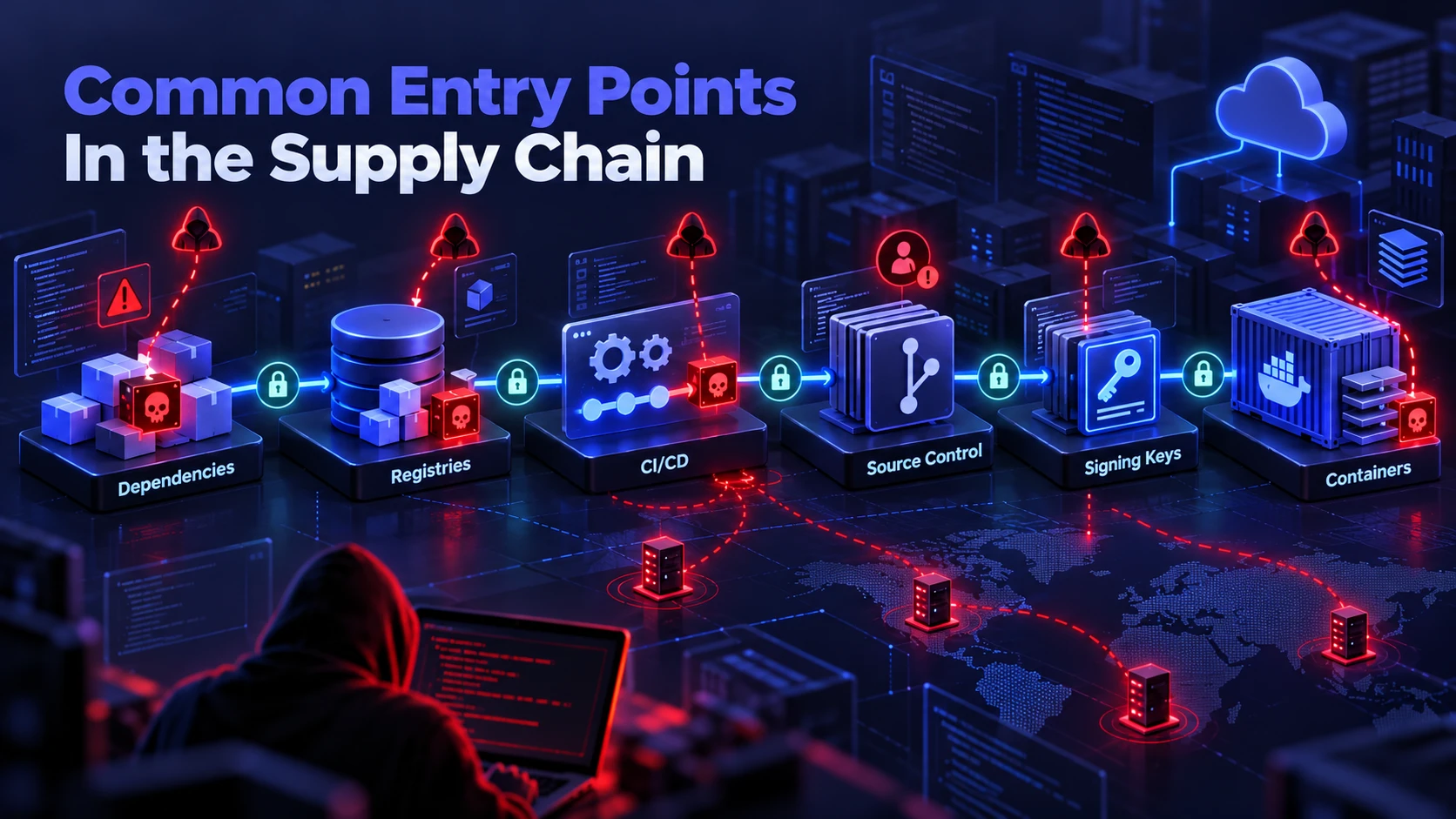
The supply chain includes every step from writing code to delivering it to production. Attackers choose entry points that maximize access and minimize scrutiny. Some entry points are technical, while others rely on process gaps and identity abuse.
- Third-Party Dependencies: Compromised libraries or packages can introduce backdoors, data theft, or remote execution.
- Package Registries and Repositories: Attackers can publish lookalike packages, hijack accounts, or tamper with hosted artifacts.
- Build and CI CD Systems: A compromised runner, plugin, or pipeline secret can let attackers inject code during builds.
- Source Control and Maintainer Accounts: Stolen credentials can be used to merge malicious changes that appear legitimate.
- Signing Keys and Release Infrastructure: If attackers obtain signing keys, they can distribute malware that passes authenticity checks.
- Container Images and Base Layers: A poisoned base image can propagate into many services that inherit it.
Container security is especially important because applications often depend on shared base images and third-party components. Understanding the differences between containers and virtual machines can help teams evaluate isolation, software packaging, and security responsibilities in modern deployment environments.
These pathways share a pattern. Trust is granted to components and identities, and attackers abuse that trust rather than brute forcing perimeter defenses.
Build and deployment pipelines are particularly important because they can access source code, software artifacts, and sensitive credentials. The OWASP CI/CD Security Cheat Sheet explains practical security measures for protecting automated software delivery pipelines from common attack risks.
How Does a Software Supply Chain Attack Work?
Software supply chain attacks can follow different paths depending on the target and the attacker’s objective. However, many incidents involve gaining access to an upstream component, introducing a malicious change, and distributing that change through a trusted software delivery process.
The following stages describe a common attack scenario. Not every incident includes every stage, and some attacks are detected before harmful code reaches users.
- Initial Compromise: Attackers gain access to a maintainer account, CI system, registry, or build host through phishing, token theft, or misconfiguration.
- Payload Insertion: Malicious code is added to a dependency, build step, or artifact so it looks like a routine change.
- Distribution Through Trusted Channels: The tampered component is shipped via updates, packages, images, or signed releases that downstream systems accept.
- Execution In Downstream Environments: The payload runs during build, install, or runtime and may steal secrets, open access, or deploy additional malware.
- Follow-On Activity and Persistence: If the malicious code executes successfully, attackers may attempt to steal information, maintain unauthorized access, deploy additional malware, or hide evidence of the compromise. These activities depend on the attacker’s objective and are not present in every incident.
This flow highlights why strong identity controls and build integrity matter as much as endpoint security.
Secure software delivery also depends on understanding how development, testing, and deployment processes work together. TechBonafide’s guide to the principles and practices of DevOps explains how automation, version control, and continuous integration support modern software development workflows.
Common Types of Software Supply Chain Attacks
Examples are best understood as patterns of compromise rather than stories. The core idea is that attackers change something upstream and victims inherit that change through normal operations.
- Dependency Confusion: Internal package names are claimed in a public registry, and build systems accidentally pull the attacker package due to resolution rules.
- Typosquatting Packages: Lookalike package names are published to catch developer install mistakes, leading to malicious installs.
- Maintainer Account Takeover: A trusted package owner account is compromised and a malicious update is released through legitimate channels.
- Build Pipeline Injection: CI scripts or plugins are modified so the built artifact includes hidden code, even when source code appears clean.
- Compromised Signing and Release Keys: Attackers who gain access to legitimate signing keys may sign malicious software so that it passes signature verification. A valid digital signature confirms that the software was signed using a particular key, but it does not guarantee that the software itself is safe.
These patterns map directly to controls. Registry governance, stricter resolution rules, and hardened build systems reduce the risk.
Similar risks can arise when suspicious code changes are submitted to open-source projects. TechBonafide previously reported an incident involving attempted open-source software poisoning, highlighting why maintainers should carefully review proposed changes before allowing them into trusted software repositories.
Real-World Software Supply Chain Attack Examples
Software supply chain attacks are not limited to theoretical risks. Several documented incidents demonstrate how malicious changes to trusted software components can threaten organizations and users.
SolarWinds Orion Attack (2020)
The SolarWinds Orion compromise became one of the most widely discussed software supply chain incidents. Attackers inserted malicious code into the software delivery process, allowing compromised Orion updates to reach customers through a trusted distribution channel.
The incident showed how compromising a software supplier could provide attackers with opportunities to access downstream organizations.
The U.S. Cybersecurity and Infrastructure Security Agency (CISA) published an official advisory about the SolarWinds compromise, identifying affected Orion versions and recommending security measures.
XZ Utils Backdoor (2024)
In March 2024, researchers discovered malicious code in certain releases of XZ Utils, a widely used data compression utility associated with the liblzma library.
The malicious changes affected upstream release archives for XZ Utils versions 5.6.0 and 5.6.1. The incident demonstrated how attackers could manipulate software packaging and build processes to introduce hidden functionality into a trusted open-source component.
The issue was discovered before widespread deployment in major stable Linux distributions. Red Hat confirmed that its Red Hat Enterprise Linux products were not affected.
For technical details, see Red Hat’s security advisory for CVE-2024-3094.
What These Incidents Teach Us?
Both examples highlight the importance of verifying software sources, reviewing unexpected changes, protecting build infrastructure, and monitoring trusted dependencies.
Software origin and authenticity are important security signals, but they do not guarantee that every component is free from malicious code. Effective protection requires multiple security controls throughout development, distribution, and deployment.
Why Software Supply Chain Attacks are Hard to Detect?
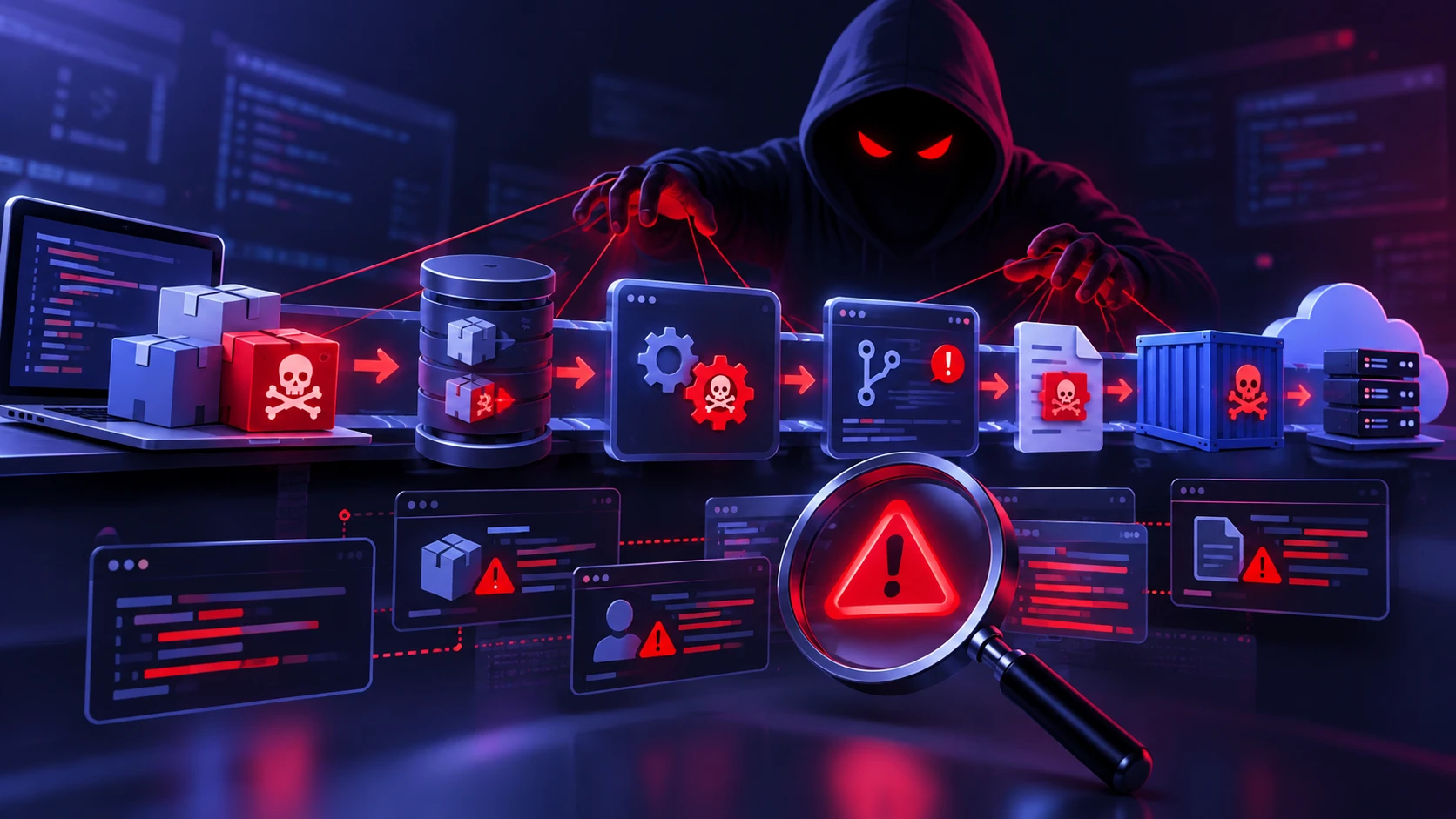
Detection is hard because symptoms often look like normal development activity. A dependency update, a new transitive library, or a minor build script change does not always raise suspicion.
Many organizations also lack end-to-end visibility across the software development lifecycle. Gaps between security, engineering, and release management can delay triage when something goes wrong.
Security teams can improve detection by monitoring activities that may indicate unexpected changes to software or its delivery process.
- Unexpected Dependency Changes: A package is added, upgraded, or downloaded from an unfamiliar source without an approved reason.
- Unusual Repository Activity: A privileged account makes unexpected commits, changes branch protection rules, or modifies release workflows.
- Suspicious Pipeline Behavior: A build job requests new permissions, accesses sensitive secrets, or connects to unexpected external services.
- Unverified Software Artifacts: A downloaded package fails an expected signature, checksum, or provenance verification.
- Unexpected Package Publishing: A new package version appears outside the normal release process or from an unrecognized maintainer account.
These signals do not automatically prove that an attack has occurred. However, they can help teams identify changes that deserve investigation before affected software is deployed.
Key Risks and Business Impact
The impact is not limited to malware infection. Supply chain compromises can create long-term access, expose sensitive information, and damage customer trust.
- Credential Theft: API keys, tokens, and cloud credentials can be harvested from build logs, environment variables, or runtime memory.
- Data Exfiltration: Sensitive datasets, customer records, and proprietary code can be copied without immediate disruption.
- Operational Downtime: Incident response can require halting deployments, rotating secrets, and rebuilding pipelines from scratch.
- Regulatory and Contract Risk: Breaches can trigger reporting obligations, audits, and penalties, especially in regulated industries.
- Customer Trust Erosion: A single compromise can impact many downstream users and amplify reputational damage.
Because the blast radius can be large, leadership often treats this risk as both a security and resilience priority.
Protecting credentials is an important part of reducing the impact of a compromised development pipeline. Teams can use secure secret storage, limited access permissions, and short-lived credentials where supported. For more information, read TechBonafide’s guide to automated secrets management in DevOps, which explains how organizations can manage sensitive credentials across automated software delivery workflows.
How to Reduce Software Supply Chain Attack Risks?
Effective defenses focus on integrity, identity, and visibility. The goal is to ensure that what you build and run is exactly what you intended, and that only authorized identities can change it.
- Software Bill of Materials (SBOM): Maintain an inventory of software components, their versions, and dependency relationships. This helps teams identify potentially affected products when a component is compromised or found vulnerable. An SBOM improves visibility but does not automatically detect malicious code.
- Dependency Pinning and Lockfiles: Pin approved dependency versions and use lockfiles where supported to reduce unexpected changes between installations. Review dependency updates carefully and monitor for known vulnerabilities. Pinning improves consistency but does not, by itself, guarantee a fully reproducible or secure build.
- Package and Registry Governance: Restrict where packages can be pulled from and apply allowlists for critical projects.
- Hardened CI/CD Pipelines: Use isolated build runners, restrict workflow permissions, protect sensitive credentials, and review third-party automation tools. Where appropriate, pin external actions to reviewed immutable versions or commit hashes and separate untrusted pull-request testing from privileged deployment workflows.
- Artifact Signing and Verification: Sign release artifacts, verify signatures before deployment, and protect signing credentials from unauthorized access. Where supported, use build provenance or artifact attestations to verify how and where software was produced. Remember that signing alone cannot prove that the underlying code is harmless.
- Least Privilege for Humans and Machines: Reduce token scope, rotate credentials, and enforce multi-factor authentication.
- Continuous Monitoring: Alert on unusual publish events, dependency changes, and abnormal build behavior.
Controls work best when they are consistent. A few well-enforced guardrails beat a long checklist that no one follows.
For organizations building a software component inventory, CISA’s 2026 SBOM guidance explains the baseline information that a software bill of materials should contain. Maintaining reliable component information helps teams understand software dependencies and make better decisions when vulnerabilities or compromises are discovered.
Teams using GitHub Actions can also review GitHub’s secure workflow guidance for recommendations on limiting workflow permissions, protecting secrets, reviewing third-party actions, and reducing the risks associated with untrusted code.
Software Supply Chain Risks and Prevention Checklist
This table summarizes common supply chain weaknesses and practical mitigations that fit most organizations. Use it to prioritize controls during roadmap planning and audits.
| Risk Area | Potential Security Risk | Recommended Protection |
|---|---|---|
| Third-Party Dependencies | Malicious or vulnerable packages enter applications | Use approved registries, lockfiles, and dependency scanning |
| Source Code Repositories | Attackers introduce unauthorized code changes | Require MFA, protected branches, and code reviews |
| CI/CD Pipelines | Attackers modify builds or access sensitive credentials | Use isolated runners, least-privilege permissions, and secure secret storage |
| Container Images | Compromised base images introduce unwanted software | Use trusted images, vulnerability scanning, and image digest verification |
| Software Releases | Modified or malicious artifacts reach users | Verify signatures, protect signing credentials, and check build provenance |
| Monitoring And Incident Response | Compromised components remain undetected | Monitor releases, maintain component inventories, and prepare response procedures |
Once these basics are in place, deeper improvements become easier, such as provenance, policy-as-code, and tighter runtime admission controls.
Organizations looking to strengthen build integrity can use the SLSA supply chain security framework to understand security requirements for software source code, build processes, and artifact provenance. SLSA provides a structured approach to improving confidence in how software is produced and distributed.
How to Assess Your Software Supply Chain Risk?
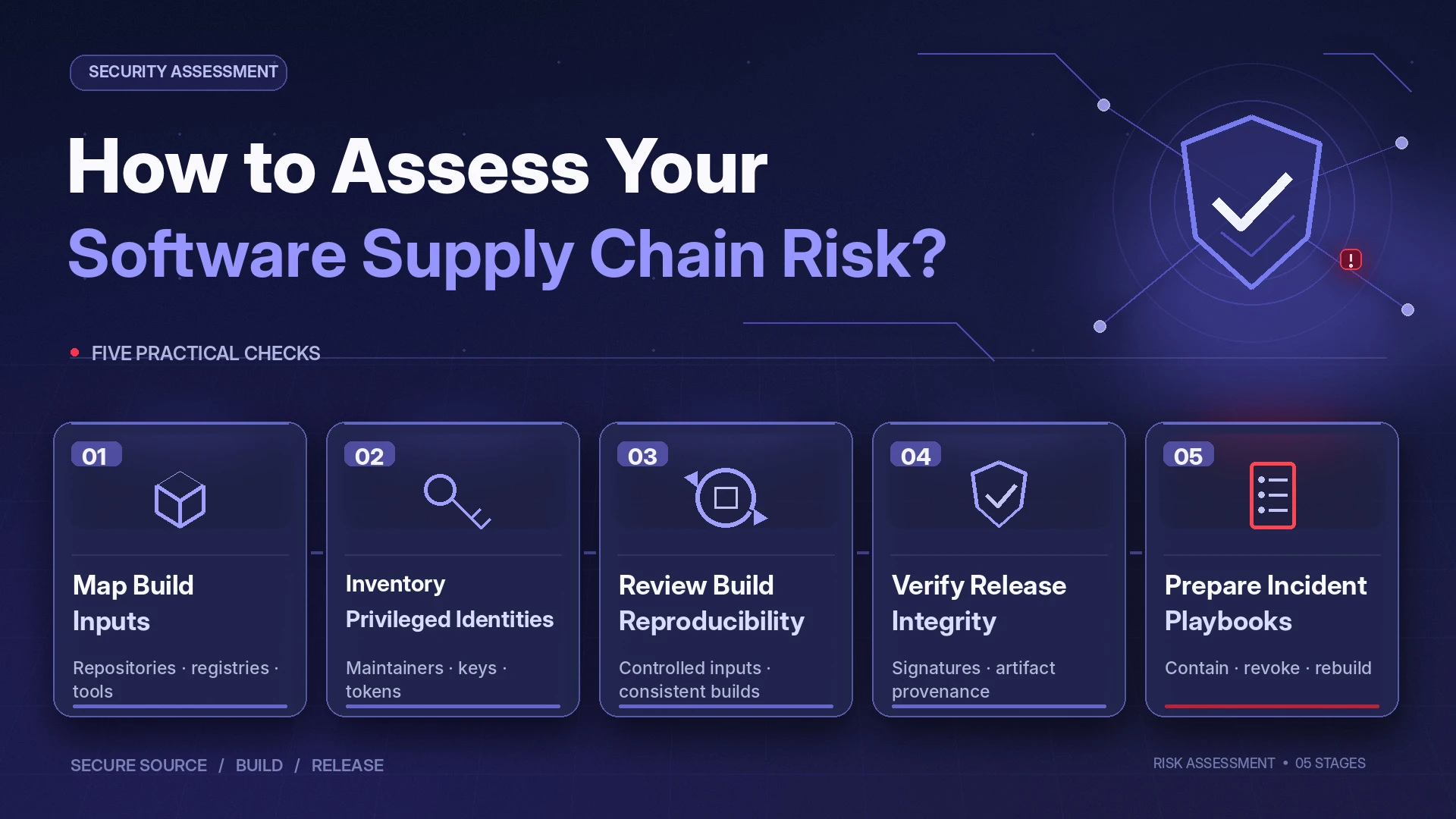
A practical assessment is lightweight and repeatable. Focus on the systems that can change code or ship artifacts, and on the identities that can approve those changes.
- Map Your Build Inputs: List key repositories, registries, base images, and build tools used for production workloads.
- Inventory High-Privilege Identities: Identify maintainers, automation accounts, tokens, and service principals with publish or deploy rights.
- Review Build Consistency and Reproducibility: Check whether dependency versions are controlled, build inputs are documented, and critical builds produce consistent results under equivalent conditions. Where reproducible builds are supported, verify that independent builds produce matching artifacts. Dependency pinning alone does not establish reproducibility.
- Review Release Integrity: Confirm that artifacts are signed, signatures are verified, and keys are protected and rotated.
- Define Incident Playbooks: Document how to revoke tokens, roll back releases, and rebuild clean environments quickly.
Keep the output actionable. The best assessment ends with a short set of fixes that can be implemented in the next sprint.
What to Do After Discovering A Supply Chain Compromise?
If your team suspects that a software dependency, build pipeline, or distributed application has been compromised, the first priority is to limit further exposure while preserving the information needed for investigation.
Follow these practical steps:
- Identify Affected Components: Determine which package versions, repositories, build artifacts, and environments may be involved.
- Contain the Compromise: Pause affected deployments, restrict compromised accounts, and isolate systems when necessary. Preserve relevant logs and evidence.
- Protect Credentials: Revoke or rotate exposed API keys, access tokens, signing credentials, and other secrets based on the investigation.
- Verify Clean Software: Obtain components from trusted sources, review their integrity, and rebuild affected artifacts using a verified environment.
- Restore and Monitor: Redeploy trusted software, monitor for suspicious activity, and confirm that known indicators of compromise are no longer present.
- Document and Report: Record the incident timeline, affected systems, corrective actions, and any notification obligations that apply.
The exact response depends on the affected software and the scope of the compromise. Teams should follow established incident-response procedures and involve qualified security personnel when the impact is uncertain or potentially serious.
Conclusion
A software supply chain attack succeeds by exploiting trust in the tools and components used to deliver software. The strongest defense is a clear chain of integrity from source to build to release, backed by tight identity controls and continuous monitoring.
Teams that invest in reproducible builds, dependency governance, and protected CI CD pipelines reduce both the likelihood and the blast radius of compromise. Treat supply chain security as an engineering practice, not a one-time audit activity.
Frequently Asked Questions
How is A Software Supply Chain Attack Different From A Regular Breach?
A regular breach targets a specific organization directly, often through exposed services or employee accounts. A supply chain attack targets an upstream component or delivery process so many downstream systems inherit the compromise. This makes attribution, detection, and cleanup more complex.
What is the First Control to Implement If Resources are Limited?
Start by hardening identity and access in source control and CI/CD, since those systems can change what gets shipped. Enforce multi-factor authentication, restrict token scopes, and protect branches and release workflows. These steps reduce the easiest takeover paths.
Small organizations can build on these protections by applying least-privilege access and stronger identity verification across their systems. TechBonafide’s guide to Zero Trust security for small businesses explains how these principles can help limit unauthorized access without requiring a large enterprise security budget.
Do Small Teams Need Supply Chain Security Practices?
Yes. Small development teams also depend on third-party packages, code repositories, and automated deployment tools, which can introduce supply chain risks. Teams with limited resources should begin with multi-factor authentication, protected repositories, dependency pinning, approved package sources, and secure handling of credentials. Additional controls such as artifact signing and provenance verification can be introduced according to the team’s software delivery requirements and available resources.
Can A Digitally Signed Software Update Still Be Malicious?
Yes. A digital signature helps verify the integrity of a software package and its relationship to a signing key, but it does not guarantee that the code is safe. If attackers compromise a trusted development process or signing key, malicious software may still carry a valid signature. Organizations should combine signature verification with secure development practices, dependency monitoring, and build integrity controls.