

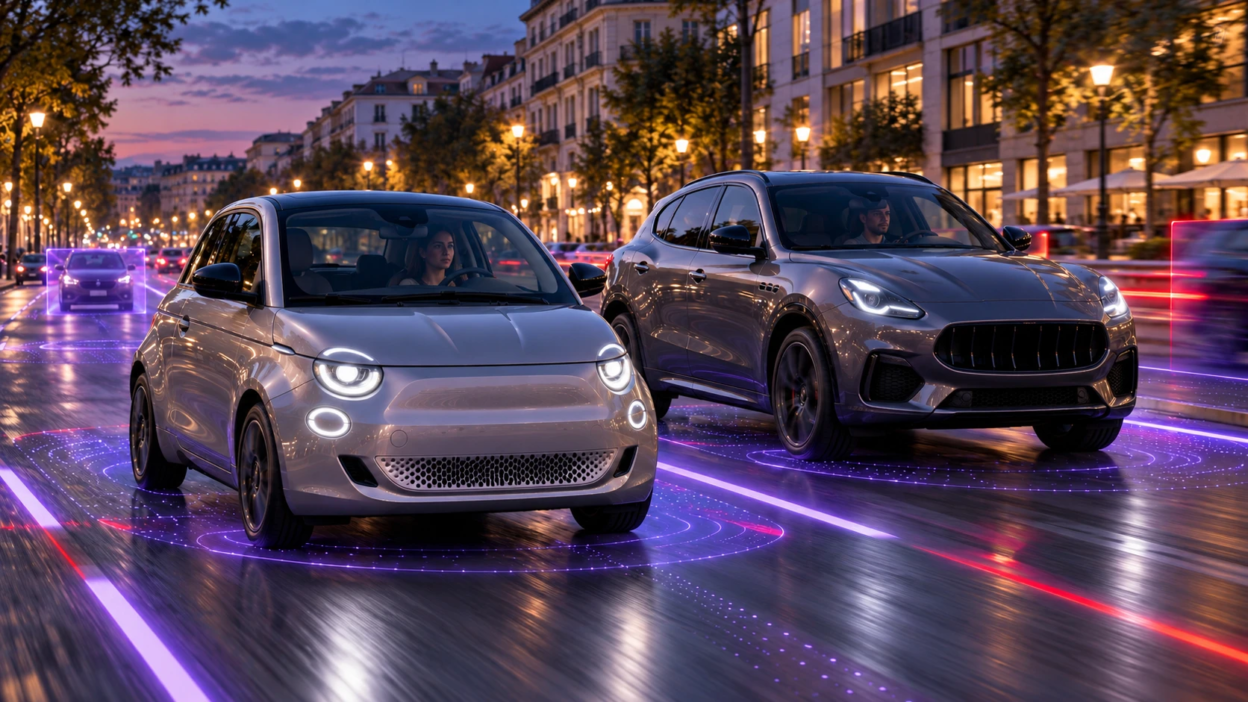
Stellantis and Wayve have reached a new milestone in developing AI-powered hands-free driving technology. The companies demonstrated their system in Fiat 500e and Maserati Grecale development vehicles, showing how artificial intelligence could support driving across different vehicle types while keeping a human driver responsible for supervision.
The technology was demonstrated in Fiat 500e and Maserati Grecale development vehicles during the Wave by Vento 2026 event in Turin, Italy, on October 9. According to the official Stellantis announcement, the demonstration showed how one AI driving system could support supervised, hands-free driving across different vehicle platforms. The technology is designed for future use on city streets and highways.
Stellantis developed the system through its partnership with Wayve, an AI driving technology company. The project combines Wayve AI Driver with Stellantis’ STLA AutoDrive platform to help vehicles respond to everyday road conditions.
Wayve says its AI Driver uses technology that learns from real-world driving experience to understand road conditions and support driving decisions. The system is designed to work without relying on high-definition maps or fixed driving rules for every situation. This approach is related to physical AI, where intelligent systems use sensor information to understand their surroundings and guide actions in the real world. However, the system must still be tested and validated for the conditions in which it will operate.
One of its main features is hands-free driving from one location to another. The technology can support driving on city streets and highways while the human driver remains responsible for supervising the vehicle.
Stellantis describes the technology as Level 2++ automated driving, a term used for advanced driver-assistance capabilities. However, Level 2++ is not a separate official SAE automation level. Under the NHTSA automated vehicle safety guidelines, Level 2 systems can assist with steering, acceleration, and braking, but the human driver must remain fully engaged and responsible for driving. Therefore, hands-free operation does not mean the vehicle can drive independently without human supervision.
The company is also exploring how the same AI technology can work across different vehicles without creating a completely separate driving system for every model.
The Fiat 500e and Maserati Grecale demonstrations followed an earlier integration involving a Jeep Grand Cherokee development vehicle. Stellantis and Wayve said the two newer vehicles moved from integration to real-world road testing in less than four weeks. This progress shows how the shared AI driving system could make development more efficient across different vehicle platforms, although each model still requires its own testing and validation.
Stellantis CEO Antonio Filosa and Wayve CEO Alex Kendall discussed how AI could change the automotive industry during the event. Their focus included creating vehicles that can better understand real-world driving conditions while improving convenience for drivers.
The partnership is part of Stellantis’ wider effort to develop advanced vehicle software and smarter mobility systems. Its plans also include exploring Level 4 automated driving technology for future driverless services.
Level 4 automation allows a vehicle to handle driving tasks without a human driver within specific operating conditions or approved service areas. This technology can support future robotaxi services, where passengers travel in vehicles designed to operate without a human driver. However, Stellantis’ Level 4 ambitions are separate from the supervised Level 2++ system demonstrated in the Fiat 500e and Maserati Grecale development vehicles.
Stellantis is targeting 2028 for the first commercial introduction of its Wayve-powered supervised driving technology, beginning in North America. The timeline was outlined in the companies’ May 2026 automated driving partnership announcement. However, 2028 remains a target rather than a guaranteed release date. Stellantis has not announced which production vehicle will receive the feature first or confirmed its pricing.
The development comes as automakers compete to introduce more advanced software, artificial intelligence, and automated driving features. These technologies could become important selling points as cars increasingly depend on digital systems.
For customers, the technology could eventually reduce driving effort on supported city streets and highways. However, the Turin demonstration does not establish how the system will perform in every real-world situation. Stellantis must still complete the testing, validation, and regulatory steps needed for a commercial release. Drivers using a Level 2 assistance system must remain attentive to the road and ready to take control whenever necessary.
The Fiat 500e and Maserati Grecale demonstrations mark another step in Stellantis and Wayve’s automated driving partnership. The next major milestones will be confirming the first production vehicle, completing the necessary safety validation, and providing a clearer commercial launch schedule.

Tech Bonafide is the editorial identity of TechBonafide, an independent technology publication covering AI, software, cybersecurity, gadgets, and emerging technology.


