
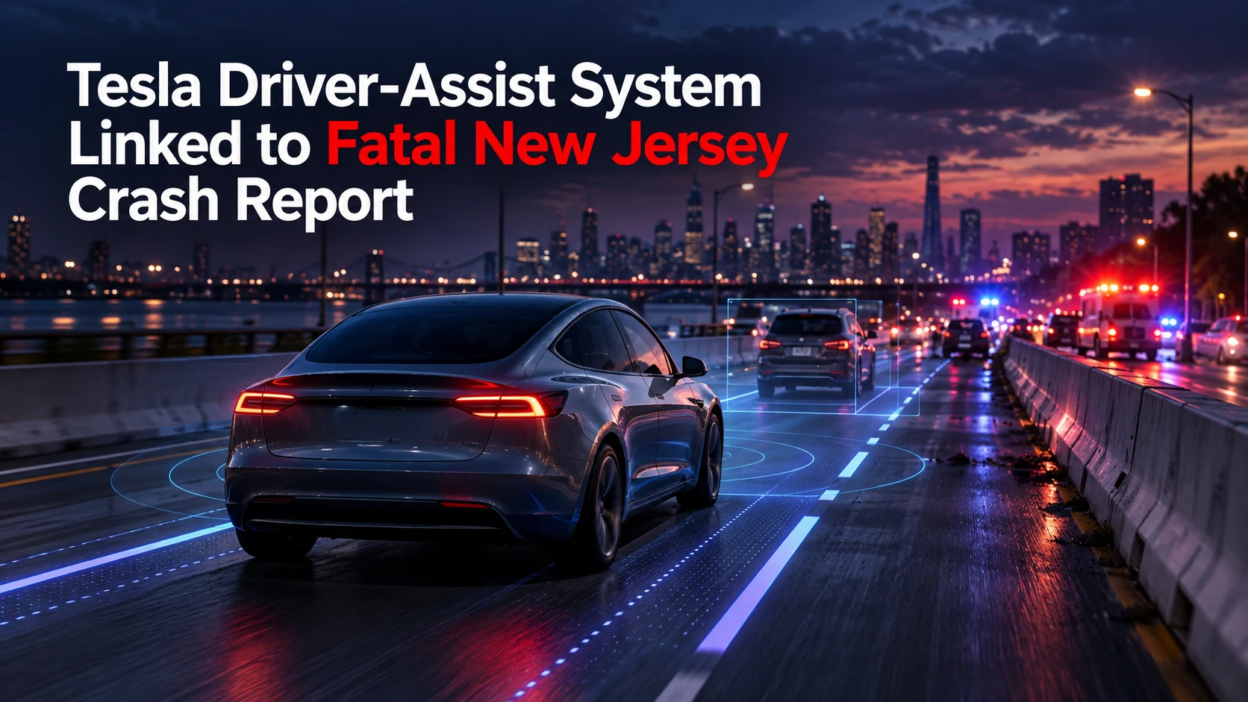
An October 15 investigation by Electrek has connected a fatal Tesla crash in New Jersey to a federal report showing that the vehicle’s driver-assistance system was verified as engaged within 30 seconds before the collision.
The finding raises new questions about Tesla’s driving technology and what happened before the accident. However, the available information does not establish that the software was controlling the vehicle at the time of the crash or that it caused the collision.
The accident happened on August 22, 2026, on Route 55 in Vineland, New Jersey. A 2021 Tesla Model Y traveling south crossed a grassy median, struck a tree, and entered the opposite lanes before crashing into a Chevrolet SUV.
The collision killed 68-year-old Phillip Eastman, who was driving the SUV. The Tesla driver and a passenger in the Chevrolet were also injured.
The crash information submitted to the National Highway Traffic Safety Administration (NHTSA) lists the Tesla driver-assistance system’s engagement status as “Verified Engaged,” according to the published analysis of the federal record.
Under NHTSA’s Standing General Order on Crash Reporting, certain crashes must be reported when a Level 2 driver-assistance system was used at any time within 30 seconds before the collision.
However, the publicly available information does not identify whether the vehicle was using basic Autopilot or Full Self-Driving (Supervised). It also does not establish whether the system was steering when the Tesla crossed the median.
The reporting data alone cannot establish the cause of the accident. Additional evidence would be needed to determine how the driver and the vehicle’s assistance technology behaved before the collision.
Tesla’s Autopilot features can assist with tasks such as maintaining speed, following surrounding traffic, and steering within a lane. Full Self-Driving (Supervised) provides more advanced assistance, including navigating roads, making turns, and changing lanes, depending on vehicle configuration, software, and regional availability.
Despite these capabilities, neither system makes a Tesla fully autonomous. Drivers must continue watching the road, remain responsible for the vehicle, and be prepared to take control when necessary.
Driver-assistance systems are one example of how artificial intelligence is used in transportation, where software helps vehicles process information and support driving decisions.
Tesla’s advanced driving software has also faced separate investigations by the National Highway Traffic Safety Administration.
In October 2025, NHTSA opened an investigation into Full Self-Driving traffic violations, including reports of vehicles proceeding through red lights or entering opposing traffic lanes.
In March 2026, the agency expanded a separate investigation into Full Self-Driving performance during reduced visibility. That investigation examines whether the technology can detect reduced camera visibility and warn drivers with enough time to respond.
These federal investigations examine broader potential safety problems and do not establish what caused the fatal New Jersey collision.
Tesla has also changed how it presents its advanced driving technology in Europe. In October 2026, the company began using the name “Tesla Assisted Driving” instead of “Full Self-Driving (Supervised)” on several European websites.
Germany’s Federal Ministry of Transport explained on October 6 that the previous name could be misleading because the system does not perform the complete driving task without human supervision.
Although the European naming change is separate from the New Jersey crash, both developments highlight the importance of clearly explaining the limits of driver-assistance technology.
Modern driver-assistance technology also draws on machine learning, which allows computer systems to learn patterns from data. However, the use of machine learning alone does not establish how safely a particular driving system performs.
The newly examined crash information leaves several important questions unanswered, including which Tesla driver-assistance package was active and what the system was doing immediately before the collision.
Although the federal report confirms that driver assistance was engaged during the reporting window, it does not establish whether the software contributed to the crash.
Further evidence from investigators or additional technical disclosures may help explain what happened. Until then, the New Jersey case highlights the importance of driver supervision, careful safety investigations, and transparency about advanced driving technology.