Webhooks vs polling is an important comparison when designing API integrations, real-time notifications, and data synchronization systems. Both methods help applications detect changes, but they differ in how updates are delivered, how quickly information becomes available, and how much infrastructure they require. Webhooks send event notifications when changes occur, while polling checks for updates at scheduled intervals. Understanding their differences in latency, reliability, security, API usage, and maintenance can help developers choose the right approach.
The right choice depends on how quickly your application needs updates, how frequently changes occur, and what your infrastructure can safely handle. Both approaches have advantages and limitations, and many production systems combine them to improve reliability and data consistency.
What Webhooks are?
Webhooks deliver event notifications from one system to another over HTTP when something changes. The provider sends a request to a configured endpoint, and the receiving application processes the event immediately or places it in a queue for later processing.
Webhooks follow an event-driven model, meaning notifications are triggered by activity instead of repeated scheduled requests. They can reduce unnecessary API calls and deliver updates quickly, especially when changes are infrequent or unpredictable. However, delivery is not always immediate. Provider-side queues, network delays, outages, and retry policies can affect how quickly an event reaches the receiving application.
How Webhooks Work in Practice?
A typical webhook integration uses an HTTPS endpoint that the provider can reach directly or through a secure gateway or managed relay. When an event occurs, the provider sends an HTTP request containing event information. The receiver verifies the request, validates the payload, and ideally stores or queues the event before returning a successful HTTP response. Background workers then process the event without blocking incoming deliveries.
A reliable webhook integration must handle duplicate notifications, delayed deliveries, unexpected event ordering, and failed requests. GitHub’s webhook best practices explain important safeguards such as verifying requests, responding within provider timeouts, and recovering missed deliveries. Because webhook behavior differs between platforms, developers should check each provider’s event delivery and retry policies before deployment.
What Polling is?
Polling is a pull-based approach where an application requests updates from another system at regular intervals. The application calls an API, checks whether information has changed, and repeats the process according to a configured schedule.
Polling gives the receiving application direct control over when API requests occur and how often updates are checked. It can simplify network configuration because the application usually initiates outbound connections without requiring a public webhook endpoint. However, polling still requires secure API credentials, access controls, encrypted connections, and careful handling of rate limits.
How Polling Works in Practice?
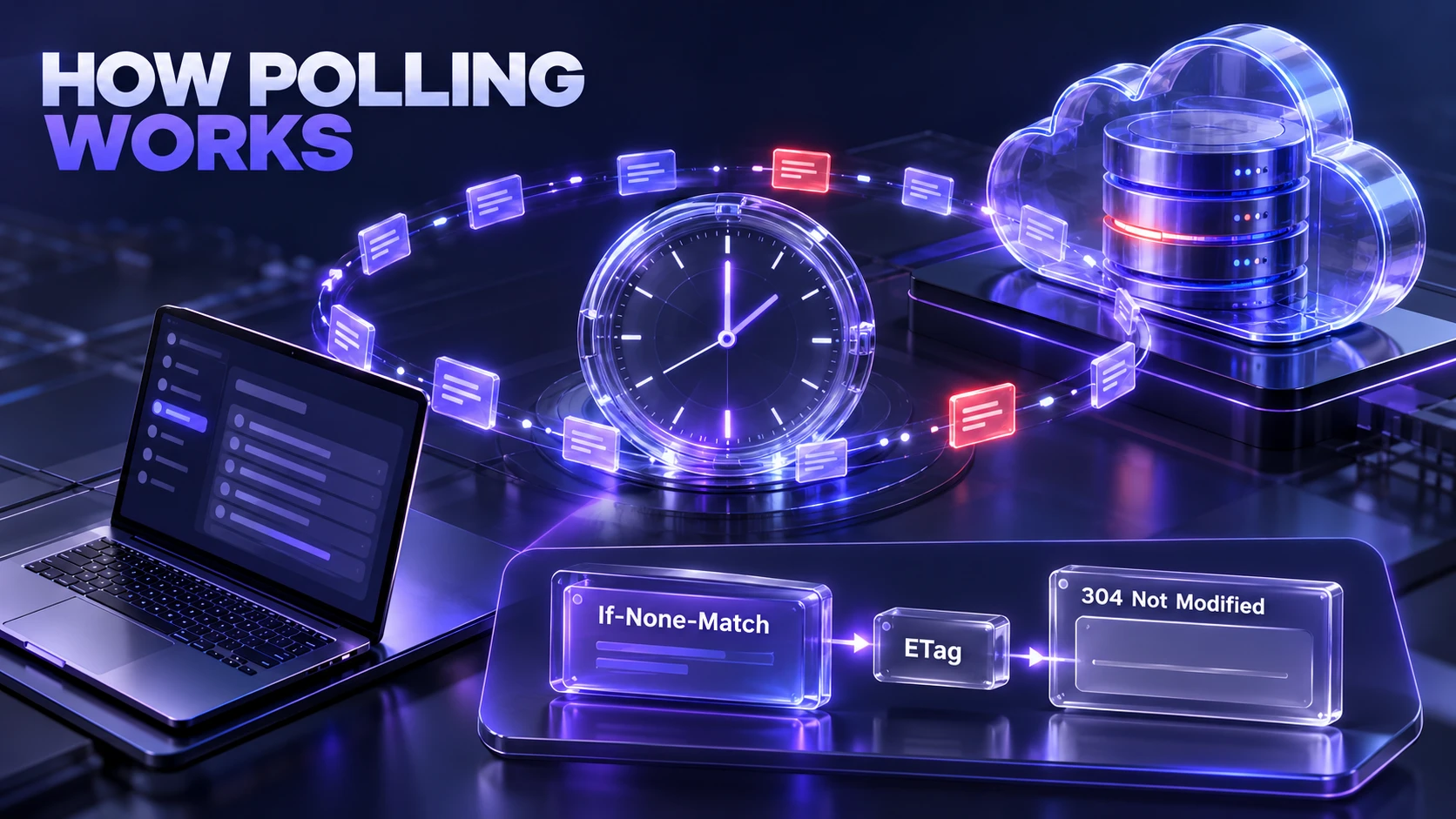
An application sets a polling interval and requests a resource or a list of recent changes. If the API supports filtering by timestamps, cursors, change tokens, or resource versions, the application can retrieve updates more efficiently. These features help reduce unnecessary requests and make synchronization easier to manage.
Without incremental change tracking, polling can repeatedly retrieve unchanged information, increasing data transfer, processing overhead, and pressure on API quotas. When an API supports conditional HTTP requests, ETags can help avoid downloading an unchanged resource. The HTTP ETag documentation explains how clients can use If-None-Match headers to check whether a resource has changed before receiving its full response.
Key Differences That Matter in Production
Both webhooks and polling can support reliable API integrations, but they operate differently and introduce different technical challenges. Comparing their latency, request volume, reliability, infrastructure requirements, and security controls helps developers select an approach that matches their application.
| Decision Factor | Webhooks | Polling |
|---|---|---|
| Communication Model | Push-based event notifications | Pull-based API requests |
| Update Latency | Often low, but depends on provider delivery | Primarily determined by polling interval |
| Request Volume | Generally follows event activity | Follows the configured schedule |
| Reliability | Depends on delivery policies, retries, and recovery mechanisms | Depends on scheduling, checkpoints, and change tracking |
| Failure Handling | Requires deduplication, replay planning, and event processing controls | Requires backoff, pagination, and checkpoint management |
| Security | Requires request verification and receiver protection | Requires secure credentials and outbound API access |
| Infrastructure | HTTPS receiver, potentially a queue and workers | Scheduler, API client, and state storage |
| Scalability | Must accommodate event spikes | Must manage request volume and API quotas |
| Best Use Cases | Notifications, automation, and event-driven workflows | Periodic synchronization, monitoring, and APIs without webhook support |
Use this comparison as a starting point, then evaluate the provider’s capabilities, API limits, compliance requirements, and expected traffic growth. The most suitable integration method is one your team can maintain securely and reliably as the application scales.
Webhooks vs Polling: A Practical Example
Consider an application that needs to detect updates from an external API. The application receives approximately 12 relevant changes per day.
If the application polls the API once every minute, it makes 1,440 requests per day, even when no data has changed. Assuming changes occur randomly between checks and requests finish promptly, the average detection delay is roughly 30 seconds, with a scheduled-check delay of up to 60 seconds.
With webhooks, the provider can send approximately 12 event notifications instead of the application making 1,440 scheduled requests. Webhook delivery may still involve retries, additional API calls, and background processing. The actual cost and speed therefore depend on the provider’s behavior and infrastructure.
| Measurement | Polling Every 60 Seconds | Webhooks |
|---|---|---|
| Scheduled API Checks Per Day | 1,440 | 0 |
| Example Relevant Changes Per Day | 12 | 12 |
| Update Detection | Usually within one polling interval | When the provider delivers the event |
| Additional Work | Pagination, rate-limit handling, and state tracking | Verification, deduplication, and event processing |
| Main Advantage | Predictable request schedule | Avoids repeated checks for unchanged data |
This simplified example shows why webhooks can be efficient for irregular updates. However, frequent event delivery, retries, and complex processing can change the cost comparison. Teams should measure actual request usage and processing load before making a final decision.
When Webhooks are the Better Choice
Webhooks are often preferred when applications need timely updates and the provider supports reliable event notifications. They work particularly well for automated workflows, payment notifications, order updates, and systems that need to react when specific events occur.
- Low latency requirements: Notifications and automation workflows often need updates quickly to provide a responsive user experience.
- Infrequent or unpredictable changes: Webhooks avoid repeated checks when nothing has changed, making them especially useful when events occur irregularly.
- Cost control: Reducing unnecessary outbound API requests can lower network usage and certain API-related costs, depending on the provider’s pricing and infrastructure requirements.
- Event-driven integrations: Webhooks let applications react to specific events without repeatedly requesting resource lists. However, providers may still need to send separate deliveries to individual subscribers, so high event volumes can create processing and infrastructure costs.
These advantages depend on a properly designed event receiver. Production implementations should support reliable queues, controlled retries, dead-letter handling, and safe event reprocessing. Without these protections, temporary failures or sudden traffic spikes can cause delays and inconsistent application data.
Webhook Design Requirements You Should Not Skip

Webhook consumers must treat incoming requests as untrusted input. Request authentication, payload validation, replay protection, and clearly defined processing rules help protect the integration from malicious requests and operational failures.
- Signature verification: Validate incoming webhook signatures using the authentication mechanism specified by the provider. Some platforms require verification against the original, unmodified request body and include timestamps to help detect replay attempts. Stripe’s webhook documentation provides an example of signature verification and secure event handling.
- Idempotency: Track processed event IDs or other provider-supported identifiers so duplicate notifications do not trigger the same business action multiple times.
- Fast acknowledgement: Verify the incoming request and hand the event to a durable processing system before returning a successful HTTP response. Keep the acknowledgement within the provider’s required timeout and perform expensive operations asynchronously.
- Event ordering: Do not assume webhook notifications arrive in the order they occurred. When order matters, use provider-supported versions, sequence information, or a fresh API lookup to determine the current resource state.
- Replay strategy: Support safe reprocessing and manual recovery procedures when events fail, applications experience outages, or historical records need to be reconciled.
Before deploying webhooks in production, test how the integration handles duplicate deliveries, invalid signatures, slow responses, temporary outages, and sudden traffic spikes. These tests help identify reliability problems before they affect users or connected services.
When Polling is the Better Choice
Polling is often the practical choice when an API does not support webhooks or when inbound connectivity is restricted. It can also simplify deployments where applications operate inside private networks and should not expose additional publicly reachable endpoints.
- Limited provider features: Some APIs provide only list and detail endpoints without supporting event notifications.
- Strict network policies: Outbound-only deployments can request updates without opening inbound routes for webhook delivery.
- Predictable workload needs: Configured intervals make it easier to estimate expected request frequency, although actual resource usage also depends on response sizes and processing costs.
- Simple operational model: Scheduling, controlled retries, and checkpoints can be straightforward to implement when data volumes and synchronization requirements are manageable.
Polling becomes more efficient when the API supports incremental synchronization through cursors, change tokens, or updated-since filters. Without these features, applications may repeatedly retrieve unchanged data and consume API quotas unnecessarily. Developers managing frequent requests should also understand API rate limits and HTTP 429 errors so they can control polling frequency and avoid unnecessary retries.
Polling Design Requirements You Should Not Skip
A reliable polling system requires more than a timer. It needs persistent state, careful pagination, error handling, and protection against excessive API requests. These controls become increasingly important as data volumes and synchronization requirements grow.
- Checkpointing: Persist the last successfully processed cursor, change token, or timestamp after completing the relevant processing work. When using timestamps, consider overlapping synchronization windows and deduplicating records so updates near polling boundaries are not missed.
- Backoff policy: When an API returns a rate-limit error, follow the provider’s retry instructions, including the HTTP
Retry-Afterheader when supplied. Use exponential backoff with jitter for appropriate transient failures, and limit repeated retry attempts. GitHub’s API rate-limit guidance explains how clients should respond to HTTP 403 and 429 rate-limit errors. - Pagination safety: Handle page boundaries consistently, especially when records are added, removed, or updated during synchronization. Prefer stable cursors or provider-supported snapshot mechanisms when available.
- Consistency strategy: Use provider-supported version identifiers or change tokens to detect updates accurately. Where supported, ETags and conditional HTTP requests can reduce unnecessary response data, but they do not replace reliable checkpoints or synchronization logic.
Production polling systems should be tested against realistic API response times, changing datasets, rate limits, and temporary service failures. Monitoring request counts, synchronization delays, and failed checkpoints helps teams identify inefficiencies before they become major operational problems.
Security and Compliance Considerations
Webhooks introduce security considerations around incoming HTTP requests, while polling concentrates more responsibility around API credentials and outbound connectivity. Both approaches need appropriate security controls, but their threat models and operational requirements differ.
For webhooks, prioritize signature verification, payload validation, replay protection, and request filtering where supported. For polling, focus on secure credential storage, least-privilege permissions, and audit logging. Both approaches require strong authentication and careful handling of external data. For additional guidance on protecting connected applications, review our article on API security risks and best practices.
Common Security Controls for Both Approaches
- Transport security: Use HTTPS and appropriately configured TLS to protect information exchanged between connected systems.
- Least privilege: Restrict API tokens, credentials, and application permissions to the specific operations required by the integration.
- Logging and traceability: Record event identifiers, request identifiers, error conditions, and processing outcomes while avoiding unnecessary exposure of sensitive data.
- Abuse protection: Apply suitable request limits, payload size restrictions, input validation, and resource controls to protect services and processing queues.
Security controls should be supported by documented operational procedures. Teams need clear instructions for responding to compromised credentials, failed authentication, provider configuration changes, and unexpected integration behavior.
Reliability and Operational Load
Reliability depends on how an integration handles retries, delays, duplicates, and partial failures. Webhooks require careful event processing and replay planning, while polling requires dependable scheduling and state management to avoid synchronization gaps.
Operational complexity differs between the two approaches. Webhooks require monitoring of event receivers, processing queues, failed deliveries, and retry workflows. Polling requires monitoring of scheduled jobs, API response times, pagination, and synchronization checkpoints. Effective observability helps engineering teams identify failures and understand their causes. Our comparison of observability vs monitoring explains how these practices support reliable system operations.
Operational Questions to Ask Before Deciding
- Observability readiness: Can your team trace an event or API request from its initial receipt to the final processing outcome?
- Recovery expectations: Can missed or failed updates be recovered after outages, deployments, or temporary provider failures?
- Volume variability: Could sudden traffic spikes require queues, concurrency limits, or additional processing capacity?
- Team ownership: Who is responsible for monitoring the integration, investigating failures, and responding when provider behavior changes?
Answering these questions often reveals the most important operational constraints. A method that appears technically efficient may become difficult to maintain if the organization lacks the infrastructure or expertise required to operate it reliably.
How to Choose the Right Method?
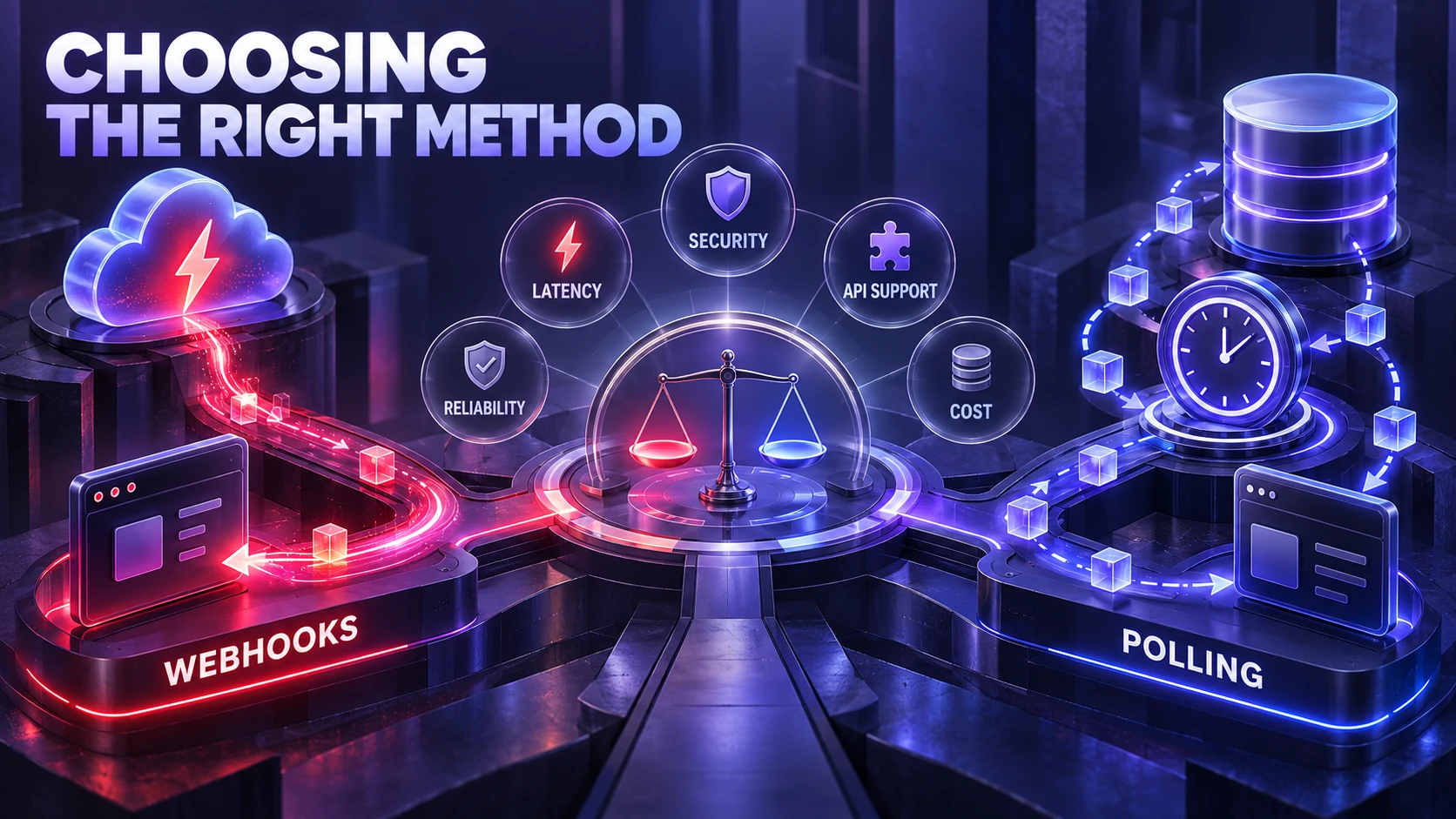
Choosing between webhooks and polling involves balancing freshness, reliability, security, provider capabilities, and operational costs. Many established applications use different integration methods for different data sources rather than relying on one approach for every workflow.
- Define freshness requirements: Determine the maximum acceptable delay between a change occurring and your application detecting it. Consider whether updates must arrive within seconds or whether scheduled synchronization is sufficient.
- Check provider capabilities: Confirm whether the API supports webhooks, which event types are available, how failed deliveries are handled, and whether incremental synchronization features exist.
- Assess your infrastructure: Determine whether your application can securely receive webhook requests or needs to rely on scheduled outbound API calls. Evaluate gateway configuration, network access, worker availability, and traffic management. For a broader understanding of incoming API traffic and routing, read our comparison of API gateway vs load balancer.
- Design for failure first: Plan how the application will handle duplicate events, missed updates, API outages, retry attempts, and synchronization recovery before implementing the integration.
- Validate cost and limits: Compare API request quotas, expected event volumes, network usage, compute requirements, queue processing, and database operations under realistic conditions.
After selecting an integration method, document the assumptions behind the decision. Provider capabilities, event schemas, traffic patterns, and business requirements can change over time. Periodically reviewing these assumptions helps keep the architecture suitable as the application evolves.
Hybrid Patterns That Work Well
Webhooks and polling are not mutually exclusive. Some applications benefit from combining event-driven notifications with periodic synchronization to improve data freshness and reduce the risk of missed updates.
- Webhook plus periodic reconciliation: Use webhooks for timely notifications and run a lower-frequency polling job to verify that important records remain consistent with the provider’s current data.
- Polling bootstrap followed by webhooks: Use polling or a bulk API operation to retrieve existing records during initial setup, then use webhooks to detect subsequent changes. Include a recovery process for events that occur during the transition.
- Webhook-triggered API refresh with reconciliation: Treat incoming notifications as signals to retrieve the latest resource state from the provider. Combine this approach with periodic reconciliation when the application needs additional protection against missed events.
Webhook ingestion can also use asynchronous processing queues to smooth traffic spikes and isolate failures. Although queue-based processing is not itself a combination of webhooks and polling, it is an important supporting design for reliable event-driven integrations.
Hybrid architectures introduce additional implementation and monitoring requirements, but they can reduce synchronization gaps when designed carefully. Shared identifiers, consistent checkpoint management, and deduplication rules help prevent the same updates from being processed incorrectly through multiple paths.
Conclusion
Webhooks are a strong option when applications need timely updates and can support a secure, resilient event receiver. Polling is often more practical when applications require control over request timing, operate in outbound-only environments, or depend on APIs that do not provide event notifications.
The best choice between webhooks and polling depends on update frequency, acceptable latency, provider capabilities, API limits, security requirements, and operational resources. Webhooks are often suitable for event-driven updates, while polling works well for scheduled synchronization and APIs without event delivery. A hybrid approach is worth considering when fast notifications and periodic consistency checks are both necessary.
Frequently Asked Questions
Are Webhooks Always Faster Than Polling?
No. Webhooks often provide faster updates because they notify applications when events occur instead of waiting for scheduled checks. However, provider queues, network delays, and delivery problems can slow notifications. Polling may detect a change sooner if a webhook is delayed and a scheduled API request happens first. Polling more frequently can reduce detection delays but may increase API usage, infrastructure costs, and rate-limit pressure.
Do Webhooks Guarantee Delivery?
No. Webhook delivery guarantees depend on the provider. Some platforms automatically retry failed notifications, while others require developers to handle redelivery manually or through additional code. For example, GitHub’s failed webhook delivery documentation explains its recovery options when notifications do not reach an endpoint successfully. Applications should handle duplicate events, maintain processing records, and use reconciliation when missed updates could cause data inconsistencies.
How Do I Reduce Polling Costs Without Missing Updates?
Use provider-supported features such as cursors, updated-since filters, change tokens, and ETags where available. Follow API rate-limit instructions and apply exponential backoff with jitter when appropriate. Store synchronization checkpoints only after successful processing, and use overlapping time windows with deduplication when timestamp-based filtering could miss updates near polling boundaries. These practices can reduce unnecessary data transfers while improving synchronization reliability.
Can I Use Webhooks and Polling Together?
Yes. Many applications use webhooks for timely notifications and periodic polling to confirm that important records remain synchronized. This approach is useful when webhook deliveries can be missed, delayed, or processed incorrectly. However, both methods should share a consistent state-management and deduplication strategy to avoid processing the same change multiple times.