

Connected apps move data across services, devices, and partners, which makes the API layer a prime target for abuse. Strong protection starts with knowing how APIs fail in predictable ways and how to prevent those failures with simple, repeatable controls.
What API Security Means In Practice?
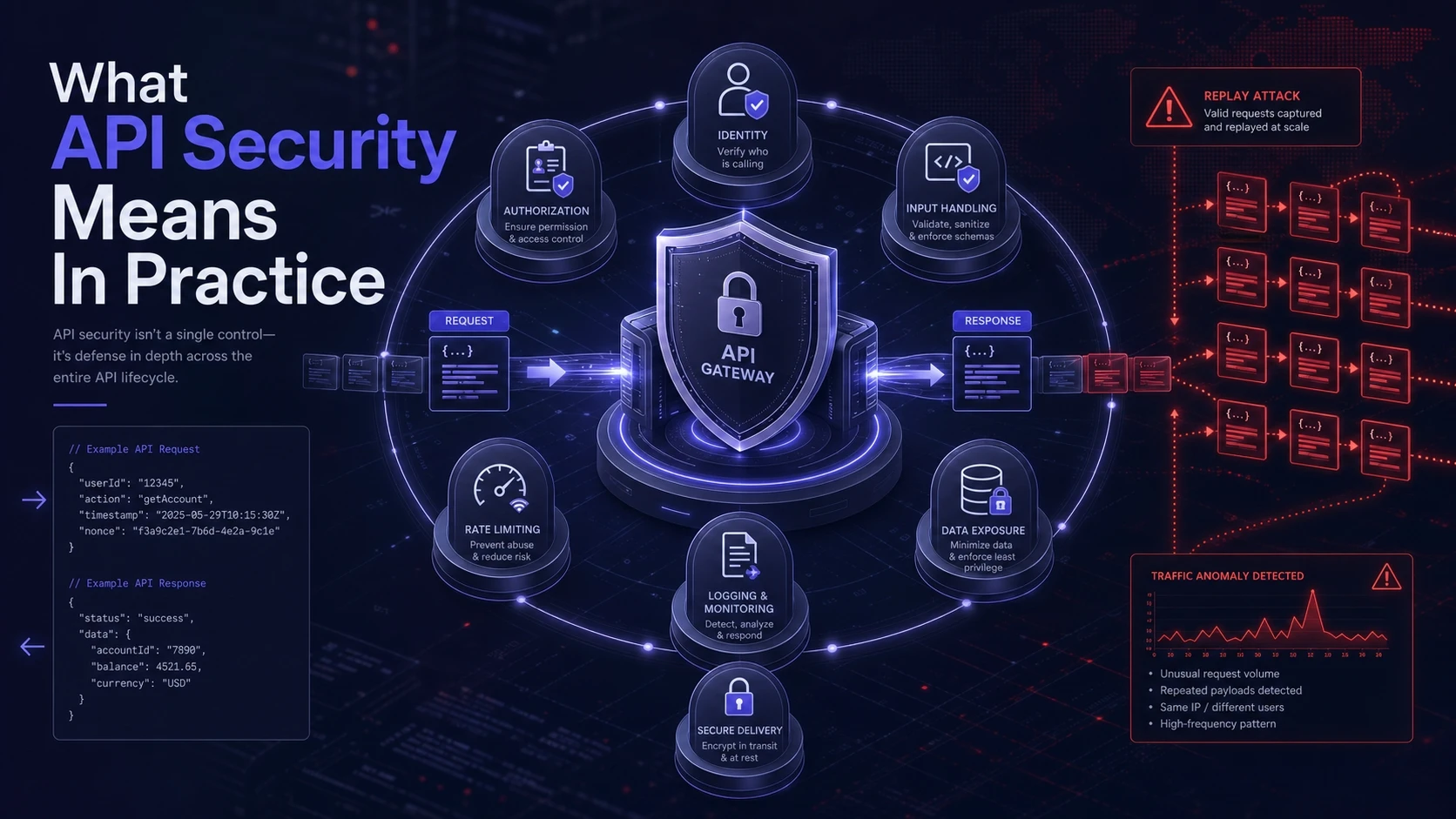
API security is the set of safeguards that keep an API available, correct, and confidential under real traffic and hostile conditions. It covers identity, authorization, input handling, data exposure, rate limiting, logging, and secure delivery.
APIs differ from traditional web pages because requests are structured, automated, and easy to replay at scale. A small authorization mistake or leaky response field can turn into a high-impact incident quickly.
Authentication Risks
Authentication proves who is calling the API. Weak or inconsistent authentication allows attackers to access endpoints with stolen keys, leaked tokens, or bypasses in custom logic.
Common issues include long-lived tokens, shared credentials, missing multi-factor controls for sensitive operations, and accepting tokens intended for a different audience. Misconfigured JWT validation is a frequent problem when teams skip checking issuer, audience, signature, and expiry.
- Overly permissive token lifetime: Long expirations increase the blast radius of a leak and make revocation harder.
- Weak client secret handling: Secrets stored in mobile apps or front-end code are easy to extract and reuse.
- Broken token validation: Skipping signature checks or accepting none algorithms enables trivial impersonation.
Authentication gets safer when tokens are short-lived, secrets stay server-side, and validation is strict and consistent across services.
Authorization Risks
Authorization controls what an authenticated caller can do. Many API breaches happen because an identity is verified but permissions are enforced inconsistently or too late.
Object-level authorization failures occur when the API trusts user-provided identifiers and returns or updates data that belongs to someone else. Function-level failures occur when sensitive endpoints are exposed to roles that should not have access.
- Broken Object Level Authorization: IDs in paths or bodies are accepted without confirming ownership at the data layer.
- Broken Function Level Authorization: Admin or internal actions are reachable by standard accounts due to missing role checks.
- Over-broad scopes: Tokens grant access to more resources than needed, which enables lateral movement.
Reliable authorization uses deny-by-default rules, checks permissions on every request, and enforces ownership at query time rather than in UI code.
Excessive Data Exposure
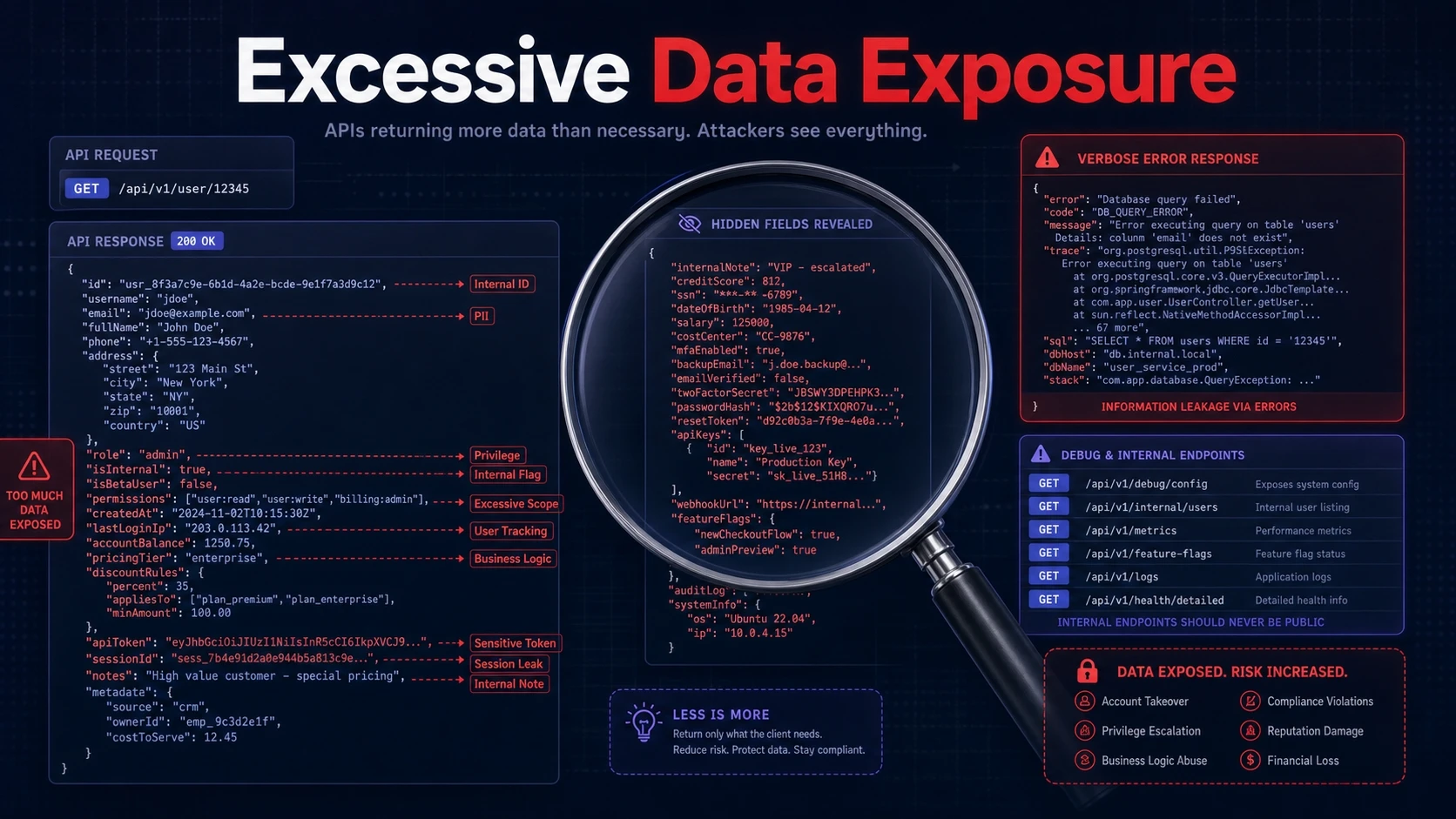
APIs often return more fields than a client needs. Even if the UI hides those fields, the response may still include sensitive attributes such as internal identifiers, roles, pricing rules, or personal data.
Data exposure also happens through verbose error messages, debug endpoints, and metadata that reveals architecture details. Tight response contracts and explicit allowlists reduce accidental leakage.
- Overly large response payloads: Returning full records encourages scraping and makes privacy compliance harder.
- Verbose errors: Stack traces and SQL details help attackers refine exploits.
- Unmasked sensitive fields: Tokens, secrets, and identifiers leak through logs and API responses.
Response shaping should be intentional, with clear schemas and field-level controls tied to user roles.
Injection And Unsafe Input Handling
APIs accept structured input that is often assumed to be safe. Attackers exploit weak validation to inject SQL, NoSQL operators, command arguments, or template payloads.
Risk increases when APIs pass user input into queries, filters, search expressions, or downstream services without strict type and format checks. Parameterized queries and allowlisted validation are more dependable than blacklists.
- SQL and NoSQL injection: Untrusted filters and query fragments manipulate database operations.
- Command injection: User-supplied strings reach shell or system calls through utility endpoints.
- Server-side request forgery: URL fetch features allow access to internal services and metadata endpoints.
Input handling improves when validation is centralized, schemas are enforced, and dangerous transformations are avoided across microservices.
Rate Limiting And Abuse Controls
APIs can be abused without exploiting a bug. Credential stuffing, token guessing, enumeration, and scraping can exhaust resources or expose data through repeated legitimate calls.
Without rate limits, quotas, and anomaly detection, even basic endpoints can become denial-of-service vectors. Abuse controls should consider user, IP, token, device fingerprint, and endpoint sensitivity.
- Missing throttling: Unlimited requests enable brute force attempts and large-scale scraping.
- No cost-aware limits: Expensive operations are treated the same as cheap reads, leading to resource exhaustion.
- Weak enumeration defenses: Predictable IDs and broad search endpoints reveal records at scale.
Effective controls combine rate limiting with pagination caps, result size limits, and progressive challenges for suspicious traffic.
Security Misconfiguration In Gateways And Services
Misconfiguration is a leading cause of API exposure. It includes open debugging endpoints, permissive CORS rules, missing TLS enforcement, and inconsistent policies across environments.
Gateway rules that are different from service-level enforcement create gaps. If the gateway blocks something but the service does not, internal access paths or alternate routes can bypass protections.
- Permissive CORS: Broad origins and credentials settings enable browser-based token abuse.
- Inconsistent auth enforcement: Some endpoints require tokens while others rely on network location.
- Unrestricted methods: Allowing PUT or DELETE where only GET is required increases risk.
Standardized configurations and automated checks reduce drift between staging and production.
Third Party And Supply Chain Exposure
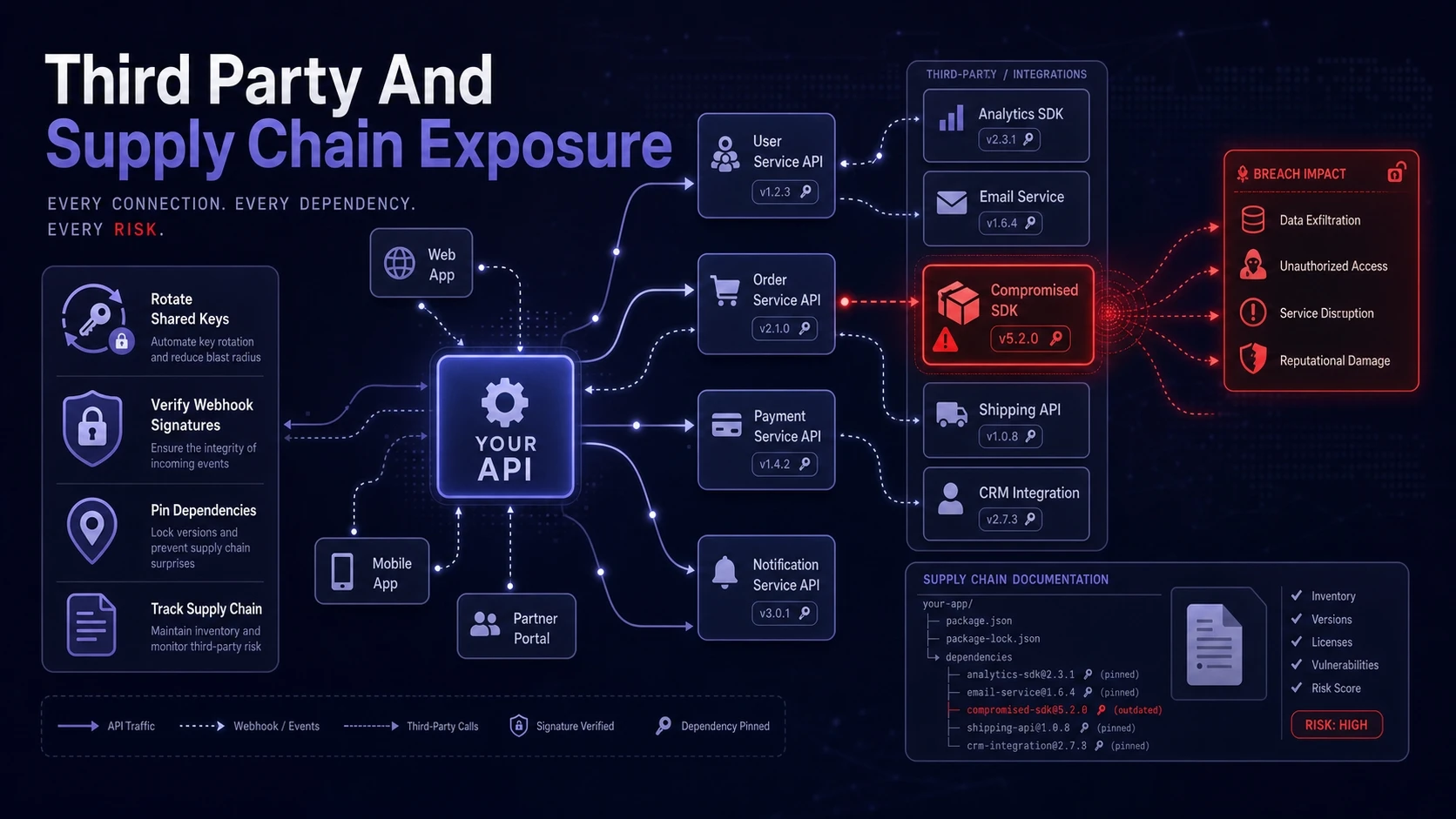
Connected apps often rely on external APIs, SDKs, and integrations. A compromise in a dependency can introduce malicious behavior, leak tokens, or degrade integrity without touching your core code.
Risk also appears when partner integrations use shared keys, broad permissions, or outdated webhook verification. Clear contracts, key rotation, and scoped access keep relationships safer.
- Leaky integration secrets: Shared keys across tenants increase the impact of a single breach.
- Unverified webhooks: Missing signature verification allows forged events and unauthorized actions.
- Unpinned dependencies: Unexpected library updates can change behavior or introduce vulnerabilities.
Supply chain hygiene is strongest when every integration has least privilege, documented ownership, and continuous review.
Logging Monitoring And Incident Readiness
Many teams discover API issues only after customer impact. Without structured logs and monitoring, it is difficult to prove what happened, limit damage, and recover quickly.
Logs should capture authentication outcomes, authorization decisions, request identifiers, and rate limit events. Sensitive data should be redacted to avoid turning logs into a secondary leak source.
- Low-visibility failures: Authorization denials and unusual request patterns are not aggregated or alerted on.
- Over-logging secrets: Tokens and personal data appear in logs and tracing systems.
- Weak incident runbooks: Teams lack a clear process to revoke keys, rotate secrets, and isolate services.
Preparedness improves when alerts are tied to user impact and clear actions exist for containment and recovery.
Common Risks And Practical Fixes
The most effective improvements focus on a few high-leverage controls that reduce multiple risks at once. A consistent checklist helps teams build safer APIs while shipping features.
| Risk Area | What Typically Goes Wrong | Practical Fix |
|---|---|---|
| Authentication | Long-lived tokens and weak validation | Short expirations, strict JWT checks, server-side secret storage |
| Authorization | Ownership not enforced on objects and actions | Deny by default, check permissions on every request, enforce at query time |
| Data Exposure | Responses include extra fields and verbose errors | Schema allowlists, response shaping, safe error handling |
| Abuse Controls | No throttling or weak anomaly detection | Rate limits, quotas, pagination caps, endpoint-specific policies |
After these basics are stable, deeper work such as threat modeling and continuous security testing becomes easier and more predictable.
Implementation Checklist For Teams
A short checklist makes it easier to standardize API security across services, teams, and environments. It also reduces debates during reviews by setting clear expectations.
- Define a consistent identity model: Standardize how users, services, and partners authenticate across all APIs.
- Enforce least privilege: Use scopes and roles that map to real operations, and remove unused permissions quickly.
- Validate input with schemas: Reject unexpected fields and enforce types, ranges, and formats at the edge.
- Shape responses intentionally: Return only what the client needs and avoid exposing internal metadata.
- Apply rate limits by endpoint: Add stricter controls on login, search, exports, and expensive writes.
- Secure webhooks and callbacks: Verify signatures, use replay protection, and restrict outbound destinations.
- Harden configurations: Lock down CORS, require TLS, and keep non-production settings out of production.
- Log decisions and monitor abuse: Alert on spikes in errors, unusual patterns, and repeated authorization failures.
When these items are embedded in design reviews and CI checks, risk drops without slowing delivery.
Conclusion
API security basics come down to a few themes: verify identity, enforce authorization everywhere, minimize exposed data, validate inputs, and control abuse. Most incidents are not caused by exotic exploits, but by small gaps repeated across endpoints and services.
Start with the highest-risk endpoints, standardize controls in shared libraries or gateways, and keep monitoring tight. Consistency is the difference between a secure connected app and one that fails under pressure.
Frequently Asked Questions
What Is The Biggest API Security Risk For Most Teams?
Authorization mistakes tend to cause the most damage because valid users can access data they should not see. Fixing it requires ownership checks at the data layer and consistent role enforcement on every endpoint.
How Do I Know If My API Is Exposing Too Much Data?
Review responses against a documented schema and verify that each field is required for the client experience. If sensitive attributes appear in logs, traces, or error messages, reduce payloads and add field-level allowlists.
Do Rate Limits Really Help If An Attacker Has Valid Credentials?
Yes, because many attacks rely on volume, including scraping, enumeration, and credential stuffing. Rate limits, quotas, and anomaly detection reduce the speed and scale of abuse while buying time for detection and response.