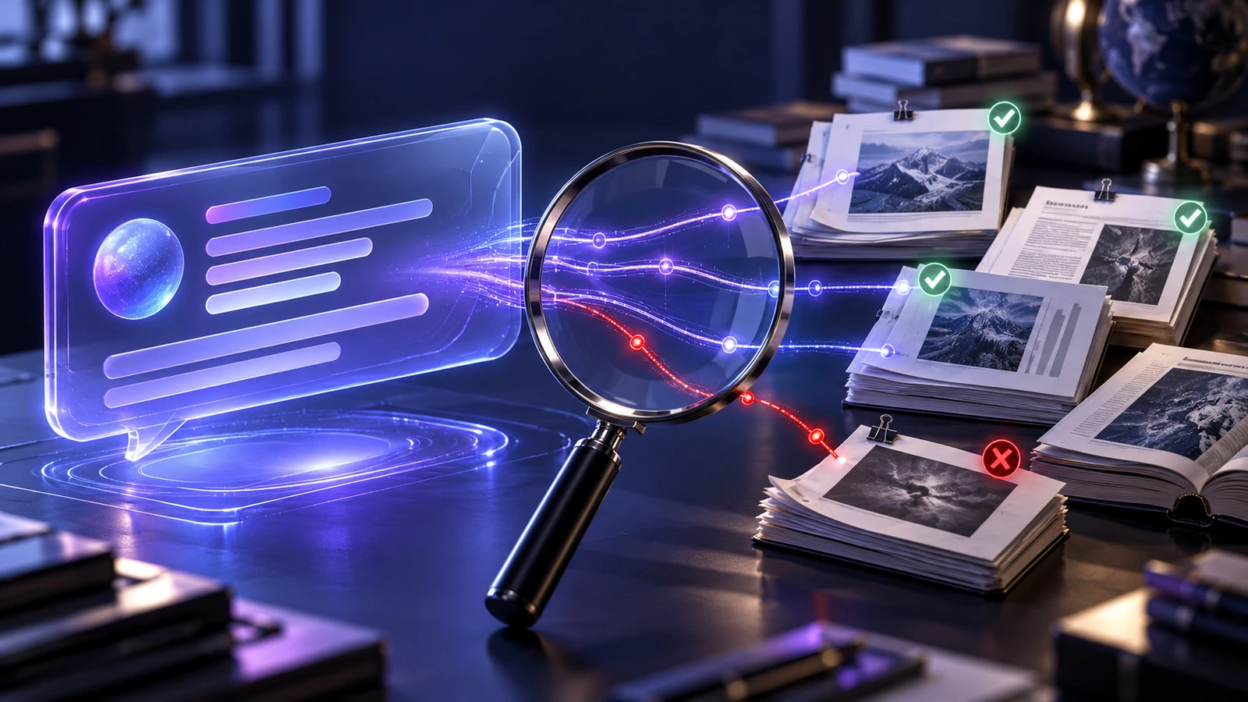
AI can produce confident answers that look complete, even when the underlying evidence is weak. Checking whether an AI response is backed by real sources is an important skill for anyone using AI for research, writing, decision-making, or technical work. A reliable verification process involves checking whether cited documents exist, confirming that they support the exact claims, reviewing their credibility, and identifying outdated or misleading evidence. The goal is not to distrust every AI response, but to verify important information before using it.
What It Means for an AI Answer to Be Source-Backed?
A source-backed answer ties key claims to traceable evidence you can inspect. That evidence should exist, match what the AI says, and be relevant to the question. A list of citations is not enough if the citations are unrelated, outdated, or misquoted.
Strong evidence often comes from original research, official documentation, published standards, government records, and reliable datasets. However, the most suitable source depends on the claim being checked. Official documentation is useful for verifying software features, while original research is generally more appropriate for evaluating scientific findings. Secondary sources, including news reports and explanatory articles, can provide helpful context but should accurately represent the original evidence. For medical, legal, financial, or security-related decisions, readers should apply stricter verification standards and consult qualified professionals when appropriate.
Common Ways AI Answers Go Wrong with Sources
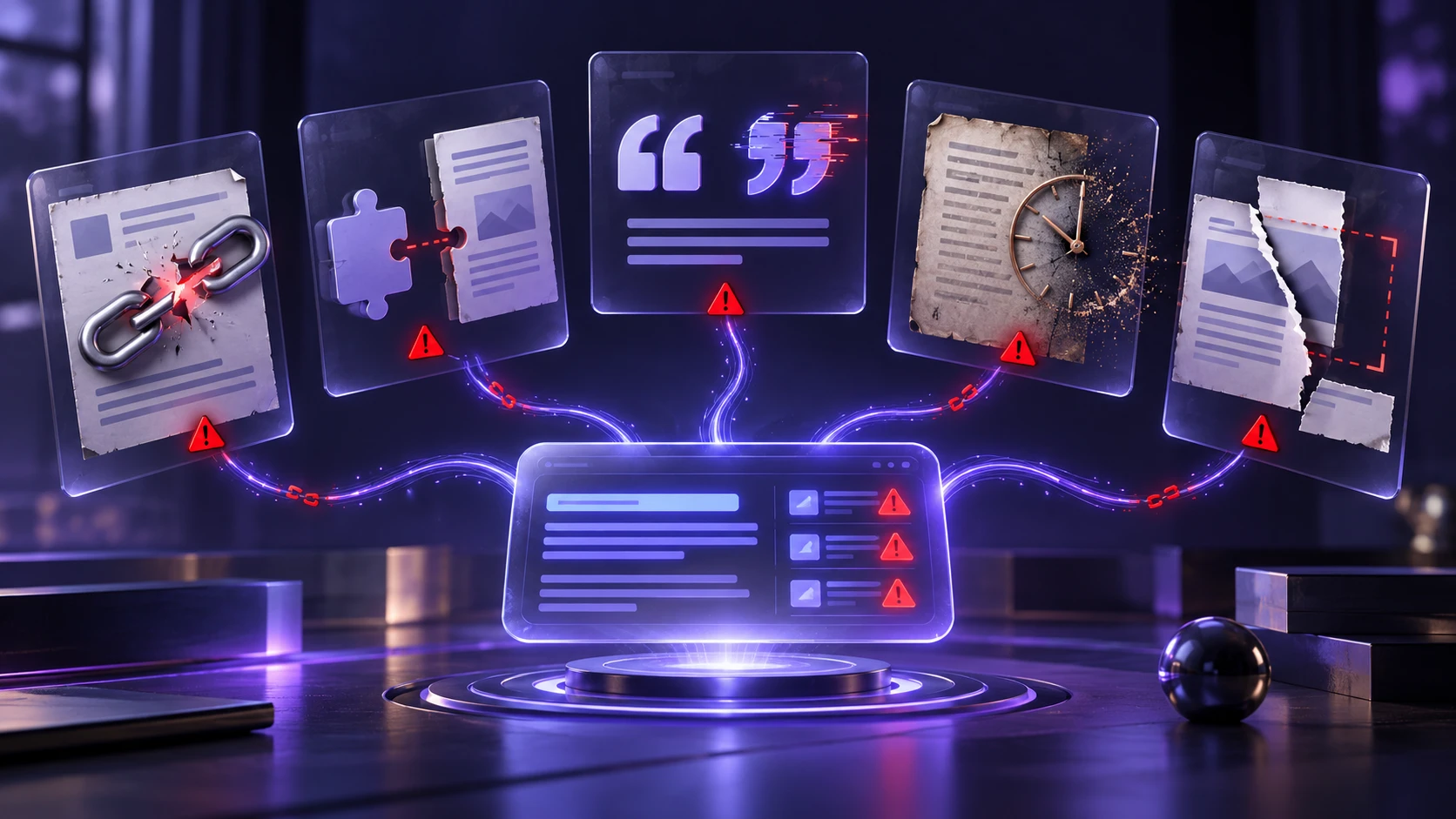
Understanding typical failure patterns helps you audit quickly. Many issues come from summarization errors, missing context, or invented references. Some problems are subtle and can slip through if you only skim.
These problems are recognized in official AI risk research. The National Institute of Standards and Technology explains in its generative AI risk profile that generative AI systems can produce confident but inaccurate information, including fabricated citations. This is why readers should verify the evidence behind important claims instead of relying on an answer’s confident wording.
- Fabricated citations: The AI provides an author, title, or link that does not exist or cannot be verified.
- Wrong source for the claim: The cited material is real, but it does not support the specific statement.
- Quote drift: The AI paraphrases a source in a way that changes its meaning, strength, or scope.
- Outdated information: The source was correct at the time, but policies, versions, or guidance have since changed.
- Context stripping: A source is used without its assumptions, limitations, or conditions.
Once you recognize these patterns, you can focus your checks on the claims most likely to be wrong.
These issues are closely related to AI hallucinations, where a system produces information that appears believable but lacks factual support. Our guide explaining why AI hallucinations happen and how to reduce wrong answers explores the causes of these errors and practical ways to reduce them.
Start By Identifying Claims That Need Evidence
Not every sentence needs a citation. Facts with consequences should be verified first, especially anything that is numerical, legal, medical, security-related, or time-sensitive. Also verify any claim that would be surprising if it were wrong.
Split the answer into claim types, then decide what proof is appropriate. A definition needs a reputable reference, a statistic needs an original dataset or study, and a best practice needs documentation or well-supported guidance from credible authorities.
- Factual claims: Names, dates, thresholds, and technical specifications.
- Causal claims: Statements that one action leads to a specific outcome.
- Comparative claims: Claims that one tool, method, or approach is better than another.
- Procedural claims: Steps that must be followed to comply, configure, or troubleshoot.
This triage keeps verification manageable without reducing rigor.
Check Whether the Sources Actually Exist
Start by confirming that each cited source actually exists. Search for its exact title, author, publisher, publication date, or document identifier using a search engine, academic database, or official publisher website. If the exact title produces no results, try searching for the author and distinctive keywords separately. Some legitimate documents may be archived, renamed, or unavailable through ordinary search results. If you still cannot confirm the publication through reliable records, classify the citation as unverified rather than automatically assuming it was fabricated.
For standards or laws, confirm the issuing body and the official publication page. For academic work, confirm the journal, DOI, and author list. For software documentation, confirm it is on the official domain and matches the product and version being discussed.
Readers can use Crossref Metadata Search to check whether an academic publication’s title, authors, and DOI match registered bibliographic records. For technical standards, the IETF Datatracker helps locate RFC documents and review their publication information. These resources can help establish whether a reference is genuine, but readers must still examine the original document to determine whether it supports the AI-generated claim.
- Verify document identifiers: Check whether the DOI, RFC number, case number, bill number, or standard identifier leads to the expected document. Compare its title, authors, publication details, and version with the AI-generated citation. Remember that a working identifier confirms a traceable record, not the accuracy or quality of the document’s conclusions.
- Confirm publisher credibility: Prefer official agencies, established journals, and vendor documentation that are appropriate to the claim.
- Check for duplicates: A citation that appears only on scraper sites is a warning sign that calls for further investigation.
Existence checks are fast and often catch the most serious issues early.
Confirm the Source Supports the Exact Claim

After confirming that a source exists, open the original document and locate the passage supporting the AI-generated claim. For research studies, check the methods, results, and conclusions rather than relying only on an abstract or third-party summary. Use the document’s search function to find important terms, figures, or statistics. Then compare the AI’s wording with the original evidence, paying attention to sample size, limitations, conditions, and uncertainty. A real citation does not automatically prove that the statement attached to it is accurate.
Pay attention to qualifiers like may, under certain conditions, or within a defined sample. AI can compress these qualifiers away, making a limited conclusion sound universal. If the claim is strong, the support must be equally strong.
- Match wording and strength: A cautious statement does not support a definitive claim.
- Match scope: A finding in one region, population, or software version does not generalize automatically.
- Match time frame: Older sources may not apply to current guidance or current product behavior.
This is where many plausible-looking answers fail, even when the citations are real.
Example: Checking Whether an AI Citation Supports a Claim
Consider an AI-generated answer that makes the following statement:
According to NIST, generative AI systems always produce incorrect information.
The answer might cite NIST’s Artificial Intelligence Risk Management Framework: Generative Artificial Intelligence Profile. The document is real, but that does not mean the AI’s statement is accurate.
A proper verification involves three checks:
- Confirm the source exists: Locate the original NIST publication and verify its title and publication details.
- Read the relevant section: Review Section 2.2, which discusses confabulation, commonly called AI hallucination. The document describes the possibility of AI producing incorrect information, but does not claim that every generated answer is wrong.
- Compare the claim with the evidence: The word always makes the AI’s statement stronger than the original evidence supports.
The original claim should therefore be classified as unsupported.
A more accurate statement would be:
Generative AI systems can produce confident but incorrect information, including fabricated facts and citations.
This example demonstrates why verifying a source’s existence is only the first step. The wording, scope, and certainty of the AI-generated claim must also match what the evidence actually establishes.
Evaluate Source Quality and Relevance
Not all sources deserve equal weight. A peer-reviewed paper, official standard, or regulator guidance may offer stronger evidence than an unsupported personal blog, depending on the question. Relevance matters too, since a high-quality source can still be the wrong source for a particular claim.
Use quick credibility checks such as author expertise, editorial oversight, funding disclosures, and whether the source is primary or secondary. Also consider whether the source is current enough for the topic, particularly in cybersecurity, AI, and fast-moving product ecosystems.
When an AI answer cites an unfamiliar technology website, evaluate the publisher before relying on its information. Our guide to checking whether a tech website is trustworthy explains how to examine author credibility, editorial standards, website authenticity, and the reliability of technical recommendations. These checks are especially useful when an AI response relies on third-party articles rather than official documentation.
| Source Type | Best Use | What to Check |
|---|---|---|
| Official Documentation and Standards | Verifying technical requirements, product behavior, and specifications | Product version, publication status, and updates |
| Peer-Reviewed Research | Evaluating scientific findings and research-based claims | Study methods, sample size, limitations, and corrections |
| Government and Regulatory Guidance | Checking official rules, policies, and regulatory requirements | Jurisdiction, effective dates, and amendments |
| Original Datasets and Reports | Verifying statistics, measurements, and reported findings | Data collection methods, definitions, and reporting periods |
| News Articles and Industry Blogs | Understanding recent developments and broader context | Original sources, editorial standards, and factual accuracy |
When evaluating published research, readers should also check whether the original paper has been corrected, updated, or retracted. The Crossmark service provides publication-status information for participating publishers. However, not every publication uses Crossmark, and the absence of a correction notice does not guarantee that a study is accurate. Always examine the publisher’s official record and any available updates.
Once you grade the sources, you can decide whether the answer is good enough to use or needs deeper confirmation.
Use Cross-Checking to Reduce Single-Source Risk
A single citation may be accurate but still leave out important context. Cross-checking involves comparing a claim against other relevant evidence, preferably from sources that independently collected or evaluated the information. However, two websites repeating the same press release do not represent two independent confirmations. For high-impact claims involving health, finance, security, or legal requirements, look for additional evidence and investigate any meaningful disagreements before making decisions.
Look for agreement on key points and differences in assumptions, methods, or edge cases. If credible sources disagree, the AI answer should reflect uncertainty rather than presenting one side as settled. When the topic is new, a lack of agreement can itself be important information.
- Check independent evidence: For important or disputed claims, compare sources that do not merely repeat the same underlying report.
- Prefer primary material: Trace back from summaries to the original document, dataset, or announcement.
- Note disagreements: Differences often point to assumptions, methods, or limitations that need to be stated.
Cross-checking takes longer, but it is a valuable way to validate complex claims when combined with direct source review and relevant expertise.
Ask the AI for Citations in a Verifiable Format
If the response lacks citations, ask for them in a format you can verify quickly. Request exact titles, authors, publication dates, and stable identifiers such as DOI, RFC, or official document numbers. If you need direct support, ask for short quotations and page or section references, then confirm those details in the original source.
A useful approach is to ask the AI to separate claims directly supported by evidence from general explanations, assumptions, and interpretations. Request a clear citation for each important factual claim, including a document title, link, publication date, and relevant section when available. You can also instruct the AI to identify any references it could not verify. However, asking for citations does not guarantee their accuracy. Readers must still open the cited documents and confirm the evidence independently.
- Request pinpoint references: Page, section, or paragraph locations reduce ambiguity.
- Separate facts from interpretation: This clarifies which parts need extra scrutiny.
- Ask for independent supporting evidence: Request additional sources when a claim is complex, disputed, or important to a decision. One authoritative primary source may be sufficient for a straightforward factual question, while high-impact or contested claims often require further confirmation.
Structured citation requests can make review faster and more organized, but they do not replace direct verification.
Some AI applications use retrieval-augmented generation (RAG) to locate relevant documents before generating responses. Our comparison of RAG vs fine-tuning explains how retrieval-based systems work and why access to external documents can help support AI-generated answers. However, retrieved information can still be outdated, incomplete, or incorrectly interpreted, so citation checking remains important.
Example Prompt for Checking AI Sources
You can use the following prompt when asking an AI assistant to provide evidence for its answer:
Review the following answer and identify its important factual claims.
For each claim:
- Provide the original source title and publisher.
- Include a working source link, if available.
- Identify the relevant page or section.
- Explain whether the source directly supports the claim.
- Highlight outdated information, missing context, or uncertainty.
Separate verified claims from interpretations and unsupported statements. Do not invent citations. Clearly state when you cannot access or verify a source.
This prompt helps organize the review, but it does not independently prove that any citation is genuine.
Spot Red Flags That Suggest Weak or Invented Support
Several warning signs can suggest weak sourcing. Watch for citations that look plausible but are hard to locate, or references that are overly generic. Also be cautious when the AI provides precise numbers without a clear dataset or methodology.
Another red flag is when an answer uses an authoritative tone while avoiding specifics you could verify. A good source-backed answer makes verification easier by naming the document, providing context, and acknowledging limits. When in doubt, lower your confidence until the relevant evidence has been checked.
- Unverifiable citations: References containing convincing titles, author names, dates, or publication details that cannot be matched to reliable publisher records.
- Untraceable statistics: Percentages and counts without study details or a named dataset.
- No limits stated: Claims presented as universal when conditions matter.
- Inconsistent terminology: Shifting definitions that can hide mismatched sources.
Red flags do not prove the answer is wrong, but they justify a deeper check.
Build a Simple AI Answer Verification Workflow
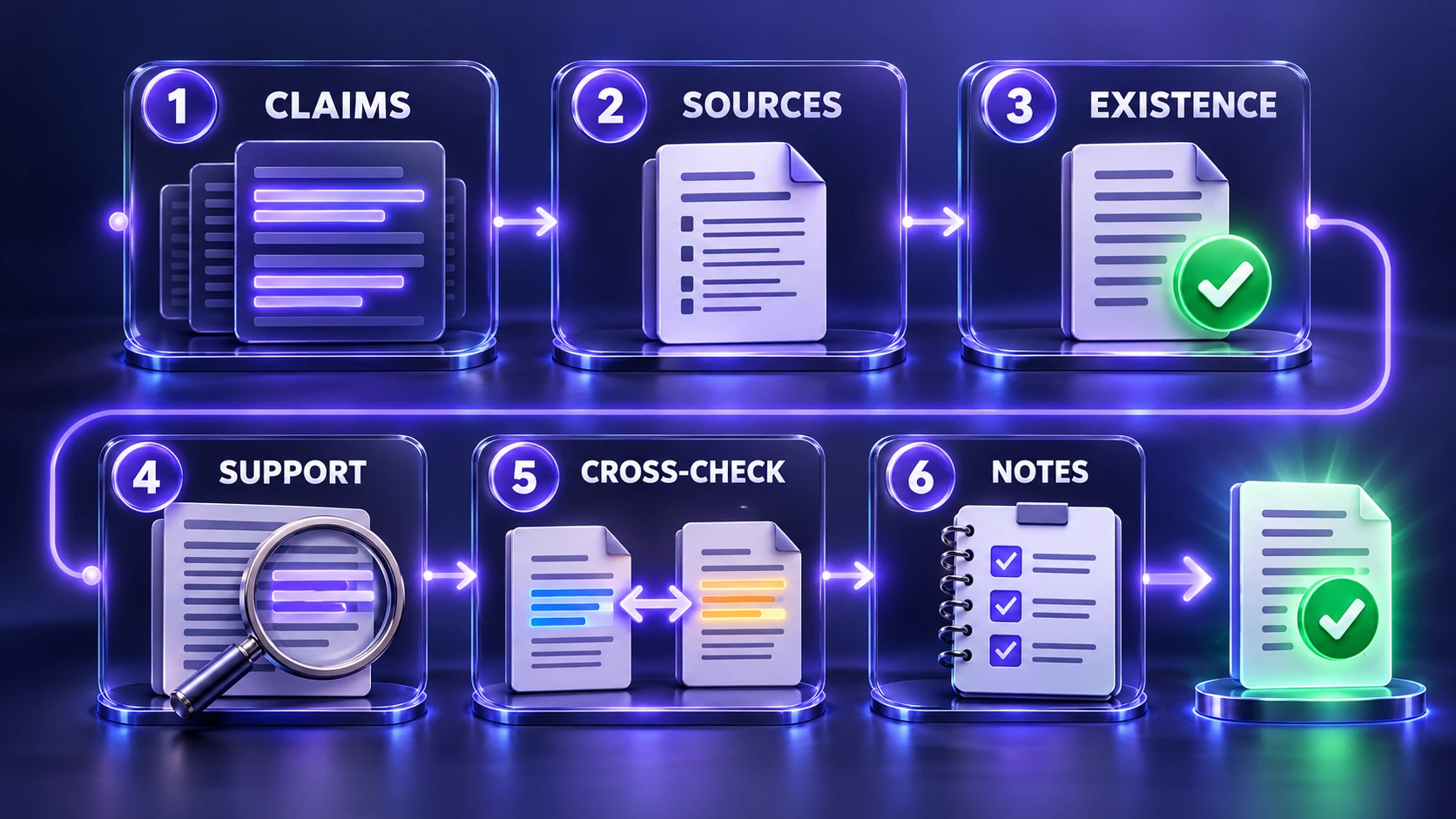
Consistency beats intensity. A repeatable workflow helps you verify quickly without missing key steps. Over time, it also improves how you prompt AI because you learn what information you need upfront.
- Extract key claims: Pull out the statements that would change a decision if wrong.
- Demand traceable sources: Collect titles, authors, dates, and identifiers you can look up.
- Verify existence: Confirm that each source is real and identify its publisher.
- Verify support: Find the relevant passage and check wording, scope, and conditions.
- Cross-check critical points: Seek additional independent evidence for high-impact or disputed claims.
- Document what you confirmed: Save notes on where the supporting evidence appears for later review.
With practice, this workflow becomes fast enough for daily use.
Verification can also become easier when AI systems receive reliable information before generating an answer. This approach is related to context engineering, which involves organizing relevant documents, instructions, and constraints so AI models can produce more useful responses. Providing trustworthy context can reduce unsupported assumptions, although important claims should still be checked against their original sources.
Conclusion
Checking whether an AI answer is backed by real sources is about traceability, accuracy, and relevance. Confirm that the sources exist, verify that they support the specific claims, and cross-check anything that carries real consequences. Treat confident language as presentation, not proof.
When you adopt a simple verification workflow, AI becomes more useful and less risky. Clear prompts can help organize evidence, but independent checking is what makes the result dependable. Combining citation checks, careful source evaluation, and awareness of uncertainty helps you make better-informed decisions.
Frequently Asked Questions
Can An AI Provide Citations That Look Real But are Not?
Yes. AI systems can generate plausible-looking references that do not exist or do not match the claim. Verify that a cited document is real and published by an identifiable source, then check whether it actually supports the statement. If you cannot locate it through reliable channels, treat the citation as unverified.
How Many Sources Should I Check Before Trusting An AI Answer?
It depends on the risk and complexity of the topic. For low-stakes background information, verifying one strong primary source may be enough. For high-stakes or disputed decisions, check additional independent evidence and investigate disagreements on the key points. Multiple links repeating one original report should not be counted as independent confirmation.
What Should I Do When Sources Exist But Do Not Support the AI Claim?
Treat the claim as unsupported and either remove it or rewrite it to match what the sources actually establish. Ask the AI to identify the relevant passages if that helps organize the review, but confirm the wording yourself in the original material. For important topics, consult authoritative documents and qualified experts when necessary.