


RAG and fine-tuning solve different problems in applied generative AI. The right choice depends on what must change in the system knowledge, behavior, reliability, and operating cost. This guide breaks down both approaches in practical terms and helps you pick a path that matches your AI project goals.
What Retrieval Augmented Generation Does?
Retrieval augmented generation, often shortened to RAG, pairs a base model with a search layer. The system retrieves relevant passages from your data and provides them to the model at request time. The model then answers using the retrieved context rather than relying only on its internal training.
RAG is strongest when your AI output must stay grounded in fast-changing or proprietary information. It also supports citations, audit trails, and controlled knowledge boundaries when implemented carefully. Many teams choose RAG first because it avoids model retraining and can be iterated quickly.
Core Building Blocks Of RAG
A production RAG stack combines data preparation, indexing, retrieval, and generation. Each part affects accuracy and cost. Small design choices, such as chunk size or reranking, often matter more than switching models.
- Content Pipeline: Data ingestion, cleaning, deduplication, and chunking to make text retrievable.
- Embeddings And Index: Vector representations stored in a database for similarity search.
- Retriever And Reranker: First-pass retrieval followed by relevance refinement to reduce noise.
- Prompt Assembly: A structured context window with instructions, retrieved passages, and constraints.
- Guardrails And Logging: Policies for sensitive data, output filtering, and traceability of sources.
Once these pieces are stable, improvements become measurable through offline evaluation and controlled online tests.
What Fine-Tuning Changes?
 Fine-tuning updates a model’s parameters to better match your desired output style, task pattern, or domain language. Instead of retrieving external knowledge at runtime, you train the model to behave differently based on a dataset of high-quality examples. This can reduce prompt complexity and improve consistency for narrow tasks.
Fine-tuning is most useful when the problem is behavioral rather than informational. It is also valuable when latency must be low and you want fewer tokens in prompts. However, it adds a training lifecycle and introduces governance work around data, evaluation, and model versioning.
Common Fine-Tuning Goals
Fine-tuning typically targets repeatable output structures and stable requirements. It can improve adherence to a rubric, reduce format errors, and increase correctness in domain-specific patterns. The gain depends heavily on dataset quality and the base model.
- Formatting And Schema Adherence: More reliable JSON, templates, and constrained outputs.
- Tone And Brand Voice: Consistent style across responses without long prompts.
- Task Specialization: Better performance on classification, extraction, and summarization variants.
- Domain Terminology: Improved handling of internal acronyms and technical language.
These benefits show up when the target behavior is stable and the training set reflects real requests.
Key Differences That Matter In Production
Both approaches can produce high-quality answers, but the tradeoffs differ. RAG primarily changes what the model can access at runtime. Fine-tuning primarily changes how the model responds even when no external context is provided.
The most common production issues are not abstract model debates. They show up as missing facts, outdated answers, inconsistent formatting, slow responses, and unclear auditability.
| Decision Factor | RAG | Fine-Tuning |
|---|---|---|
| Best When Knowledge Changes | High fit because retrieval can refresh daily | Lower fit because training updates take cycles |
| Best When Behavior Must Change | Medium fit through prompts and policies | High fit through learned patterns |
| Latency Sensitivity | Can be higher due to retrieval and reranking | Often lower at inference |
| Governance And Traceability | Strong with source logging and controlled corpora | Harder to attribute outputs to sources |
Use the table to anchor priorities before you commit engineering time. A clear decision rubric also helps stakeholders align on risk and operating constraints.
Data Readiness And Maintenance Requirements
RAG and fine-tuning fail for different data reasons. RAG fails when the content is messy, fragmented, or poorly chunked, which leads to weak retrieval. Fine-tuning fails when the dataset is small, inconsistent, or includes conflicting labels and instructions.
RAG maintenance is usually continuous. You keep improving chunking, metadata, access controls, and evaluation. Fine-tuning maintenance is episodic and tied to model releases, drift, and new training data cycles.
RAG Data Work That Often Gets Underestimated
Good retrieval depends on structure and metadata. Without it, the model receives irrelevant context and answers confidently with the wrong grounding. Teams should plan for data quality work early rather than treating it as a final polish.
- Deduplication And Canonical Sources: Prevents retrieval from returning contradictory passages.
- Chunk Strategy And Overlap: Balances completeness with precision in retrieved text.
- Metadata And Filters: Supports access control, product scoping, and time-based retrieval.
- Document Lifecycle: Handles expired policies and superseded documentation safely.
When these are handled well, RAG becomes a dependable knowledge layer rather than a brittle demo.
Fine-Tuning Data Work That Often Gets Underestimated
Fine-tuning quality is driven by labels and consistency. If training samples are noisy, the model learns the noise. A smaller but carefully curated set often outperforms a larger set with mixed instructions.
- Instruction Consistency: Reduces conflicting behaviors across similar prompts.
- Coverage Of Edge Cases: Improves reliability where failures are costly.
- Holdout And Regression Sets: Prevents improvements in one area from breaking another.
- Privacy And Licensing Checks: Ensures training data can be used safely and repeatedly.
These practices support trust and repeatability across model versions.
Cost, Latency, And Scaling Considerations
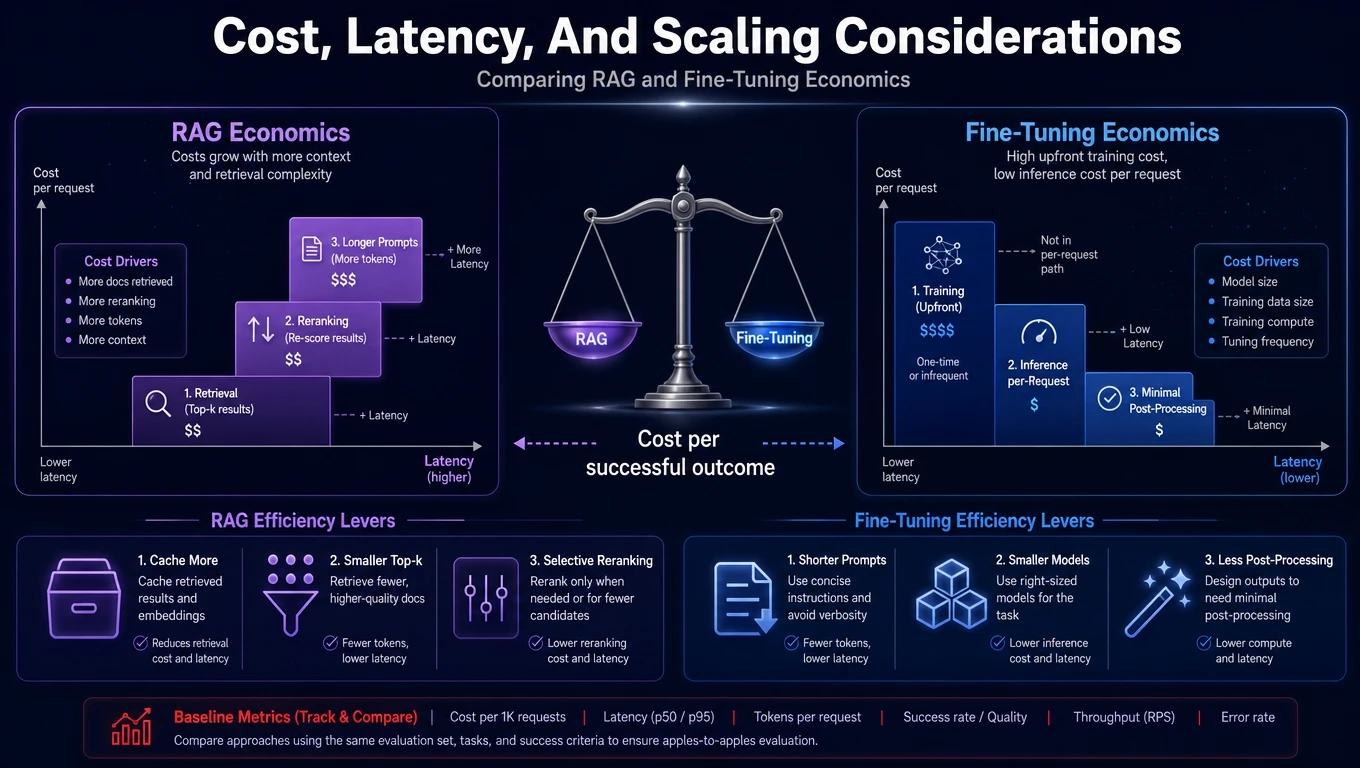 RAG adds runtime components that impact cost per request. Retrieval, reranking, and larger prompts increase latency and token usage. Fine-tuning adds upfront training cost and ongoing evaluation, but inference can be cheaper if prompts become shorter.
Scaling also looks different. RAG scales with your index, caching strategy, and retrieval throughput. Fine-tuning scales with model hosting, version management, and the need to retrain when behavior requirements change.
Where Each Approach Typically Saves Money
RAG can save money by reducing the need for repeated training and by allowing selective access to knowledge. Fine-tuning can save money by reducing context size and lowering failure rates in structured tasks. The best savings come from measuring end-to-end cost per successful outcome rather than cost per token.
- RAG Efficiency Levers: Caching frequent queries, smaller top-k retrieval, and selective reranking.
- Fine-Tuning Efficiency Levers: Shorter prompts, smaller models, and reduced post-processing.
These levers become clearer once you have baseline metrics for latency, success rate, and rework.
Accuracy, Hallucinations, And Trust
RAG can reduce hallucinations by anchoring answers to retrieved text, but only if retrieval is correct. If retrieval returns irrelevant passages, the model still produces plausible but incorrect statements. Fine-tuning can improve task correctness and formatting, but it does not guarantee factual grounding unless the knowledge is already in the model.
Trust also involves explanations, auditability, and safe handling of sensitive data. RAG naturally supports showing sources and enforcing document-level permissions. Fine-tuning requires stronger governance because learned behavior can be hard to attribute and inspect.
Evaluation Metrics That Help You Decide
Choose metrics that match your real acceptance criteria. A single accuracy number rarely captures business risk. Combining automated checks with human review provides better coverage for complex outputs.
- Retrieval Quality: Recall and precision of retrieved passages against labeled relevance sets.
- Answer Groundedness: Degree to which outputs are supported by retrieved context.
- Format Validity: Rate of outputs that pass schema checks without repair.
- Safety And Policy Compliance: Rate of refusals, redactions, and sensitive data leakage.
With these metrics in place, the decision between RAG and fine-tuning becomes evidence-driven.
When A Hybrid Approach Makes Sense?
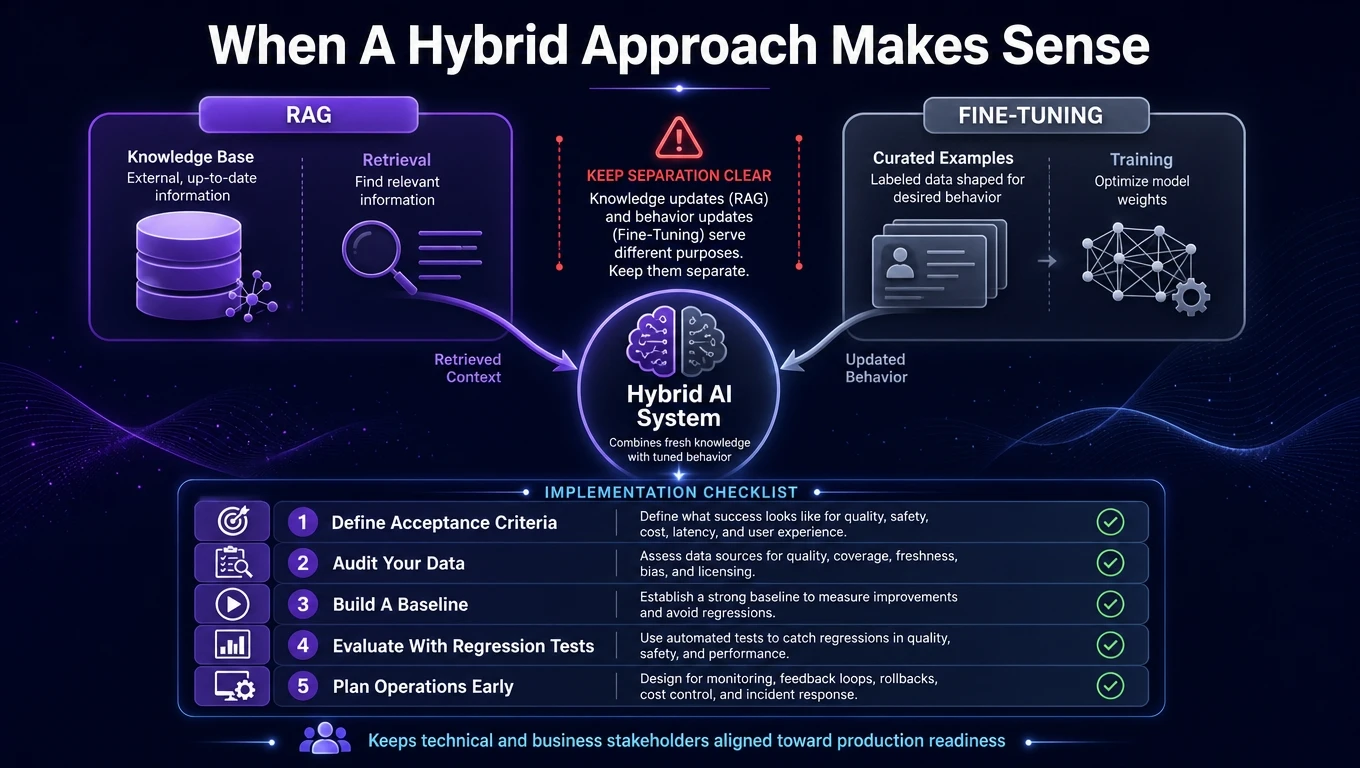 Many strong systems use both. RAG supplies fresh and proprietary knowledge, while fine-tuning enforces consistent behavior and output structure. This combination can reduce prompt size and improve grounded responses, especially in support, search, and analytics workflows.
A hybrid approach needs discipline. You still need a clear separation between knowledge updates handled by retrieval and behavior updates handled by training. Without that separation, teams end up debugging multiple moving parts at once.
Implementation Checklist For Making The Right Choice
A clean decision process prevents wasted cycles and conflicting expectations. Start by identifying whether the primary risk is missing knowledge or inconsistent behavior. Then validate the approach with a small but realistic slice of traffic and data.
- Define Acceptance Criteria: Set measurable thresholds for correctness, groundedness, latency, and formatting.
- Audit Your Data: Confirm you have clean documents for retrieval or curated examples for training.
- Build A Baseline: Implement a minimal version and measure failure modes before optimizing.
- Evaluate With Regression Tests: Track improvements against a stable holdout set and policy checks.
- Plan Operations Early: Decide how you will monitor drift, update content, and roll back safely.
This checklist keeps technical and business stakeholders aligned while the system moves toward production readiness.
How Tech Bonafide Can Support RAG And Fine-Tuning Projects?
Tech Bonafide focuses on practical AI engineering and implementation, including LLM integrations, data pipelines, and performance tuning. If your project needs grounded answers over internal documentation, a well-designed RAG architecture with strong evaluation can deliver reliable outcomes. If you need consistent outputs for extraction, classification, or strict formats, fine-tuning guidance and dataset design can reduce failure rates.
Teams also benefit from an end-to-end view that includes governance, privacy controls, and monitoring. Aligning these parts early avoids rework when systems move from prototype to production.
Conclusion
Choose RAG when your AI project depends on current, proprietary, or auditable knowledge. Choose fine-tuning when the main requirement is consistent behavior, structure, and task specialization. When both knowledge and behavior matter, a hybrid design often delivers the best balance of accuracy, cost, and maintainability.
Start with measurable acceptance criteria, build a baseline, and iterate based on observed failures. That approach keeps the decision grounded in outcomes rather than preference.
Frequently Asked Questions
Which Is Better For Reducing Hallucinations?
RAG can reduce hallucinations when retrieval is accurate and the system enforces grounded answers. Fine-tuning can improve consistency but does not automatically add factual grounding. The best results come from measuring groundedness and tightening retrieval quality.
Can Fine-Tuning Replace RAG For Proprietary Knowledge?
Fine-tuning is not ideal for frequently changing internal knowledge because updates require retraining cycles and strict data governance. RAG is usually the better fit for proprietary content because you can update the corpus without changing model weights. This also supports permissioning and source traceability.
How Do I Decide If I Need A Hybrid Approach?
A hybrid approach is helpful when you need both reliable access to internal knowledge and consistent output structure. RAG handles knowledge freshness and citations, while fine-tuning improves formatting and policy adherence. You can confirm the need by comparing failure modes in a baseline RAG system and a baseline prompted model.