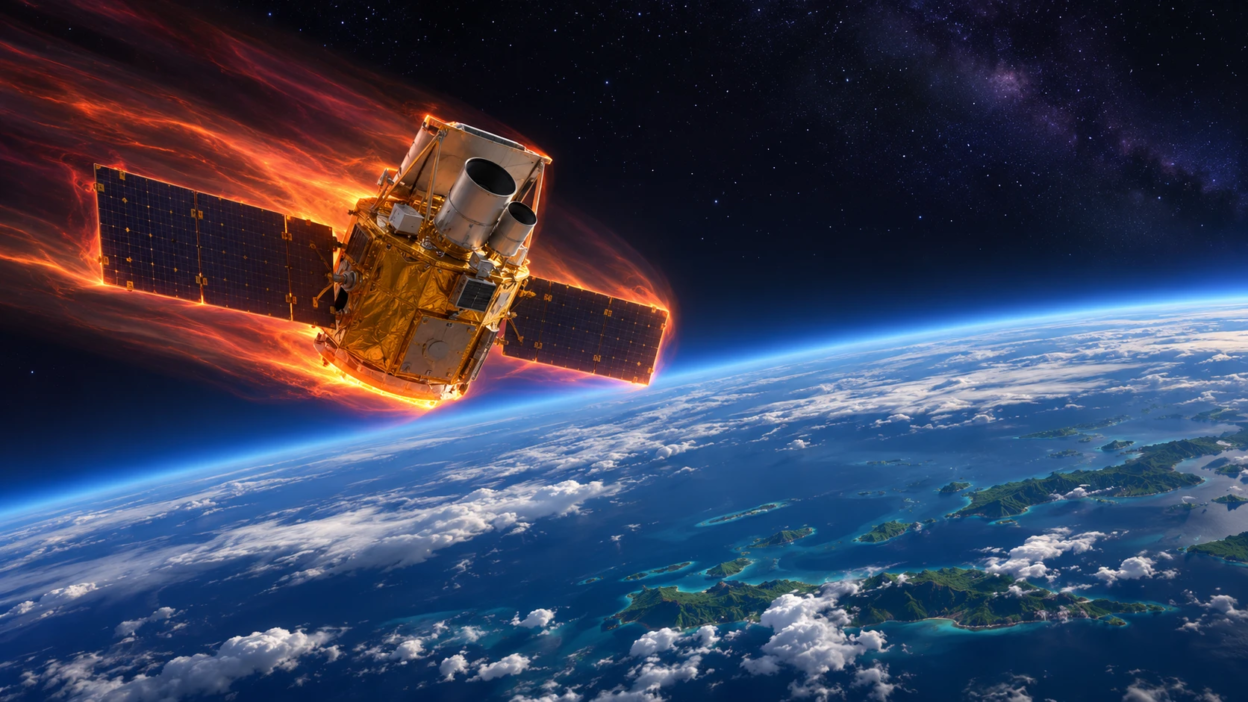
NASA’s Neil Gehrels Swift Observatory re-entered Earth’s atmosphere over North Sumatra, Indonesia, on November 4, 2026, nearly 22 years after its launch. The spacecraft had spent more than two decades studying powerful explosions in space, but an attempted robotic rescue could not extend its mission.
Swift launched on November 20, 2004, with a planned two-year mission to study gamma-ray bursts, some of the universe’s most powerful explosions. The satellite continued collecting scientific data for more than two decades, far exceeding its original mission lifetime. NASA renamed the observatory in 2018 to honor Neil Gehrels, its first principal investigator.
According to NASA’s official re-entry confirmation, the U.S. Space Force recorded Swift entering Earth’s atmosphere at 7:39 a.m. EST (12:39 UTC) on November 4, 2026. The spacecraft re-entered over the North Sumatra region of Indonesia, at approximately 3.4 degrees north latitude and 98.6 degrees east longitude.
The spacecraft weighed approximately 3,200 pounds (1,450 kilograms). NASA expected most of it to burn up during atmospheric re-entry, although some components might have survived. The confirmed re-entry location does not establish where any surviving debris landed, and NASA’s published confirmation did not identify a verified ground-impact site.
Swift’s return to Earth followed a failed rescue mission involving NASA and private space technology company Katalyst Space Technologies. The company developed a robotic spacecraft called LINK to reach Swift, attach itself to the satellite, and move it into a higher orbit.
Katalyst launched LINK on July 3, 2026, but communication interruptions and spacecraft orientation-control problems disrupted the rescue attempt. According to NASA’s report on the Swift boost mission, LINK did not capture or raise Swift into a higher orbit. The mission instead shifted toward demonstrating spacecraft servicing technologies. LINK itself re-entered Earth’s atmosphere on September 25, 2026.
Without a successful rescue, Swift continued losing altitude. The observatory had no onboard propulsion system to raise its orbit, and increased solar activity caused Earth’s upper atmosphere to expand, creating additional drag. A similar physical process was involved in the orbital decay of a Russian Rassvet satellite in 2026, although the two spacecraft had different missions and circumstances.
Swift completed its final scientific observation on October 20, 2026. By then, the spacecraft had descended to approximately 171 miles (275 kilometers) above Earth, where increased atmospheric drag made stable telescope operations impossible. Swift entered safe mode, and its operations team at Penn State sent a command that ended the mission ahead of re-entry.
During its nearly 22-year career, Swift used three scientific instruments to observe gamma-ray bursts and other changing cosmic events. According to NASA’s summary of Swift’s scientific achievements, the observatory detected more than 2,000 gamma-ray bursts and studied more than 1,400 supernova explosions. Its research also helped scientists investigate black holes, active galaxies, comets, and asteroids.
One of Swift’s most important abilities was detecting sudden explosions and quickly sharing their locations with other observatories. This allowed telescopes around the world to investigate events that might otherwise disappear before scientists could study them.
Swift’s unsuccessful rescue demonstrates both the potential and the challenges of robotic satellite servicing. Future spacecraft could help extend satellite missions by raising their orbits or performing repairs. However, these operations require precise navigation, reliable communication, and stable spacecraft orientation. NASA said the LINK mission still provided valuable technical experience that could support future commercial satellite servicing efforts.
Swift’s uncontrolled re-entry highlights the potential risk of spacecraft fragments surviving their journey through the atmosphere. This differs from the danger of abandoned satellites and other debris remaining in orbit, where they can threaten active spacecraft. TechBonafide previously reported on a Russian military satellite breakup and the resulting space debris concerns. Both issues show why space agencies and private companies need better plans for managing spacecraft at the end of their missions.
Although Swift is no longer operating, its scientific observations remain available for future research. NASA says the mission’s public archive contains approximately 12 terabytes of data, including more than 1.5 million images from its Ultraviolet/Optical Telescope. Scientists can continue using these observations to study cosmic explosions, distant galaxies, and other astronomical events.
Swift’s re-entry closes a highly productive chapter in NASA’s space research. Its scientific achievements and unsuccessful rescue attempt highlight two priorities for future space missions: developing reliable ways to extend satellite lifetimes and improving how spacecraft are managed when they reach the end of their operations.