


AI model quantization reduces the numeric precision used to store weights and run math inside neural networks. By moving from higher precision formats like FP32 to lower precision like INT8, a model becomes smaller, uses less memory bandwidth, and often runs faster on the same hardware. The tradeoff is that lower precision can introduce rounding error, so good quantization focuses on speed gains without unacceptable accuracy loss.
What Model Quantization Means?
Neural networks are mostly large collections of numbers. Those numbers represent learned weights, intermediate activations, and sometimes cached states such as attention keys and values. Quantization changes how those numbers are represented so each value takes fewer bits.
FP32 uses 32 bits per value, FP16 uses 16, and INT8 uses 8. Cutting precision can cut model size nearly in half or more, and it can reduce the amount of data moved between memory and compute units. That shift is a major reason smaller models run faster after quantization.
Why Smaller Models Run Faster?
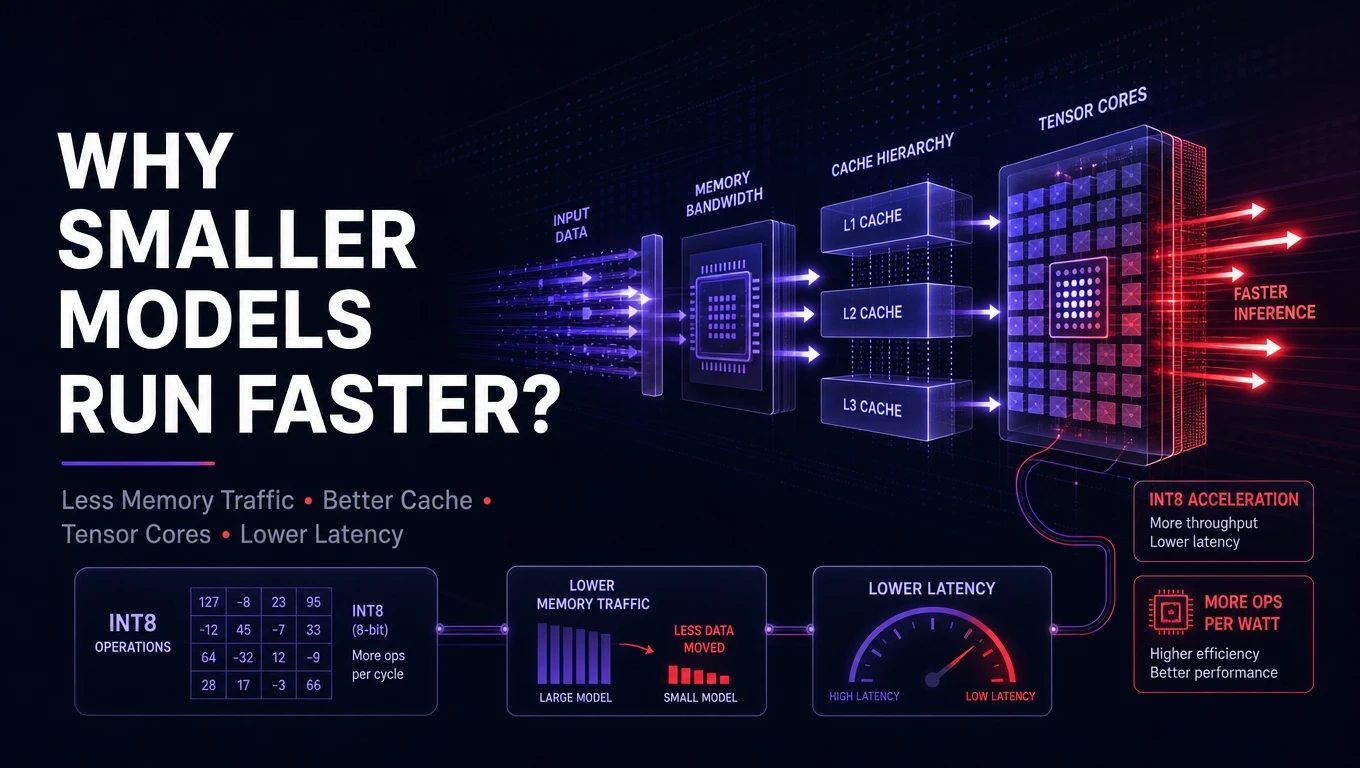
Speedups from quantization come from multiple bottlenecks, not only raw arithmetic throughput. Many inference workloads are limited by memory bandwidth, cache behavior, and how efficiently the hardware can schedule matrix multiplications. Quantization improves all three when it is supported end to end.
- Less memory traffic: Smaller weights and activations mean fewer bytes fetched from RAM and cache, which reduces stalls.
- Better cache utilization: More parameters fit in cache, increasing reuse during attention and feed-forward layers.
- Faster tensor cores and vector units: Many CPUs and GPUs accelerate INT8 and FP16 operations with higher throughput than FP32.
- Lower latency at batch size one: Reduced data movement often helps interactive workloads where batching is limited.
These benefits stack, but only when the runtime and kernels truly use low precision math rather than converting back to FP16 or FP32 internally.
Common Quantization Types
Quantization approaches differ in when and how they reduce precision. Some are applied during training, while others are applied after training with calibration. The right choice depends on accuracy tolerance, deployment hardware, and the model architecture.
Post Training Quantization
Post training quantization converts a trained model to lower precision without retraining. It often uses a calibration dataset to estimate activation ranges, then chooses scales and zero points for each tensor or channel.
This method is popular because it is quick and cheap. Accuracy can be very close to the original model for many tasks, but some models are sensitive and may need more careful calibration.
Quantization Aware Training
Quantization aware training simulates quantization during training so the model learns weights that are robust to rounding. It usually produces better accuracy than post training methods at the same bit width.
It costs more because it requires training time and stable training pipelines. When accuracy must be preserved tightly, this approach is often the safest route.
Dynamic Quantization
Dynamic quantization keeps weights quantized but quantizes activations on the fly at runtime. It can be effective for transformer layers and recurrent components, especially on CPU deployments.
It is easier to apply than full static quantization, but runtime quantization overhead can reduce gains in some setups.
Bit Widths And Precision Choices
Not all quantization is INT8. Many production stacks use FP16 or BF16 for accelerators because they reduce memory and improve throughput with very low risk. INT8 can deliver larger gains, but it demands stronger kernel support and more careful calibration.
Lower than INT8, such as INT4, can shrink memory significantly and speed up throughput on supported hardware. The risk is higher quantization error, and not every layer tolerates it equally. Mixed precision is common, keeping sensitive layers in higher precision while compressing the rest.
| Precision | Typical Size Reduction | Common Deployment Fit |
|---|---|---|
| FP16 | About 2x smaller than FP32 | GPU inference with low accuracy risk |
| BF16 | About 2x smaller than FP32 | Training and inference with wider dynamic range |
| INT8 | About 4x smaller than FP32 | CPU and edge inference with strong kernel support |
| INT4 | About 8x smaller than FP32 | Large model serving where memory is the limit |
Choosing precision should follow your real bottleneck. If GPU memory is tight, INT8 or INT4 may unlock larger batch sizes. If latency is limited by kernel overhead, FP16 with fused kernels may win.
Accuracy And Quality Tradeoffs
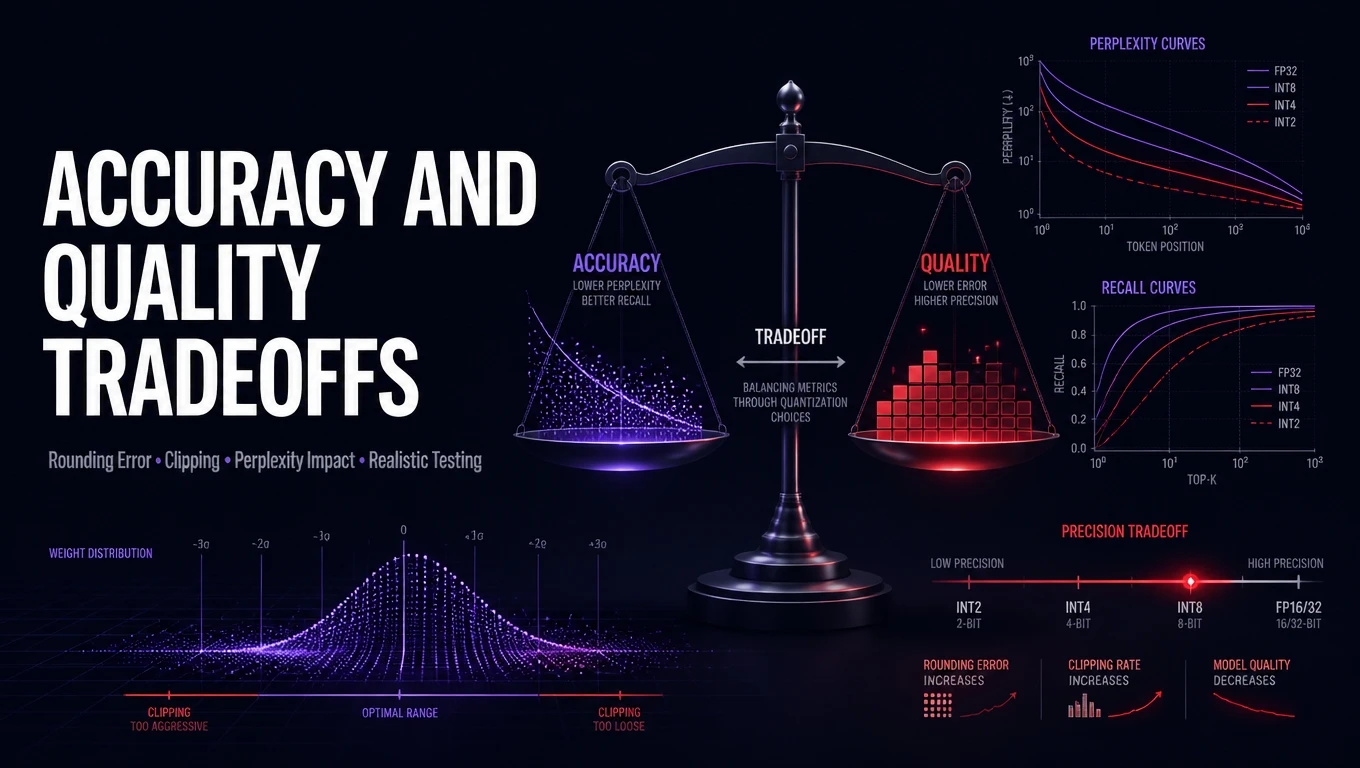
Quantization introduces rounding and clipping. That error can show up as slightly worse perplexity for language models, reduced recall for classifiers, or less stable generation for long sequences. The impact depends on the task and the model size.
To manage quality, teams track both offline metrics and user-centric evaluations. It is also important to test with realistic sequence lengths and prompts, because quantization error can compound across many layers and tokens.
What Gets Quantized In A Transformer?
Transformers include large matrix multiplications in attention and feed-forward blocks. Weight quantization usually provides the biggest memory win because weights dominate parameter storage. Activation quantization can add speedups but is more sensitive, especially in attention.
Many deployments use mixed strategies. They quantize linear layers heavily, keep layer norms and some projections at higher precision, and use careful scaling per channel to reduce error.
Hardware Support And Runtime Kernels
Quantization only helps when the hardware and software stack can execute low precision kernels efficiently. CPUs may accelerate INT8 with vector instructions, while GPUs can accelerate FP16 and sometimes INT8 through specialized units. Some NPUs and edge accelerators are designed specifically for INT8 and INT4.
Runtime choices matter as much as the quantization method. Kernel fusion, operator coverage, and memory layout all affect whether you see real speedups. A good benchmark measures end to end latency and throughput rather than a single operator.
How Quantization Is Implemented In Practice
A practical workflow focuses on repeatable measurement and safe rollbacks. It starts with a stable baseline, then introduces quantization with tight evaluation and performance profiling. Teams also validate that the deployment environment supports the intended precision without hidden upcasts.
- Baseline measurement: Record latency, throughput, peak memory, and quality metrics on the target hardware.
- Choose a quantization target: Decide between FP16, INT8, or mixed precision based on the bottleneck and acceptable quality loss.
- Calibrate or train: Run calibration for post training methods or retrain with quantization aware training when needed.
- Verify kernel execution: Confirm operators stay in low precision and that the runtime uses optimized kernels.
- Evaluate and monitor: Test quality on representative inputs and monitor drift after release.
This process keeps quantization from becoming a one-off experiment. It also makes it easier to compare multiple approaches fairly.
Deployment Pitfalls To Avoid

Quantized models sometimes underperform due to integration issues rather than the quantization method itself. The most common problems are silent precision conversions, unsupported operators falling back to slower paths, and mismatched preprocessing that changes activation ranges.
- Hidden upcasting: Some runtimes dequantize to FP16 or FP32 for unsupported layers, which erases speed gains.
- Poor calibration data: Unrepresentative calibration inputs can cause clipping and accuracy loss.
- Sequence length mismatch: Testing only short sequences can hide instability at long context lengths.
- Operator gaps: A single unsupported op can force expensive graph breaks and extra memory copies.
Addressing these pitfalls usually requires profiling tools and model graph inspection, not only metric tracking.
When Quantization Is The Right Choice?
Quantization is most valuable when memory bandwidth or memory capacity is the main constraint. It is also useful for CPU-based inference, edge deployment, and high-concurrency serving where you want more requests per machine.
When accuracy requirements are strict or the model is already small and fast, the gains may not justify the added complexity. In those cases, better batching, caching, kernel fusion, and model pruning may be more impactful.
How Tech Bonafide Can Help With Quantized Model Deployment
Quantization works best when it is paired with a deployment stack that can verify precision paths, benchmark correctly, and keep reliability high. Tech Bonafide focuses on practical AI engineering, including model optimization, inference acceleration, and production MLOps practices that reduce time to stable deployment.
If you are evaluating INT8 or mixed precision, Tech Bonafide can help you choose the right approach for your hardware, set up calibration and validation, and avoid slow fallback kernels that silently remove the benefits. That support is especially useful when moving from prototype notebooks to repeatable CI and monitored production endpoints.
Conclusion
AI model quantization makes models smaller by reducing numeric precision, which often improves speed by cutting memory traffic and using faster low precision kernels. The best results come from selecting the right bit width, validating quality carefully, and ensuring the runtime executes true low precision operations end to end. When done well, quantization is one of the most practical ways to serve faster inference without changing the model architecture.
Frequently Asked Questions
Does Quantization Always Make A Model Faster?
No. Speedups depend on hardware support and kernel coverage, and some deployments see little gain if layers fall back to higher precision. Measure end to end latency on the target device to confirm.
How Much Accuracy Loss Should Be Expected With INT8?
It varies by model and task. Many models keep near-baseline accuracy with good calibration, while others need quantization aware training or mixed precision to stay stable. Always validate with representative inputs and sequence lengths.
Is Quantization Better Than Pruning Or Distillation?
They solve different problems. Quantization mainly reduces precision to improve memory and kernel efficiency, while pruning removes parameters and distillation trains a smaller student model. In mature deployments, teams often combine these methods when quality allows.