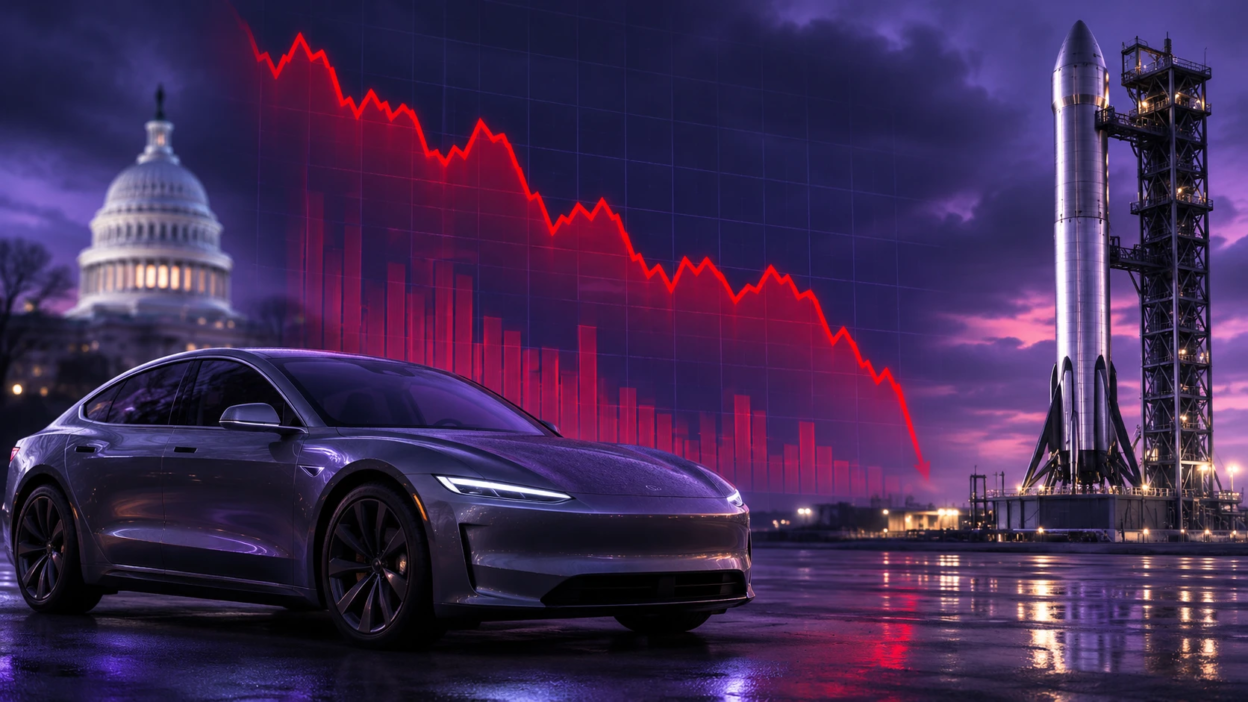
Elon Musk’s Tesla and SpaceX saw their combined stock-market value fall by approximately $456 billion over November 4 and 5, 2026, following the US midterm elections. The two-day sell-off came as investors assessed possible changes in government oversight, Texas policies, and expensive artificial intelligence investments. The decline represents a reduction in stock-market value, not cash directly lost by the companies.
The declines followed the November 3, 2026, US midterm elections, when Democrats won enough seats to take control of the House of Representatives and Senate in the next Congress. The incoming congressional majorities are expected to take office in January 2027, meaning the election results did not immediately change existing federal regulations. However, investors are watching how the political shift could affect government oversight, federal contracts, and future business expansion involving Musk’s companies.
On Thursday, November 5, Tesla (NASDAQ: TSLA) shares fell about 11%, while SpaceX (NASDAQ: SPCX) shares dropped about 9%. Across the two trading sessions, Tesla’s market capitalization declined by approximately $216 billion, while SpaceX lost around $240 billion in market value. Their combined valuation decreased from roughly $3.5 trillion at the November 3 close to approximately $3.04 trillion at the November 5 close. SpaceX became a publicly traded company in June 2026, allowing investors to follow its share price alongside Tesla’s.
Political uncertainty has also become an important concern for investors following Elon Musk’s companies. Musk supported Republican candidates during the 2026 midterms and spent hundreds of millions of dollars backing their campaigns. Democratic victories have raised questions about whether the incoming Congress could increase scrutiny of Musk’s business relationships and previous government activities. However, the stock-market decline also occurred during a wider technology-sector sell-off, making it difficult to attribute the losses entirely to the election results. TechBonafide previously examined Musk’s political activities and Tesla’s stock performance in its March 2025 coverage, showing how concerns about his political involvement had already become part of the company’s market story.
SpaceX works with US government agencies on rocket launches, satellite services, and other space-related projects. Some incoming Democratic lawmakers have raised the possibility of reviewing Musk’s previous government role and federal contracting relationships involving his businesses. Such investigations could increase political pressure, but the election results alone do not establish that any existing SpaceX government contract has been canceled or that new restrictions have taken effect.
Another major concern involves the rising cost of artificial intelligence infrastructure. SpaceX has expanded its AI computing business, which depends on powerful data centers, advanced chips, and reliable electricity supplies. On October 26, 2026, SpaceX announced a commitment to enter into an approximately $40 billion financing lease for Nvidia GPUs and related equipment, subject to closing conditions. This large planned investment highlights why investors are closely watching AI infrastructure costs, electricity availability, and potential regulatory changes. Concerns about the company’s AI business had also affected investors earlier, as TechBonafide reported in its coverage of SpaceX’s October 29 after-hours stock decline linked to uncertainty over a major AI customer.
Texas is especially important because both Tesla and SpaceX have major operations in the state. Democratic victories in the 2026 Texas elections have prompted investors and analysts to reassess possible regulatory risks for AI data centers and other technology projects. Changes to construction approvals, environmental requirements, or local policies could affect some future developments. However, these outcomes remain uncertain, and the election results do not themselves mean that existing projects have been suspended. Beyond political concerns, technology companies are also dealing with electricity shortages affecting AI data centers, which can increase development costs and delay the installation of new computing equipment.
Tesla faces a different set of questions about its long-term growth strategy. Its October 2026 quarterly financial update describes continued investment in autonomous driving technology, robotaxis, robotics, and energy storage. These businesses could create new revenue opportunities, but they also require significant spending and ongoing development. Investors will be watching whether Tesla can expand these projects while controlling costs and generating sustainable profits.
A possible merger between Tesla and SpaceX has also become an important issue for investors. During SpaceX’s October 20, 2026, earnings call, Musk said that combining the two companies would be a good idea and confirmed that special committees at both businesses were exploring a potential deal. However, no final merger agreement has been announced. Analysts believe the changing political environment could make regulatory approval more complicated if the companies move forward with a formal proposal.
The decline also comes during a difficult period for the wider US technology market. Investors have become increasingly cautious about the enormous amounts of money companies are spending on artificial intelligence infrastructure. On November 5, the Nasdaq Composite fell approximately 5.5%, while several major semiconductor and AI-related companies suffered significant stock losses. Earlier in the week, TechBonafide also examined how US stock futures and AI shares reacted to the election results, providing additional context for the technology sector’s subsequent decline.
Despite the sharp fall, Tesla and SpaceX remain among the world’s most valuable technology businesses. At Thursday’s close, SpaceX was valued at approximately $1.68 trillion, while Tesla’s market value stood near $1.36 trillion. Both companies continue to operate in important industries, including electric vehicles, satellite internet, space exploration, autonomous technology, and artificial intelligence.
The two-day decline shows how quickly the market value of major technology companies can change when investors reassess political and business risks. For Tesla and SpaceX, key issues now include government oversight, growing AI infrastructure costs, future technology projects, and the possibility of a merger. Their share prices will continue to depend on financial performance, market conditions, and how these developments unfold in the coming months.