
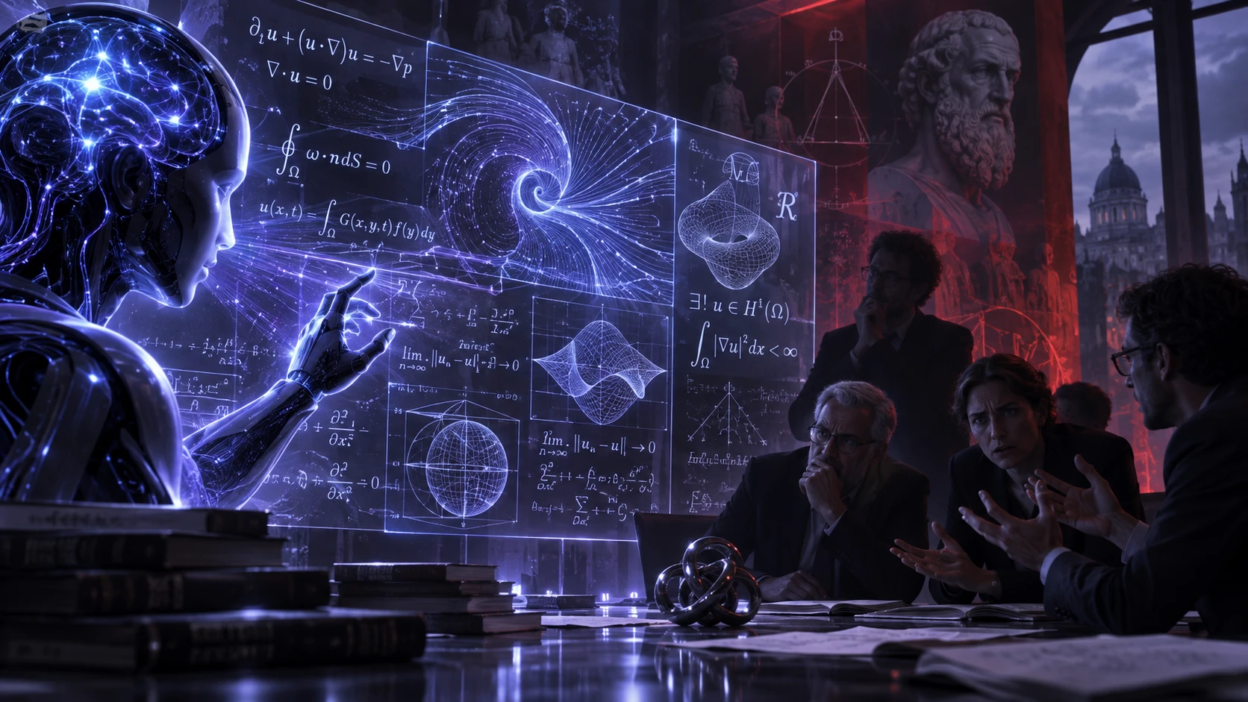
OpenAI has announced a major breakthrough in mathematics, saying one of its advanced AI systems has solved the famous Navier–Stokes existence and smoothness problem. The challenge is one of the seven Millennium Prize Problems and has remained unanswered for decades.
The Navier–Stokes equations are used to describe how fluids such as water and air move. They are important in areas including aircraft design, weather forecasting and the study of blood flow. The long-standing mathematical question asks whether smooth fluid movement can eventually develop an extreme breakdown known as a singularity.
OpenAI says its internal AI system produced a mathematical proof showing that such a breakdown can happen under certain conditions. The company also created a formal version of the proof that can be checked using mathematical verification software.
The scale of the AI effort was unusually large. Around 10,000 AI agents reportedly worked together on the Navier–Stokes problem. OpenAI says the agents reached the result in about 88 hours, followed by additional work to formally verify the proof.
The achievement shows how quickly AI is becoming more capable in advanced mathematics. Problems that once required years of work from specialist researchers may increasingly be explored by thousands of AI agents working at the same time.
However, the announcement has also caused strong concern among mathematicians.
Some researchers worry that powerful AI companies can use huge computing resources to quickly target problems that academic mathematicians have spent years studying. This could change the traditionally collaborative nature of mathematics and make researchers more careful about sharing unfinished ideas.
There are also concerns about credit. Modern mathematical breakthroughs usually build on many earlier discoveries. Critics argue that AI-generated results should clearly recognize the human researchers whose ideas, methods and published work helped make the breakthrough possible.
Another concern is the future of mathematical research itself. Difficult unsolved problems have traditionally pushed mathematicians to develop new methods and ways of thinking. If AI systems can rapidly solve many of these problems using enormous amounts of computing power, researchers may need to rethink what human mathematicians should focus on.
Education could also be affected. Universities already face difficulties when students use AI to complete assignments. More powerful mathematical AI could make traditional homework and problem-solving tests harder to use as reliable measures of a student’s own understanding.
Despite the controversy, the result could represent an important step for artificial intelligence. Advanced AI systems may eventually help scientists solve difficult problems in mathematics, physics, engineering and other research areas much faster than before.
OpenAI has said it does not intend to claim the $1 million Millennium Prize for the result. The proof will also need to face wider mathematical review before the achievement can be treated as fully settled under the formal prize process.
For now, the breakthrough is both an impressive demonstration of AI’s growing reasoning abilities and a warning that scientific research may be entering a new era. The debate is no longer only about whether AI can assist mathematicians. It is increasingly about what happens when AI begins competing with them on some of the hardest problems in the field.