
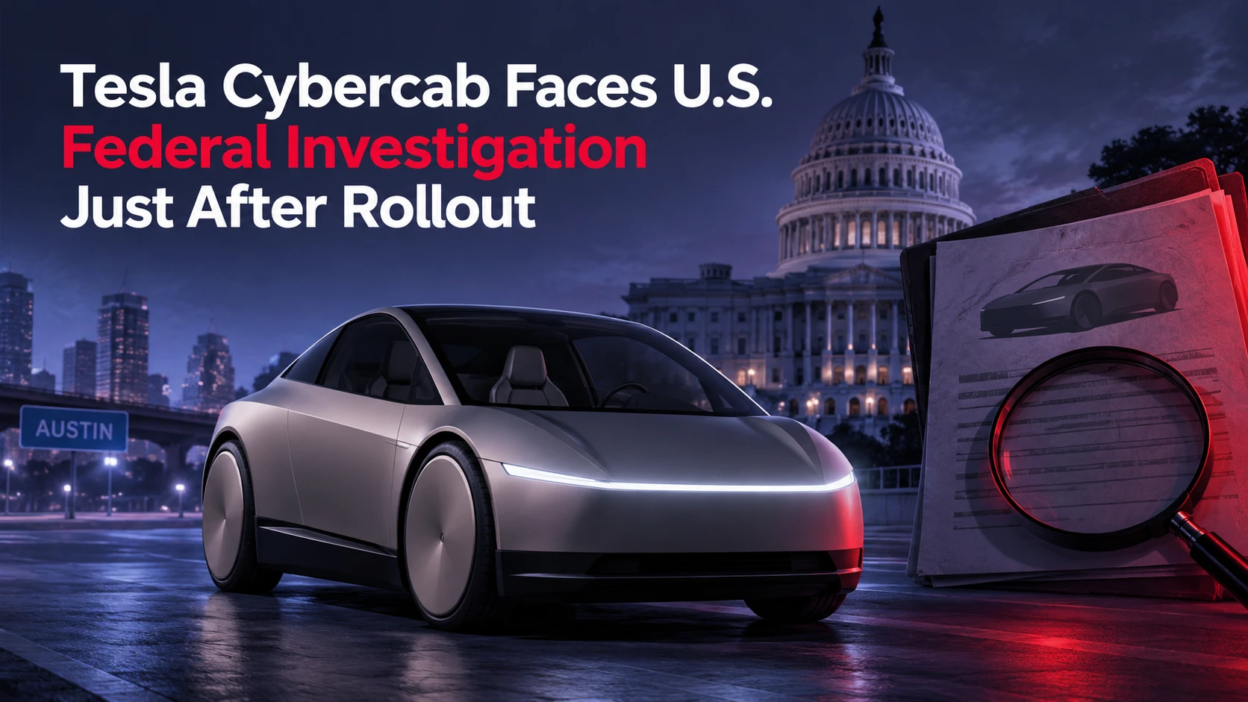
Tesla’s new Cybercab has come under federal investigation in the United States shortly after the company started rolling out the driverless vehicle in Austin, Texas.
The National Highway Traffic Safety Administration (NHTSA) has opened an investigation into how Tesla certified the Cybercab as meeting U.S. vehicle safety standards. The move comes as Tesla begins adding the purpose-built autonomous vehicle to its robotaxi service.
The Cybercab is very different from a normal passenger car. It is a two-seat electric vehicle designed to operate without a human driver and does not have traditional controls such as a steering wheel or pedals. Its unusual design is one of the main reasons regulators are taking a closer look at how the vehicle fits existing federal safety requirements.
Tesla certified the Cybercab as meeting all applicable Federal Motor Vehicle Safety Standards. In the United States, automakers are generally responsible for certifying that their vehicles follow federal requirements. Regulators can later review those claims and investigate if there are questions about compliance.
The federal investigation will examine the process and technical information Tesla used when deciding that the Cybercab meets those requirements.
The investigation does not automatically mean the Cybercab has been found unsafe or that Tesla has violated federal rules. Instead, regulators are reviewing whether the company followed the correct certification process and whether the vehicle meets the safety standards that apply to it.
The timing is important because Tesla has major plans for autonomous transportation. The company wants the Cybercab to become a key part of its robotaxi network, allowing passengers to travel without a driver sitting behind the wheel.
Tesla has already been operating robotaxi services using modified Model Y vehicles. The Cybercab takes that strategy further because it was designed from the beginning specifically for autonomous driving rather than traditional human-controlled driving.
However, existing U.S. vehicle regulations were largely created around cars with human drivers. Requirements involving steering wheels, brake pedals, mirrors and other traditional equipment can create challenges for companies developing vehicles that are designed to drive completely on their own.
Federal regulators have also been working on changes that could make safety rules more suitable for fully autonomous vehicles. Until those changes are completed, companies developing driverless cars must still show how their vehicles comply with current requirements or seek exemptions where necessary.
The investigation could therefore become an important test for Tesla’s robotaxi expansion. If regulators are satisfied with the company’s certification, Tesla could continue pushing toward a wider Cybercab rollout. If problems are found, the company could face additional requirements, delays or limits on deployment.
For Tesla, the Cybercab represents more than a new electric vehicle. It is a major part of the company’s plan to build a large autonomous transportation business. The federal investigation now adds regulatory uncertainty just as that plan starts moving from demonstrations to real-world commercial use.