
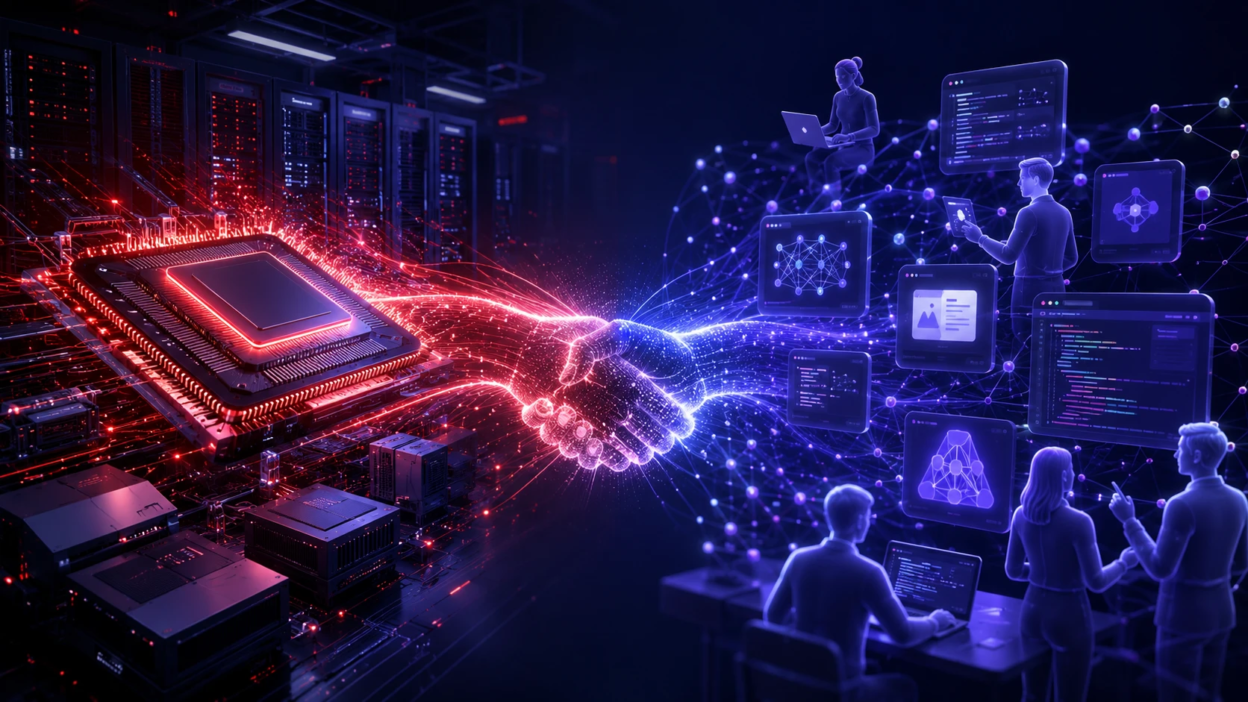
Nvidia has agreed to acquire Hugging Face in a deal worth nearly $13 billion, marking a major expansion of the chipmaker’s position in the fast-growing artificial intelligence industry.
The agreement values the transaction at about $12.93 billion. Around $11.9 billion is expected to go to Hugging Face shareholders, while Nvidia is also planning an equity-based retention program of up to about $1 billion for Hugging Face employees who join Nvidia.
Hugging Face has become one of the most important platforms for developers working with open-source and open-weight artificial intelligence. Developers, researchers and businesses use the platform to find, share, test, customize and deploy AI models, datasets and applications.
The platform is currently used by more than 18 million developers, researchers and creators. It hosts more than 3 million AI models, around 500,000 datasets and about 1 million applications. More than 200,000 companies also use Hugging Face for different AI development tasks.
For Nvidia, the acquisition is about much more than selling graphics processors and AI chips. The company has built a dominant position in AI computing hardware, but buying Hugging Face would give it a much stronger presence in the software and developer side of the AI market.
Open AI models are becoming increasingly important because they allow developers to access, modify and customize technology instead of depending completely on closed AI systems. Businesses can use these models to build specialized AI tools, run models on different infrastructure and have more control over how their AI systems operate.
Nvidia says Hugging Face will remain an open platform after the deal is completed. Developers are expected to remain free to choose their preferred AI models, software frameworks, cloud services, inference providers and computing hardware.
This is an important part of the agreement because Hugging Face supports a wide range of AI technologies rather than being tied to a single chip or cloud provider. Nvidia has also said that its own computing hardware will not be required for developers to build or deploy AI projects through Hugging Face.
The acquisition could still benefit Nvidia’s hardware business. As more developers experiment with open AI models and build larger AI applications, demand for powerful computing systems could continue to grow. Nvidia could therefore strengthen its position across both AI hardware and the software ecosystem surrounding it.
The deal also comes as major technology companies are trying to reduce their dependence on Nvidia by developing their own AI processors. Expanding deeper into software, models and developer tools could give Nvidia another way to stay closely connected with businesses building artificial intelligence systems.
Hugging Face could also gain significantly from Nvidia’s financial resources and computing infrastructure. The additional investment may help the platform improve its services, handle growing AI workloads and provide developers with more tools for training, testing and deploying models.
At the same time, the size of the deal is likely to attract regulatory attention. Hugging Face plays an important role in the open AI community, while Nvidia already holds a powerful position in the global AI computing market. Regulators may closely examine how the acquisition could affect competition, developer choice and access to AI infrastructure.
Nvidia expects the transaction to close during the first half of 2027, although the deal still depends on regulatory approvals and other standard closing conditions.
If completed, the acquisition would represent one of Nvidia’s biggest moves beyond its traditional chip business. It would bring one of the world’s largest open AI communities directly into Nvidia’s growing ecosystem and could give the company an even bigger role in determining how artificial intelligence is developed and deployed.
For the wider technology industry, the deal is another sign that open AI models are becoming strategically important. Nvidia is betting nearly $13 billion that the companies controlling the tools, platforms and communities behind AI development could become just as important as the companies supplying the chips that power them.