


Context engineering is the practice of designing the full information environment around an AI request so the model can respond with higher accuracy, consistency, and control. It goes beyond a single prompt by shaping goals, constraints, source material, tool access, and evaluation criteria. This matters because many AI failures come from missing or messy context rather than weak wording.
Strong prompts still help, but they are only one layer. When context is engineered well, the model has less room to guess, fewer conflicts to resolve, and clearer boundaries for what is allowed.
What Context Engineering Means?
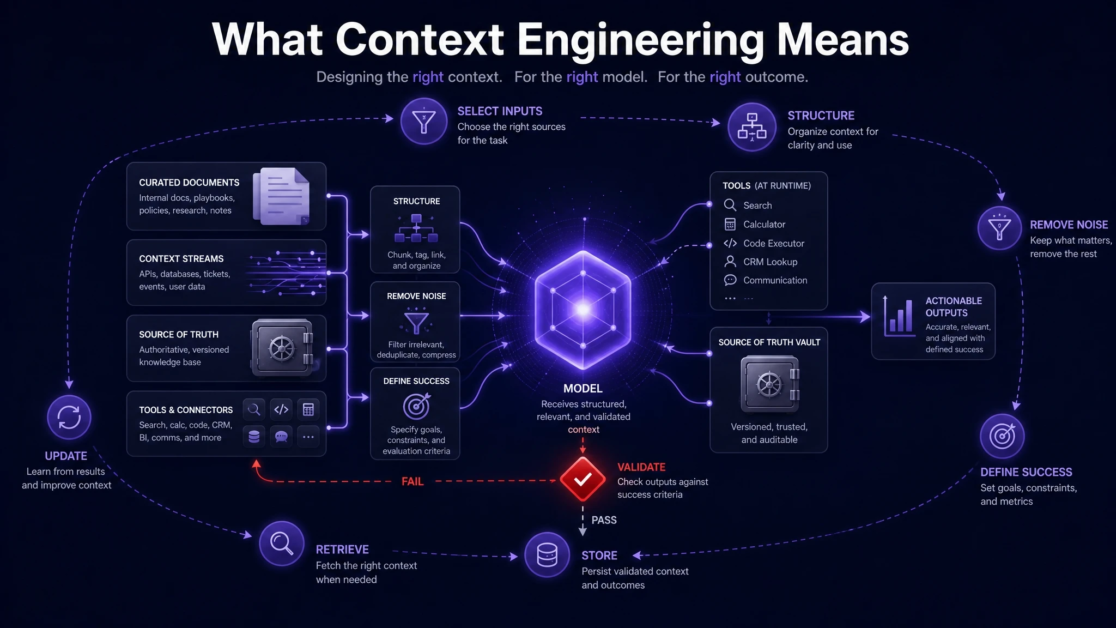 Context engineering is a system approach to getting reliable outputs from large language models. It treats the prompt as an interface, not the whole solution. The focus is on what the model sees, what it is allowed to use, and how it should behave across a workflow.
It includes selecting the right inputs, structuring them, removing irrelevant noise, and defining success. It also includes operational choices such as where context is stored, how it is retrieved, and how it is updated over time.
Why Prompts Alone Often Fail?
A prompt can only do so much when key details are missing or the information provided is inconsistent. The model may respond confidently while filling gaps with assumptions. That behavior is not a prompt issue as much as an information quality issue.
Prompts also struggle with long, evolving tasks. When requirements change, a single prompt becomes hard to maintain and easy to misinterpret. A context engineered setup keeps the task stable even when inputs change.
- Ambiguous goals: The model cannot optimize the output if success criteria are unclear.
- Conflicting instructions: Mixed constraints lead to compromised answers and unpredictable tone.
- Untrusted sources: Without approved references, the model may lean on generic patterns rather than your standards.
- Hidden constraints: Policies, brand voice, or compliance rules that are not stated cannot be followed.
Once these failure points are addressed, prompt writing becomes simpler and more repeatable.
Core Elements Of Context Engineering
Good context is intentional, scoped, and easy to parse. The aim is to reduce cognitive load for the model by making the right details obvious and the wrong details absent. The building blocks below show what typically changes results the most.
Objective And Success Criteria
Context starts with a clear objective and a definition of done. This includes the intended audience, the expected output format, and what to prioritize. It also includes what to avoid, such as unsupported claims or sensitive data exposure.
Success criteria can be a checklist, a rubric, or required sections. The key is that criteria are explicit and testable.
Audience And Domain Grounding
Domain grounding means the model should operate inside a specific knowledge boundary. It can be a product catalog, internal documentation, a style guide, or a controlled dataset. This reduces generic answers and keeps outputs aligned with real constraints.
Audience grounding sets the reading level, assumptions, and the depth expected. When this is missing, the model often swings between over explaining and under explaining.
Source Of Truth And Retrieval
Many teams improve reliability by using retrieval augmented generation. The model is given relevant passages from an approved knowledge base at request time. This keeps answers closer to your data and reduces the risk of fabricating details.
Retrieval quality depends on document structure, metadata, and chunking. If retrieval returns noisy fragments, the model will mirror that noise.
Constraints And Guardrails
Constraints define what the model must and must not do. Guardrails can include tone rules, allowed claims, safety policies, and formatting rules. They can also include operational limits such as not calling tools unless needed.
Clear guardrails reduce variance and help the model refuse unsafe or unsupported requests in a consistent way.
Tooling And Actions
In many workflows, the best answer requires actions such as searching a database, checking inventory, running calculations, or drafting output in a specific template. Context engineering defines when the model may use tools, what inputs are required, and how to report results.
This prevents tool misuse and keeps outputs auditable. It also makes the system easier to maintain as tools change.
Prompt Engineering Vs Context Engineering
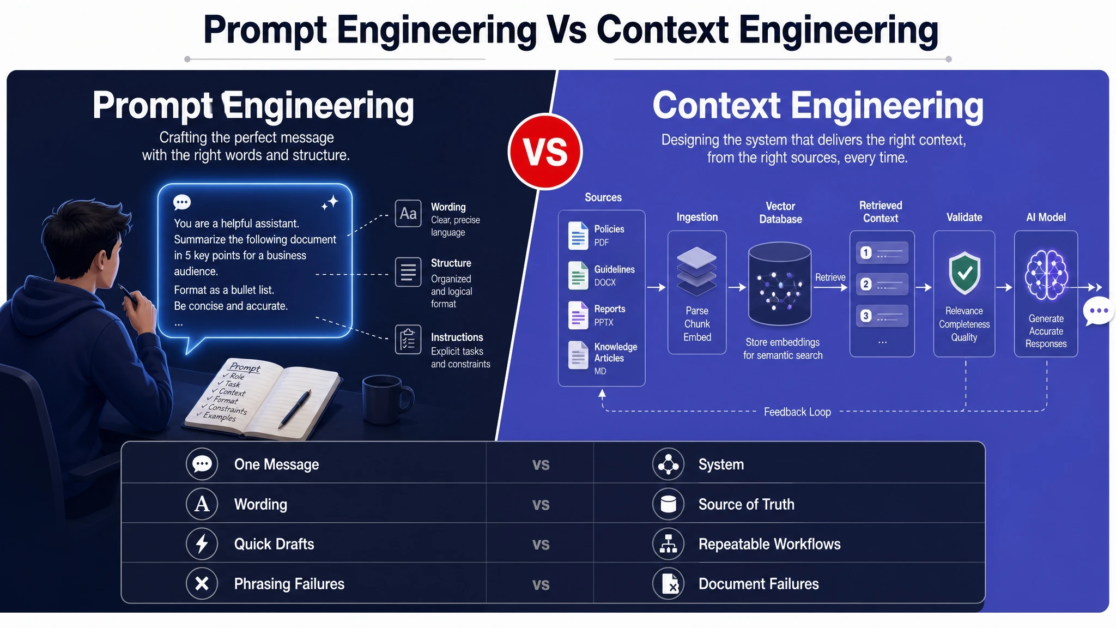 Prompt engineering focuses on phrasing, structure, and instruction clarity within a single request. Context engineering focuses on the environment that surrounds the request. Both matter, but they solve different failure modes.
The table below highlights practical differences teams see in production.
| Area | Prompt Engineering Focus | Context Engineering Focus |
|---|---|---|
| Primary Goal | Better instructions in one message | Better inputs, boundaries, and workflow |
| Reliability Driver | Wording, structure, and constraints | Source of truth, retrieval, and validation |
| Best For | One off tasks and quick drafts | Repeatable systems and multi step work |
| Common Failure | Overfitting to phrasing | Garbage in from documents or tools |
When outputs must be consistent across teams and time, context engineering usually delivers bigger gains than further prompt tuning.
How To Build A Context Engineering Workflow?
The goal is to create a repeatable pipeline that produces predictable outputs. It should be easy for others to use without becoming prompt experts. The process below keeps the work structured and reduces maintenance overhead.
- Define the job: Write a tight description of what the AI must produce and what success looks like.
- Set boundaries: List constraints, allowed sources, tone rules, and any compliance requirements.
- Choose the source of truth: Decide which documents or databases the model should rely on and keep them current.
- Design retrieval: Organize content with headings and metadata so the right passages are returned for each request.
- Standardize outputs: Use templates for structure, formatting, and required fields to reduce variability.
- Add checks: Validate facts against sources, enforce formatting rules, and flag missing inputs before completion.
After the workflow is in place, prompts become shorter because most of the intelligence lives in the context layer.
Context Hygiene That Improves AI Results
Even strong systems degrade when context gets cluttered. Old policies, duplicated docs, and conflicting guidelines create uncertainty. Regular context hygiene keeps retrieval clean and reduces contradictions.
- Remove stale content: Archive outdated documents so they are not retrieved.
- Unify terminology: Standardize product names, definitions, and abbreviations across sources.
- Limit scope: Provide only what is needed for the task to reduce distraction.
- Track changes: Version key documents and note what changed to prevent silent regressions.
These practices also make auditing easier when stakeholders ask why the model responded a certain way.
Common Mistakes To Avoid
Context engineering fails when teams treat it as a one time setup. Models, tools, and company knowledge change. Without ongoing ownership, results drift and confidence drops.
It also fails when everything is dumped into the context window. More text is not the same as better context, and irrelevant content increases errors.
- Overloading context: Too much input reduces signal and increases contradictory cues.
- Unclear authority: When multiple sources disagree, the model cannot know which one to trust.
- Missing evaluation: Without measurable checks, quality becomes subjective and inconsistent.
- Ignoring security: Sensitive data should be filtered, redacted, or access controlled before retrieval.
Fixing these issues usually improves output quality faster than rewriting prompts.
Where Context Engineering Fits In A Tech Stack?
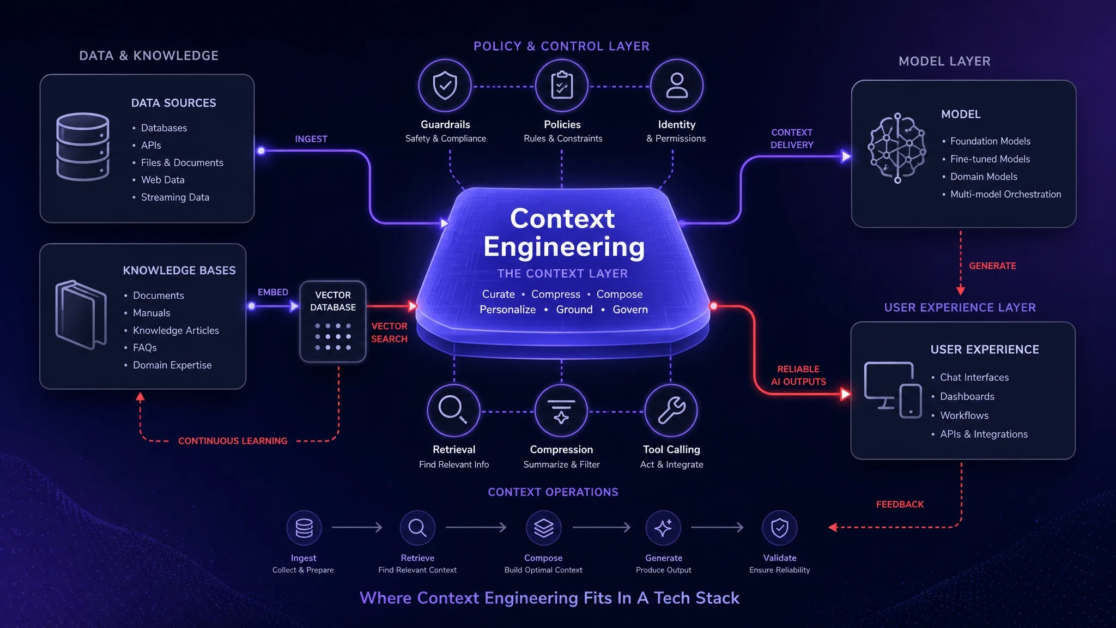 Context engineering sits between data, model, and user experience. It connects knowledge bases, vector search, policy layers, and tool calling into a coherent system. This makes AI features feel reliable rather than experimental.
Teams that build AI assistants, internal copilots, or support automation often benefit from a structured approach. Tech Bonafide readers focused on practical AI, software tooling, and implementation tradeoffs can use context engineering to turn scattered documentation into dependable AI workflows.
Conclusion
Context engineering is how teams move from clever prompts to dependable AI behavior. It clarifies goals, supplies trusted information, sets constraints, and enables tools in a controlled way. The result is output that is easier to trust, easier to audit, and easier to scale across real workflows.
If AI results feel inconsistent, the fastest path forward is often not more prompt tweaking. It is better context design, cleaner sources, and stronger evaluation.
Frequently Asked Questions
Is Context Engineering Only Needed For Retrieval Augmented Generation?
No. Retrieval helps, but context engineering also includes objectives, constraints, output templates, tool rules, and evaluation. Even without retrieval, a well designed context layer reduces ambiguity and variance.
How Do I Know If My AI Problem Is A Prompt Issue Or A Context Issue?
If small wording changes cause big swings in quality, the system likely lacks stable context and clear criteria. If answers are generic, inconsistent, or conflict with internal rules, context and source quality are usually the root causes. Testing with fixed inputs and a simple rubric makes the difference clear.
What Should Be Included In A Minimal Context Package?
Start with a clear objective, audience definition, and strict constraints. Add a short set of approved references or a retrieval layer that pulls only relevant passages. Finish with an output template and a simple checklist to verify accuracy and completeness.