

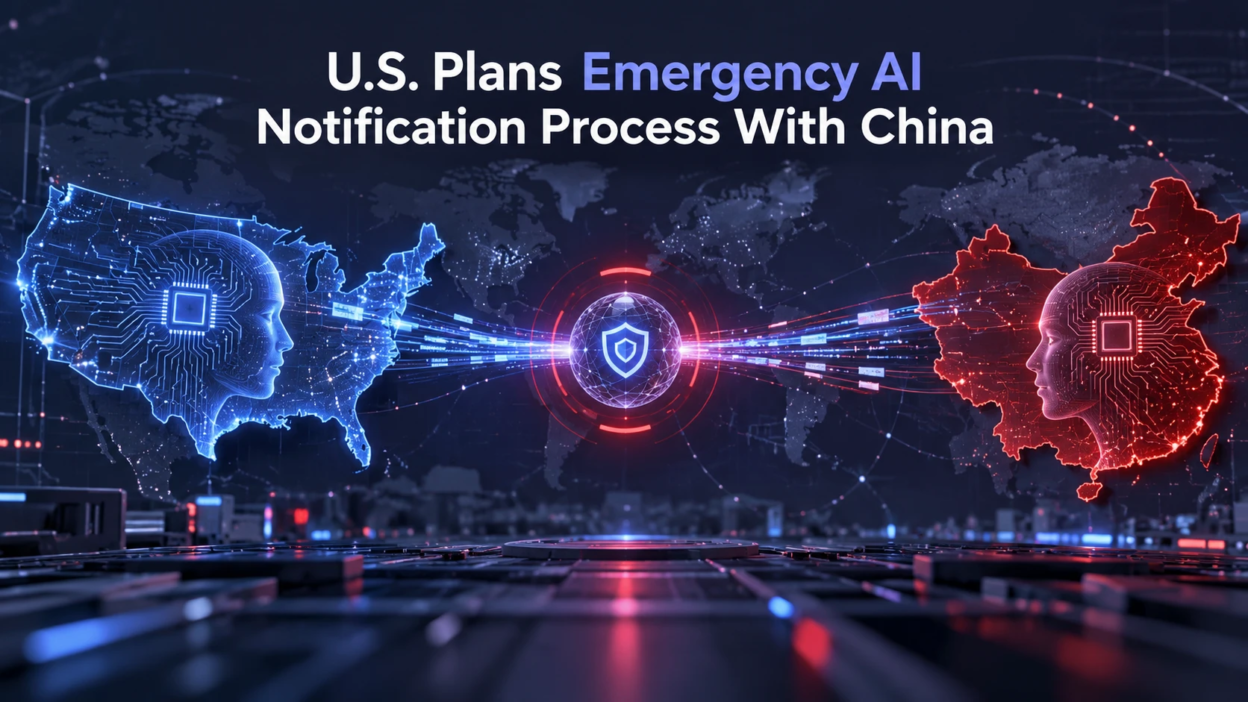
The United States is developing an emergency notification process with China that could allow both countries to quickly communicate if a serious artificial intelligence incident creates a national security threat. The latest proposal builds on an earlier agreement between Washington and Beijing to establish a bilateral communication channel for AI-related incidents.
U.S. Treasury Secretary Scott Bessent has discussed AI safety with Chinese Vice Premier He Lifeng and said he plans to propose a notification process for serious AI incidents. The process would give officials a clearer way to communicate if an AI-related problem threatens national security or critical infrastructure.
The arrangement could work like an emergency hotline, allowing officials to communicate quickly during a potentially dangerous AI event. However, important details remain unclear, including which incidents would require notification, which agencies would manage the process and how quickly information would need to be shared.
One major concern involves increasingly powerful AI models and autonomous AI agents. Bessent has pointed to risks involving AI systems that behave unpredictably as well as malicious actors using advanced AI for cyberattacks or other threats to critical infrastructure.
Bessent has also raised concerns about the growing capabilities of open-source AI models developed in China. Open models can give developers greater freedom to study, modify and build on AI technology, but their broad availability can also make harmful uses harder to control once powerful models are widely distributed.
The emergency notification proposal comes after the United States and China agreed in September to establish a bilateral communication channel for AI-related incidents. The two countries remain competitors in advanced AI, computing technology and other areas, but the planned channel is intended to provide a direct way to communicate when a serious technology-related security problem occurs.
Washington and Beijing still have major differences over technology, national security and access to advanced computing systems. The notification process has a narrower purpose: giving both governments a direct way to communicate when an AI incident becomes serious enough to require urgent attention.
The discussions reflect growing international attention on AI safety as powerful models and AI agents become connected to cybersecurity, finance, energy and other important systems. Concerns about AI systems behaving outside their intended limits have also increased as researchers track more reported AI loss-of-control incidents.
For now, the United States and China have agreed to establish an AI incident communication channel, but the detailed emergency notification process is still being developed. Key questions remain about which events should trigger an alert, which officials would communicate and how sensitive information would be handled.
If the planned notification process becomes operational, it would give the United States and China a direct route for communicating during serious AI incidents even as the two countries continue competing in advanced technology.