

OpenAI has introduced Dots, a new generation of always-on AI agents designed to keep working toward user-defined goals between conversations. The company unveiled Dots at its DevDay 2026 event in San Francisco on September 29.
Dots are powered by OpenAI’s GPT-6 Astra model. Instead of waiting for users to send one prompt at a time, a Dot can stay active and work through longer, multi-step assignments such as researching information, reviewing schedules, organizing projects and completing work across connected apps.
Users can give a Dot a goal and define boundaries around what it is allowed to do. The agent can continue making progress and return to the user when additional information, approval or a decision is required.
Dots Can Work Across Apps and Communication Tools
OpenAI is also extending Dots beyond the main ChatGPT interface. Dots can connect with Slack and, in supported workspaces, Microsoft Teams, while OpenAI is testing text messaging as a limited beta for some Pro users in the United States.
At launch, Dots are rolling out to eligible ChatGPT Pro and Business Premium users, while Enterprise customers can access the feature through an administrator-enabled beta. OpenAI says the rollout is gradual, so availability may take several days to reach eligible accounts.
Connected apps are an important part of how Dots work. With permission, a Dot can use information from supported services to understand a user’s goals and work across tools instead of operating only inside a single chatbot conversation.
Dots can handle ongoing work such as research, calendar-related tasks, project support and other multi-step assignments across connected services. OpenAI says eligible users start with one Dot and that support for adding more Dots is planned for the future.
OpenAI Dots Competes With Meta’s Muse
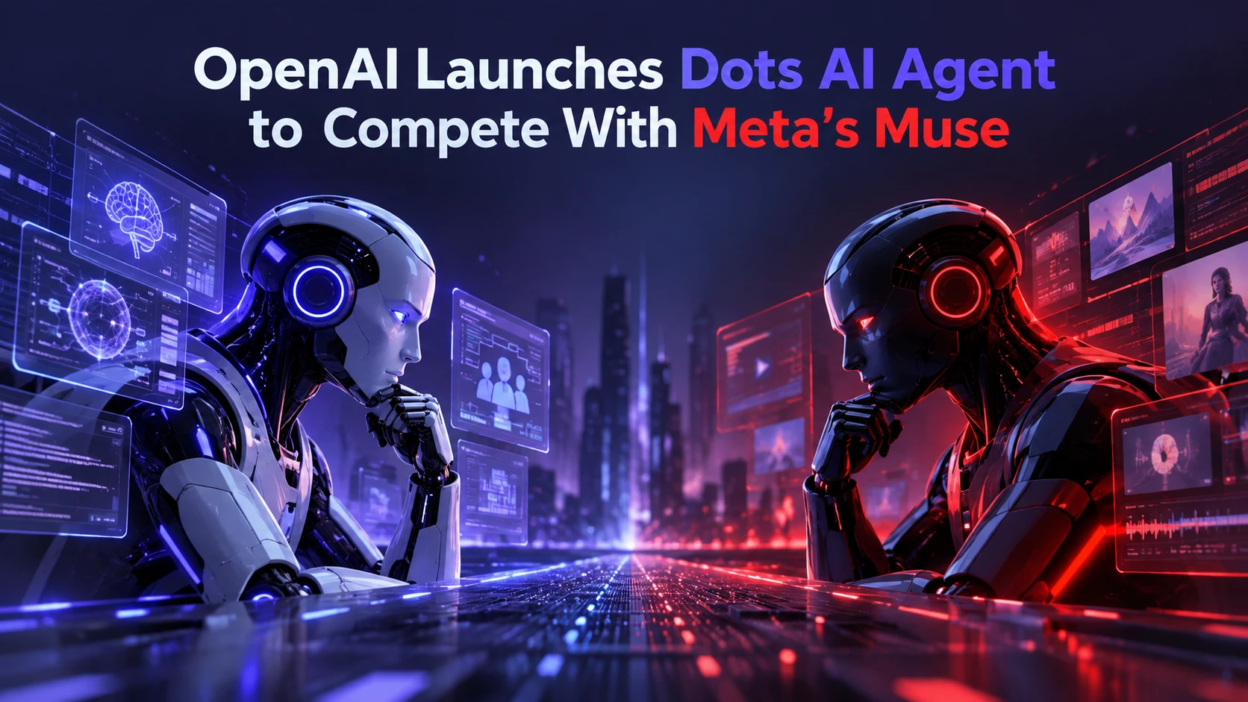
The launch puts OpenAI in more direct competition with Meta’s Muse, which arrived earlier in September.
Muse is also designed as a personal AI agent that can continue working after the user leaves the app. Meta says each Muse runs on a dedicated secure virtual machine with its own browser and can work across supported apps and online services.
Both products show how the AI industry is moving beyond traditional chatbots. Instead of focusing only on generating answers, these systems are increasingly designed to plan tasks, use connected tools and take actions on a user’s behalf.
There are differences in how the companies are positioning their products. Meta has emphasized Muse as a broadly accessible personal AI agent for everyday tasks, while OpenAI is positioning Dots for both personal assistance and professional workflows.
Privacy, Permissions and User Control
Giving AI agents access to apps, accounts and personal information also raises privacy and security considerations.
OpenAI says plugin permissions limit what a Dot can access, while Custom Rules allow users to set additional boundaries and approval requirements for supported actions. The company also uses automated review and safety checks before certain actions are carried out, although OpenAI warns that Dots can still make mistakes.
These controls are increasingly important as AI systems move beyond suggesting what users should do and begin carrying out actions through connected services.
What the Dots Launch Means for AI Agents
Dots marks another step in OpenAI’s shift from conversational AI toward systems that can carry out ongoing work. Meta is pursuing a similar direction with Muse, which uses its own secure virtual machine and connected services to complete tasks on a user’s behalf.
The growing competition suggests that the next phase of consumer and workplace AI may depend less on which assistant produces the best single answer and more on how reliably agents can complete tasks while respecting user permissions, privacy and control.


