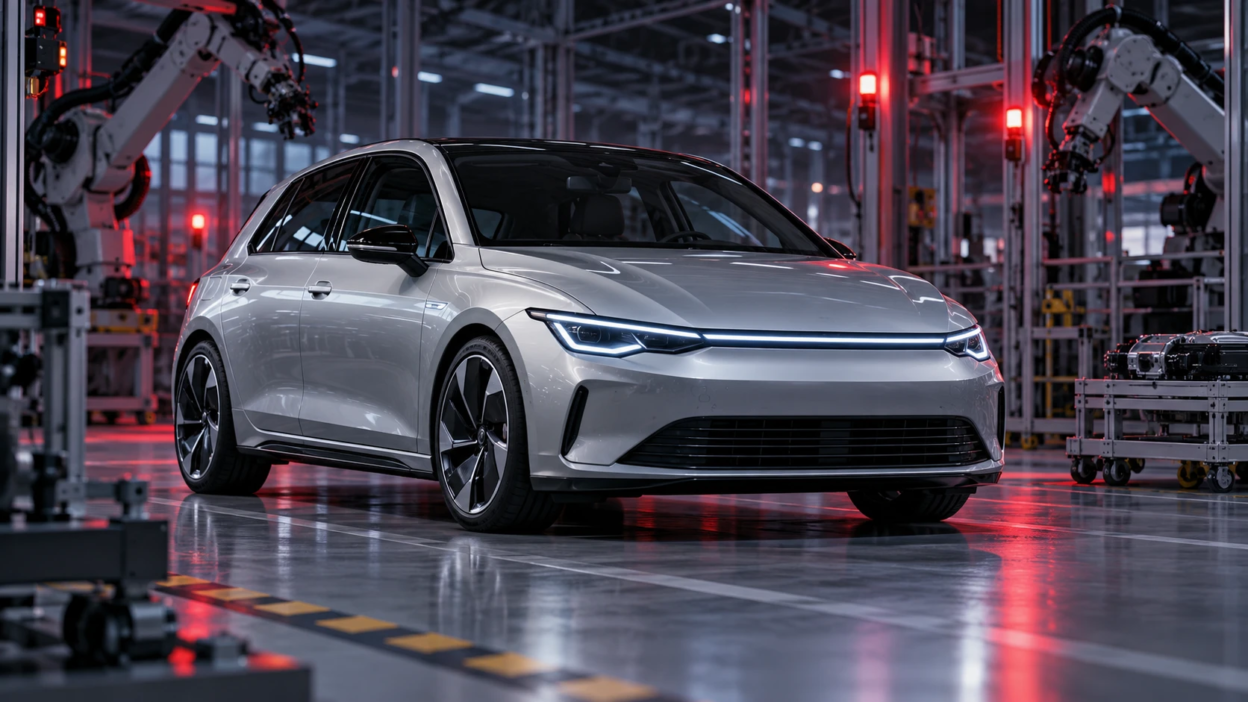
Volkswagen has temporarily paused development of its upcoming all-electric ID. Golf as the German carmaker works to reduce costs and protect its cash flow. In Volkswagen’s October 30 update, the company confirmed that development would remain on hold until it could safely fund the necessary investment. The decision comes as Volkswagen faces weaker profits and growing pressure to make its electric vehicle business more profitable.
The development pause affects work connected to Volkswagen’s Wolfsburg headquarters in Germany, where the company previously planned to build its next-generation electric Golf. The decision does not mean production of an existing ID. Golf has stopped, because the model has not yet entered production. Volkswagen has also not announced that the project has been canceled. For now, the company is reviewing its investment priorities before moving forward.
The ID. Golf is intended to bring Volkswagen’s famous Golf name into a new generation of fully electric vehicles. The company previously outlined plans to build the model using its upcoming Scalable Systems Platform. The electric version is expected to feature more advanced electronic systems and software, although its final design and technical specifications remain unconfirmed. Volkswagen has also not announced an official starting price or a confirmed launch date. For more background, our guide to electric and hybrid vehicle technology explains the battery systems, electronic features, and other innovations used in modern cars.
The planned electric Golf is connected to Volkswagen’s next-generation Scalable Systems Platform, known as SSP. This platform is being developed to support future electric vehicles across multiple Volkswagen Group brands while allowing them to share important technology. Volkswagen is also working with Rivian on advanced software and electronic systems for future vehicles using the SSP platform. The technology aims to simplify vehicle electronics, support software updates, and make future electric cars more efficient to develop and manufacture.
The decision follows Volkswagen Group’s disappointing financial results for the first nine months of 2026. According to its nine-month financial results, revenue declined to approximately €233.4 billion from €238.7 billion a year earlier. Reported operating profit dropped from €5.4 billion to just €71 million. However, this sharp decline was largely caused by €8.7 billion in special charges, including restructuring costs and asset write-downs. Excluding these charges, Volkswagen reported an operating profit of approximately €8.8 billion.
Several factors are affecting Volkswagen’s performance, including increasing competition from Chinese electric vehicle manufacturers, higher production expenses, and pressure from international trade restrictions. The company is also spending heavily on restructuring and new technology. At the same time, electric vehicles currently generate lower profit margins than many traditional petrol and diesel models, making the transition more financially challenging. Competition is also affecting other electric vehicle manufacturers in China, as highlighted by our earlier report on BYD’s January 2026 sales decline amid changing market demand.
Despite the financial pressure, Volkswagen Group reported stronger demand for battery-electric vehicles in Europe. Its European electric vehicle orders increased by approximately 39% during the first nine months of 2026, while fully electric models represented around 40% of its European order book at the end of September. The group’s separately launched Electric Urban Car Family, featuring models from Volkswagen, Škoda, and CUPRA, also attracted approximately 150,000 orders. These figures show continued interest in electric vehicles, although they do not represent orders for the upcoming ID. Golf.
Volkswagen Group is responding to its financial challenges with a wider cost-cutting program totaling approximately €31 billion. The measures include simplifying company structures, improving factory efficiency, and reducing operating expenses. The program is intended to make the business more competitive while preserving funds for future investments. The €31 billion figure relates to Volkswagen’s broader cost-saving efforts, not the development budget of the ID. Golf.
The pause has raised questions about the future schedule of Volkswagen’s electric Golf. Modern electric cars require major investments in batteries, software, connected systems, and vehicle platforms. Volkswagen must balance these development costs with the need to improve profitability. The company’s employee representatives have indicated that the pause does not automatically mean the project will be canceled or delayed. However, Volkswagen has not confirmed a revised launch date or announced when development work will restart. For a closer look at the technology and manufacturing challenges facing the EV industry, our comparison of solid-state and sodium-ion batteries explains the trade-offs between cost, performance, and production.
For customers and electric vehicle enthusiasts, the ID. Golf development pause highlights the growing financial challenges facing traditional automakers as they invest in electric technology. Volkswagen has not canceled the vehicle, but it must find a way to reduce costs while continuing work on future electric models. The next important update will be confirmation of when ID. Golf development can resume and whether its planned introduction will be affected.