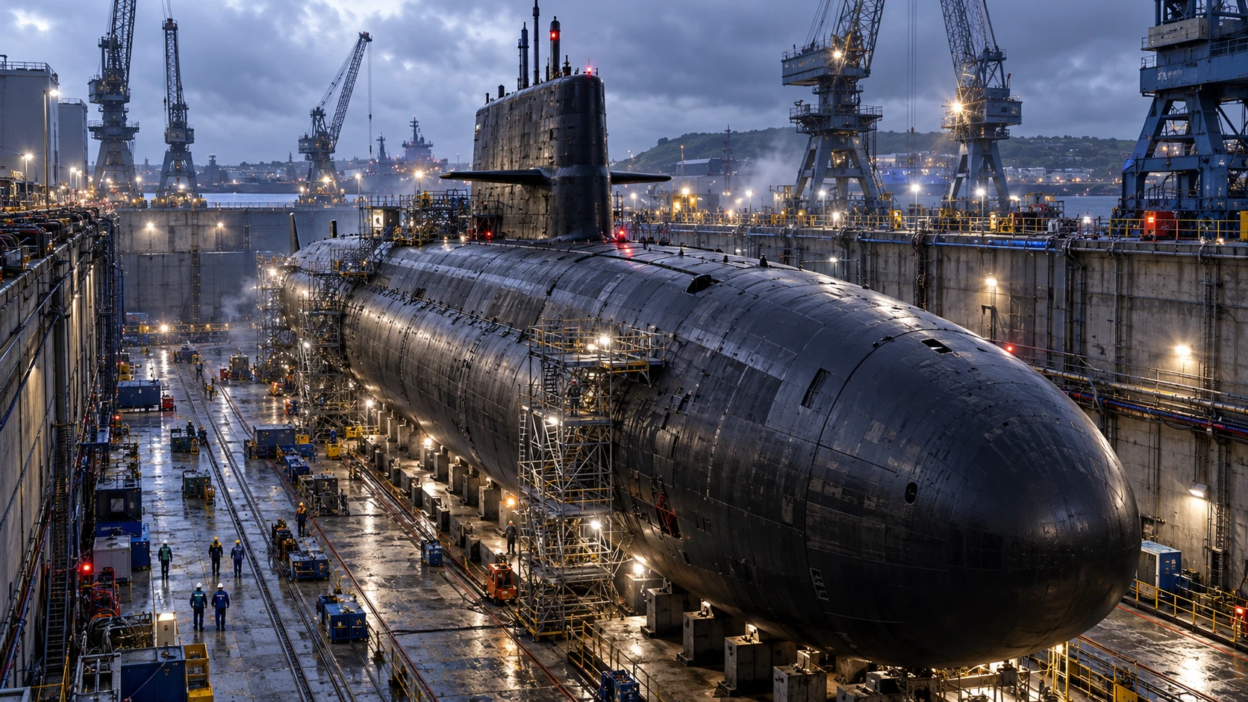
Reports published on October 27–28, 2026, said three of the Royal Navy’s four Vanguard-class nuclear submarines were at sea at the same time. The unusual situation has drawn renewed attention to Britain’s ageing submarine fleet and the challenges of keeping these vessels operational. One major example is HMS Vanguard, which underwent a lengthy reactor refuelling and maintenance programme that ended in 2023.
HMS Vanguard is one of four nuclear-powered submarines that carry Britain’s Trident ballistic missile system. The submarine arrived at Devonport Royal Dockyard in Plymouth, England, in December 2015 for an extensive maintenance and reactor refuelling programme. According to a September 2023 UK parliamentary answer, the refit and refuelling work formally began in February 2016. HMS Vanguard left Devonport in May 2023 to undergo post-refit testing after spending more than seven years in the maintenance programme.
The Ministry of Defence initially expected the maintenance programme to take approximately three and a half years. However, specialist defence reporting later identified technical difficulties, reactor refuelling challenges, project management problems, and disruptions caused by the COVID-19 pandemic as factors behind the extended timeline.
According to specialist defence publication Navy Lookout, HMS Vanguard’s maintenance programme took approximately 89 months, compared with around 83 months required to build the submarine originally. The comparison highlights how maintaining an ageing nuclear-powered submarine can become an extremely demanding engineering project, especially when unexpected technical challenges arise.
The Vanguard-class submarines use Rolls-Royce PWR2 nuclear reactors to generate power for propulsion and onboard electrical systems. Unlike conventional submarines that rely on diesel engines and batteries, nuclear-powered submarines can remain underwater for extended periods without needing to surface for fuel.
Nuclear technology also has important civilian applications. For example, Tech Bonafide has covered nuclear power deals for AI data centers, although these electricity-generation projects are different from the nuclear propulsion systems used in submarines.
The overhaul included replacing HMS Vanguard’s nuclear reactor fuel and inspecting important onboard systems. The decision followed the discovery of low levels of radioactivity in the cooling water of a prototype reactor at the Dounreay test facility in Scotland in January 2012. The Ministry of Defence’s March 2014 announcement confirmed that HMS Vanguard would be refuelled as a precaution. Officials said there was no evidence that the same problem had occurred in operational submarine reactors.
Replacing nuclear fuel inside a submarine is a highly complex engineering operation. Workers must follow strict safety procedures while handling reactor components, inspecting equipment, and ensuring that essential systems can operate reliably during future missions.
These maintenance challenges remain important in 2026 because the Royal Navy must keep its older Vanguard-class submarines available while Britain develops their replacements. Delays in major maintenance programmes can put additional pressure on the remaining fleet, affecting the time available for patrols, training, repairs, and crew recovery.
Another Vanguard-class submarine, HMS Victorious, is undergoing a maintenance and life-extension programme at Devonport under a contract valued at approximately £560 million. A May 2025 Royal Navy update confirmed that the vessel had entered dry dock for a major phase of the project. The work includes equipment upgrades, inspections, and checks of safety-critical systems to help the submarine continue operating into the 2030s. Unlike HMS Vanguard’s earlier programme, the HMS Victorious refit is not planned to include reactor refuelling.
The Royal Navy operates four Vanguard-class submarines: HMS Vanguard, HMS Vengeance, HMS Victorious, and HMS Vigilant. These vessels support Britain’s continuous at-sea nuclear deterrent, a defence arrangement that keeps at least one nuclear-armed submarine on patrol.
Submarine technology also appears in wider military research. In separate coverage, Tech Bonafide examined proposed submarine-based anti-satellite systems, although those theoretical concepts are unrelated to the Royal Navy’s Vanguard-class maintenance programme.
On October 27, 2026, Sky News reported that three of Britain’s four Vanguard-class submarines were at sea simultaneously. The individual missions were not officially confirmed. Defence analysts suggested that one submarine could be conducting a regular nuclear deterrent patrol, another preparing to take over patrol duties, and the third undergoing training or sea trials. The reported activity does not necessarily mean that three nuclear deterrent patrols were taking place at the same time.
Meanwhile, Britain is developing four next-generation Dreadnought-class submarines to replace the older Vanguard fleet. These vessels will use Rolls-Royce Pressurised Water Reactor 3 (PWR3) propulsion technology, replacing the PWR2 design used by Vanguard-class submarines. According to the Royal Navy, the newer system is designed to simplify operations, extend service life, and reduce maintenance costs over the submarines’ operational lifetimes.
According to the UK government’s 2026 Defence Nuclear Enterprise update, the first Dreadnought-class submarine is expected to enter service in the early 2030s. Until then, maintaining the existing Vanguard fleet remains essential for Britain’s naval defence operations.
The reported October 2026 submarine activity highlights the importance of keeping Britain’s nuclear deterrent fleet operational, but it does not establish a change in the country’s nuclear defence strategy. HMS Vanguard’s lengthy overhaul and the continuing maintenance of HMS Victorious show the engineering challenges involved in operating ageing nuclear-powered submarines. As Britain prepares to introduce the Dreadnought class in the early 2030s, reliable maintenance will remain essential to keeping the existing fleet available.