Apple is preparing to release five new products on Friday, November 6, 2026, including its first touchscreen MacBook Pro models. The upcoming launch will bring major upgrades to Apple’s laptop, desktop, and tablet lineup, giving customers several new options before the holiday shopping season.
Apple announced the new products over three days in October 2026. The OLED iPad mini was introduced on October 26, followed by the M6-powered iMac and 14-inch MacBook Pro on October 27. The company unveiled its first touchscreen MacBook Pro models on October 28. Pre-orders for all five products began on October 28, with general availability scheduled for November 6 in supported markets.
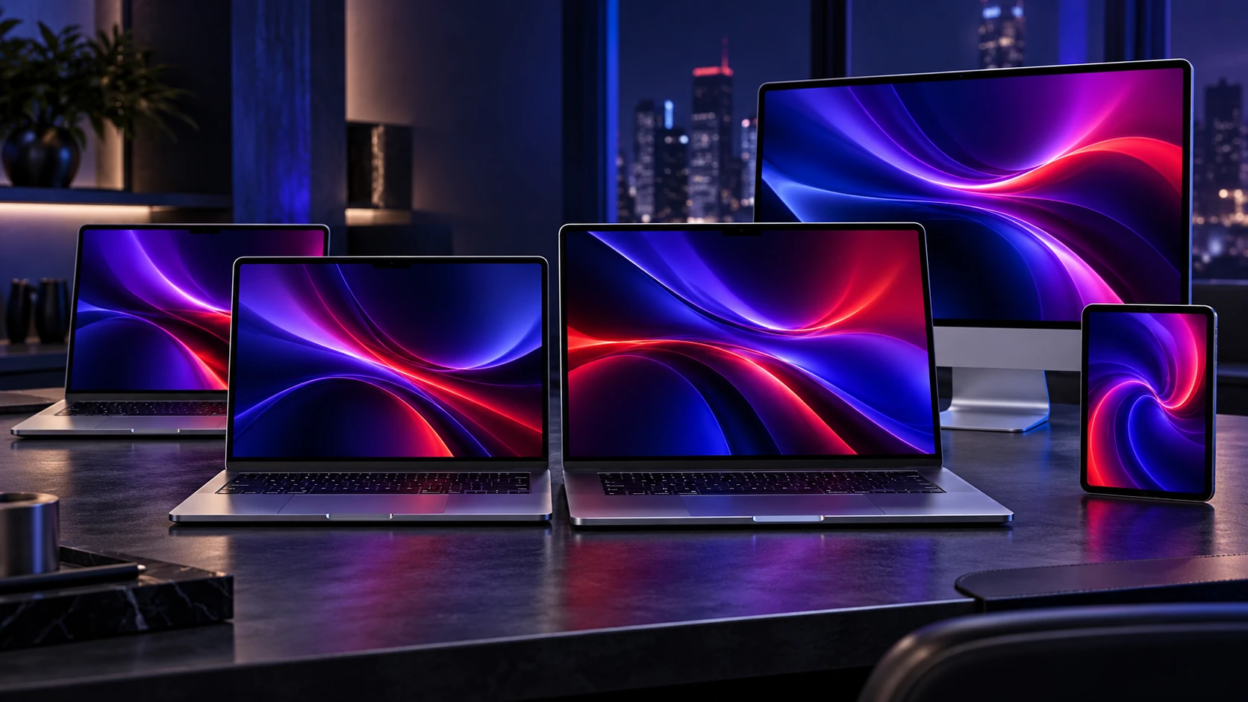
The five products scheduled for November 6 are the 14-inch touchscreen MacBook Pro, the 16-inch touchscreen MacBook Pro, the standard 14-inch MacBook Pro with M6, the M6 iMac, and the OLED iPad mini with A20 Pro. The touchscreen MacBook Pro models use M5 Pro or M5 Max chips, while the separate standard 14-inch MacBook Pro features the newer M6 chip. This gives buyers different choices in performance, display technology, and price.
The biggest change is Apple’s first built-in touchscreen MacBook Pro, offered in 14-inch and 16-inch sizes. Users can continue to use the keyboard and trackpad, but they can also swipe to scroll, pinch to zoom, and move supported items directly on the display. The redesigned models also introduce Dynamic Island to the Mac, providing access to Spotlight, Live Activities, and Siri AI.
Both touchscreen MacBook Pro models feature Apple’s new PROLED XDR display, which uses advanced OLED technology to deliver deeper blacks, brighter images, and improved contrast. The screens also support a variable refresh rate of up to 120Hz, helping make scrolling and visual movement appear smoother. These improvements could appeal to video editors, designers, photographers, and other professionals who need accurate display performance. For more information about display technology, our OLED vs mini-LED display comparison explains the differences in contrast, brightness, and image quality.
The touchscreen MacBook Pros are available with M5 Pro and M5 Max chips. In the United States, the 14-inch model with M5 Pro starts at $2,899, while the 16-inch version starts at $3,399. Buyers choosing the more powerful M5 Max chip will pay at least $4,499 for the 14-inch model or $4,799 for the 16-inch model. Final prices depend on the selected processor, memory, storage, and other options.
Apple is also introducing a separate 14-inch MacBook Pro with the M6 chip. This model keeps a non-touch Liquid Retina XDR display, unlike the touchscreen versions with M5 Pro or M5 Max. Apple says its 12-core CPU and 12-core GPU improve performance, while Wi-Fi 7 and Bluetooth 6 update connectivity. The M6 MacBook Pro starts at $1,999 in the United States.
Apple’s updated iMac uses the M6 chip while keeping its 24-inch 4.5K Retina display and slim all-in-one design. It adds Wi-Fi 7, Bluetooth 6, and faster storage for everyday work, creative projects, and demanding applications. The iMac starts at $1,499 in the United States, with a higher-performance configuration starting at $1,699.
The fifth product is the new iPad mini, which receives a significant display upgrade. The compact tablet now features an 8.5-inch OLED screen, replacing the display technology used in earlier generations. OLED technology allows individual pixels to produce their own light, creating richer colors and deeper blacks.
The iPad mini uses Apple’s A20 Pro chip and has a thinner 5.4 mm design, a new 12MP Center Stage front camera, and IP67-rated water and dust resistance. The upgraded tablet is designed for entertainment, reading, video calls, creative work, and everyday productivity. In the United States, the Wi-Fi model starts at $699, while the Wi-Fi + Cellular version starts at $849.
Artificial intelligence is another important part of Apple’s new devices. The M6-powered Macs can handle demanding AI tasks using their processors and on-device AI capabilities, while the iPad mini’s A20 Pro chip also improves AI performance. Apple Intelligence and Siri AI offer features for finding information, understanding on-screen content, and working across supported apps. However, some Siri AI functions are being introduced in beta, and feature availability can depend on the device, software version, language, and region. For background on Apple’s broader AI plans, TechBonafide previously covered its Google Gemini partnership for Siri.
Apple has confirmed Friday, November 6, 2026, as the start of retail availability for all five products in supported markets. Customers who placed pre-orders may begin receiving their devices on that date, while Apple Store locations and authorized retailers are also expected to begin offering the new models. Buyers should check availability for their country and selected configuration, as delivery estimates can vary.
For laptop buyers, the main choice is between the standard M6 MacBook Pro and the more expensive touchscreen models. The $1,999 M6 MacBook Pro offers a traditional laptop experience, while the touchscreen MacBook Pros start at $2,899 and add OLED displays, direct touch controls, and professional M5 Pro or M5 Max processors. The M6 iMac is an option for people who prefer a desktop computer, while the OLED iPad mini is designed for users who value portability.
The coming days will show how customers respond to the new devices, especially the touchscreen MacBook Pros. Their reception could help determine whether direct touch interaction becomes a bigger part of Apple’s future MacBook lineup.