

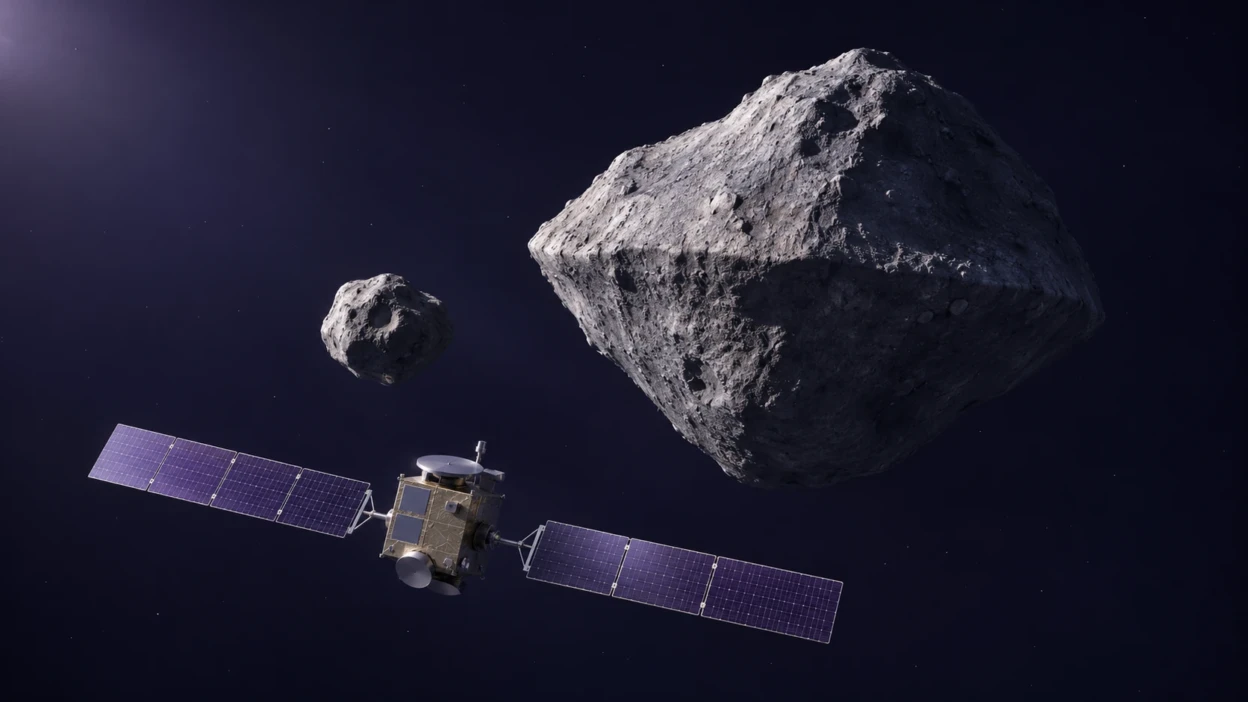
Japan’s space agency JAXA has released new details from the Hera spacecraft’s first thermal observations of the Didymos asteroid system, showing how infrared imaging can reveal surface characteristics that ordinary cameras cannot detect. Published on November 24, 2026, the findings come ahead of a European Space Agency (ESA) presentation of detailed images of Dimorphos, the asteroid moonlet deliberately struck by NASA in 2022.
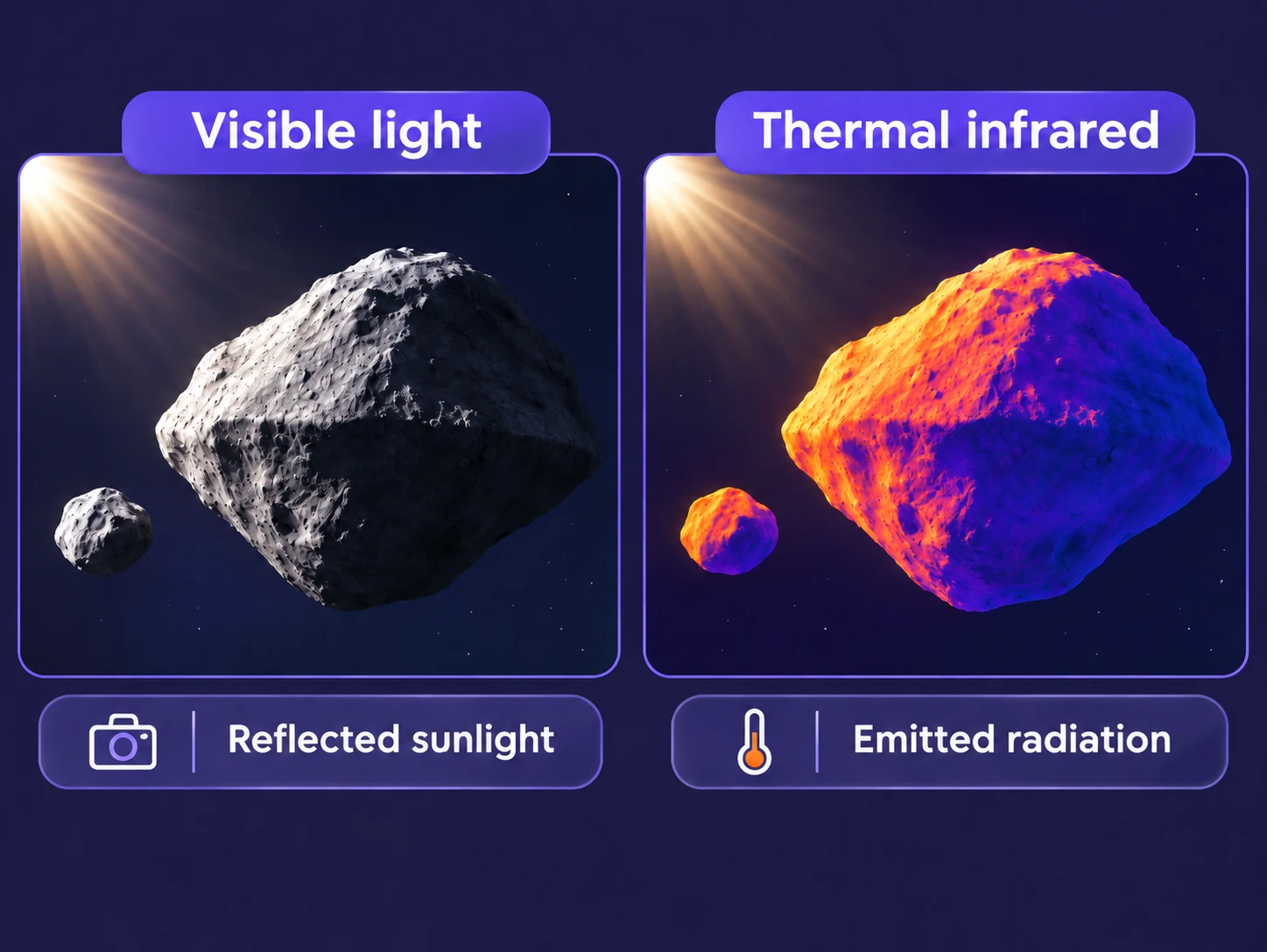
According to JAXA’s thermal imaging report, Hera captured infrared images of Didymos and its smaller companion, Dimorphos, from approximately 57 kilometers away on October 31. The observations were made using the spacecraft’s Thermal Infrared Imager (TIRI), an instrument developed by the Japanese space agency.
Unlike conventional cameras that depend on reflected sunlight, TIRI detects infrared radiation emitted by asteroid surfaces. This allows scientists to investigate regions that remain difficult to observe in visible light. JAXA also recorded a decrease in the temperature of Dimorphos as it moved through the shadow of Didymos, providing data that could help researchers understand the physical properties of its surface.
ESA launched Hera on October 7, 2024, to investigate the consequences of NASA’s Double Asteroid Redirection Test, known as DART. After a journey of approximately two years, including a flyby of Mars in March 2025, Hera reached the asteroid system in November 2026.
NASA’s DART spacecraft deliberately collided with Dimorphos on September 26, 2022, to test whether a spacecraft impact could alter an asteroid’s motion. NASA’s subsequent analysis confirmed that the collision shortened the time Dimorphos takes to orbit Didymos by approximately 33 minutes.
Although DART demonstrated that an asteroid’s motion could be deliberately changed, researchers still need to understand how the target’s mass, internal structure and surface materials influenced its response to the collision. Hera’s measurements are intended to improve that understanding and help scientists develop more reliable models for future asteroid deflection missions.
Hera’s investigation will also involve two small spacecraft called Juventas and Milani. Under the published mission operations plan, their deployment is scheduled for January 2027. Juventas will use radar to investigate the internal structure of Dimorphos, while Milani will study the composition of asteroid surfaces.
ESA has scheduled a public presentation and livestream for November 25 at 19:45 CET (18:45 UTC) from Berlin, Germany. The event is expected to provide detailed views of Dimorphos following the DART impact.
The new thermal observations represent an early step in Hera’s scientific investigation rather than a final assessment of the deflection experiment. Further measurements will be needed to determine how the collision changed Dimorphos and how lessons from the experiment could be applied to protecting Earth from potentially dangerous asteroids.

Tech Bonafide is the editorial identity of TechBonafide, an independent technology publication covering AI, software, cybersecurity, gadgets, and emerging technology.