A technology article can be easy to read and still leave out the details you need for research. When reading BenzyNews.com, judge the depth of the individual article, not the length of the page or the confidence of its title. A useful research article explains the subject, supports its important claims, identifies limitations, and gives readers a way to check its conclusions.
An independent review of BenzyNews.com’s public sections described it as a multi-topic publisher with a Technology category. That description does not establish the technical quality of any particular post. Direct access to the site’s article pages was unavailable during preparation of this guide, so the checks below are a reader-facing evaluation method, not a claim that TechBonafide has tested or rated its technology archive.
First, Decide How Much Depth Your Research Needs
Not every technology story needs code, benchmarks, or a long technical appendix. An introductory explanation can be excellent for a beginner and still be unsuitable for someone choosing software for a business. Start by defining what you plan to do with the information.
| Your Purpose | What Sufficient Depth Looks Like | When to Look Further |
|---|---|---|
| Learn a concept | Clear definition, accurate example, and enough context to distinguish related ideas. | Important terms are unexplained or claims sound absolute. |
| Compare products or tools | Like-for-like criteria, supported versions, practical trade-offs, and evidence for recommendations. | The article declares a winner without showing the basis. |
| Follow a technical guide | Prerequisites, ordered steps, expected results, known exceptions, and recovery precautions. | A setting, command, or download is recommended without enough context. |
| Cite a technical claim | A traceable original document, correctly represented data, and clear date or version scope. | The page repeats a claim without identifying where it came from. |
This distinction prevents a common mistake: calling a short overview “low quality” merely because it is not a developer tutorial. The real question is whether its detail matches its stated purpose.
Six Checks That Reveal an Article’s Technical Depth
1. Does It Define the Question and Its Scope?
Read the opening paragraph and ask what specific question the article promises to answer. If it discusses AI software, does it mean a consumer app, a developer model, or a business workflow? If it discusses device compatibility, does it identify the operating system, product generation, or region where the advice applies?
Depth begins with a boundary. A focused article about one feature can be more useful than a broad piece that briefly mentions twenty features but never explains one.
2. Does It Explain the Mechanism, Not Just the Benefit?
Look for the how and why behind important statements. A page that says automation “saves time” has made a general claim. A deeper explanation identifies which task is automated, what input the software needs, how its output is reviewed, and what work remains for a person.
You do not need dense technical language. A diagram, a short sequence of steps, or a well-chosen example can demonstrate real understanding more clearly than several paragraphs of jargon.
3. Can You Trace the Strongest Claims to Evidence?
Choose two or three statements that would change your conclusion if they were wrong. They might concern a feature’s availability, an AI benchmark, a security problem, or a product’s compatibility. Follow each citation and check whether the original source actually says what the article claims.
An official release note is useful for confirming what a software maker announced. An independent test is more relevant when the claim concerns real-world performance. An original research paper is often preferable to a blog’s summary of a study. These are different kinds of evidence, and none should be described as proving more than it does.
This follows the broader principle in Google’s guidance on helpful and reliable content: useful material should offer substantive explanation, original value, and a clear basis for trust. Google’s page is guidance for publishers, not a certificate of quality for BenzyNews.com or any other website.
4. Could You Check the Method or Reproduce the Result?
For a tutorial, look for prerequisites, the relevant version, numbered actions, and a description of the expected outcome. For a benchmark or comparison, look for the device or software tested, the workload, the measurement, and the conditions. For an opinion piece, look for the criteria used to reach its conclusion.
An article does not need to perform its own laboratory testing to be useful. It does need to distinguish a documented feature from a claim the writer personally tested. When that distinction is missing, treat practical recommendations as unverified.
5. Does It Explain Limitations and Exceptions?
Strong research does more than list advantages. It tells readers when a method fails, what assumptions were made, which users might need a different approach, and what is not yet known.
For example, a cloud-tool comparison should mention relevant limitations such as support requirements, data handling, and differences between plans when those factors affect the decision. A security guide should describe possible risks and recovery steps before recommending a system change. Silence about trade-offs is not proof of an error, but it is a reason to investigate further.
6. Is the Information Current, Attributable, and Maintained?
Check the publication date, any meaningful revision notes, and whether the author has relevant experience or cites people who do. Dates alone are weak evidence of maintenance. Software instructions need to match the version and interface a reader is actually using; a new timestamp does not prove an older procedure was retested.
Technical standards need similar care. For instance, the RFC Editor explains how published RFCs can be updated, replaced, or accompanied by verified errata. A research article citing an RFC should not assume an old document is still the complete, current technical reference.
A Practical Worksheet for One BenzyNews.com Article
Open one technology article and record an example of the evidence you actually find. Use present, partial, or missing for each row. These labels are a note-taking aid, not a scientific score or a rating of the entire website.
| Check | Evidence to Record | If It Is Missing |
|---|---|---|
| Clear scope | Exact question, audience, product, and version. | Treat it as a general introduction. |
| Explanation | A mechanism, example, workflow, or meaningful comparison. | Seek a more detailed source. |
| Sources | Original documentation, research, or identifiable reporting. | Verify central claims elsewhere. |
| Verification | Reproducible steps, test conditions, or checkable criteria. | Do not rely on the result for an important decision. |
| Limitations | Exceptions, uncertainty, risks, or trade-offs. | Look for contrary evidence. |
| Maintenance | Author, publication context, and version-aware updates. | Check current primary sources. |
Next, write one sentence:
“This article is sufficient for _____, but I still need _____ before I can rely on it for _____.”
That statement is more useful than an unexplained star rating.
If you are assessing the publication rather than one post, repeat the worksheet on several technology articles from different topics and publication dates. Keep the page URLs and observation dates. Do not assume that findings from one article apply automatically to all the others.
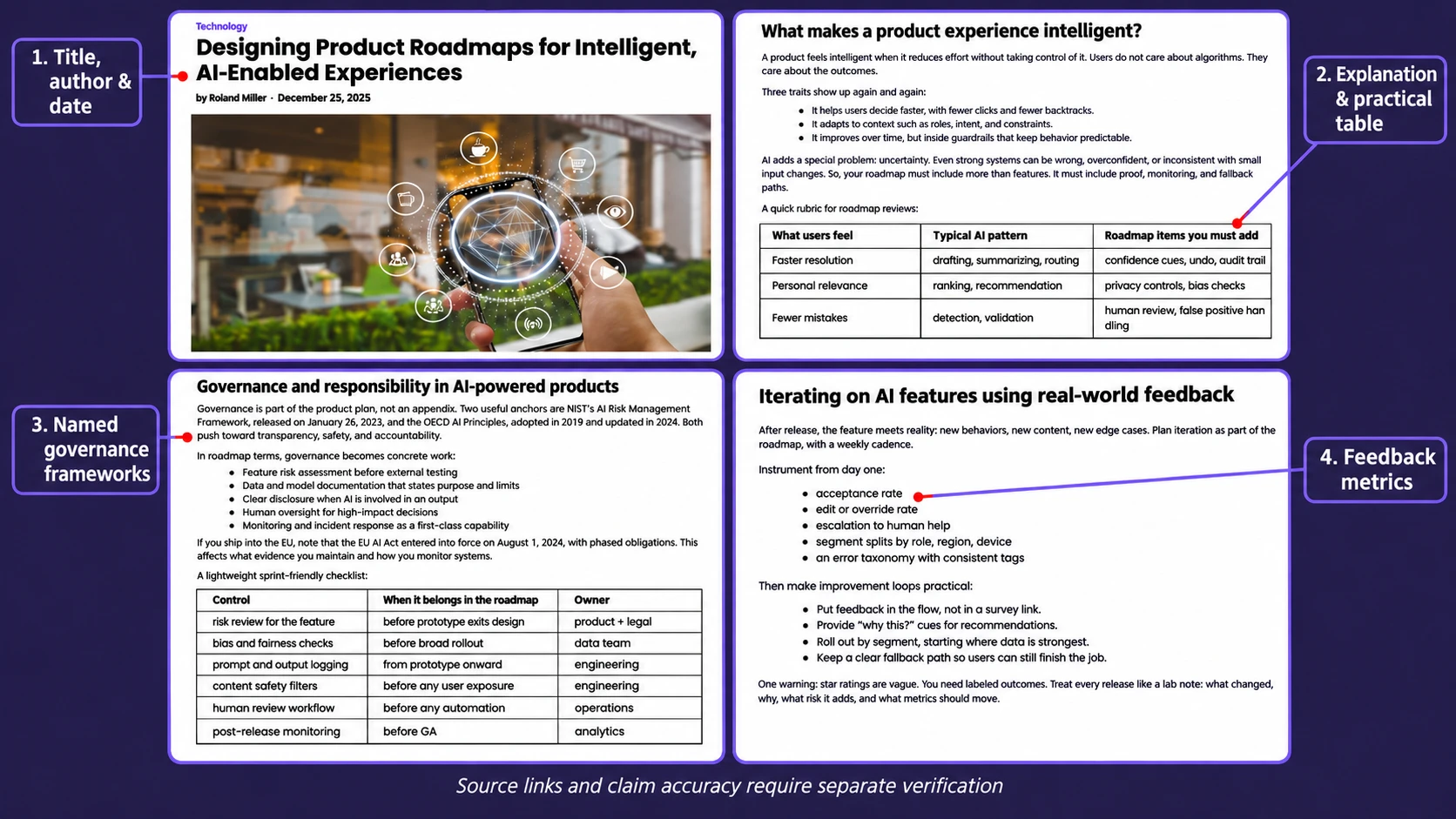
Worked Example: Evaluating an Article About an AI Product Roadmap
Imagine a technology post that says companies can improve products by adding AI. That may introduce the idea, but it does not give a product team enough information to plan a feature. This is a hypothetical example, not a description or test of a specific BenzyNews article.
To judge whether the article goes deeper, look for answers to these questions:
- What problem is AI solving? The writer should name a real user task rather than treating AI as a benefit by itself.
- What information does the feature need? Useful detail could cover input quality, user consent, evaluation data, and what happens when information is unavailable.
- How would success be measured? The article should suggest relevant measures such as task completion, error rates, or human review requirements and explain their limitations.
- What can go wrong? Look for inaccurate outputs, inappropriate recommendations, privacy concerns, or a cost that outweighs the benefit.
- What evidence supports the recommendation? Check whether examples are hypothetical, drawn from a vendor announcement, or backed by independent research.
An article answering these questions has greater decision-making depth than one that only lists benefits. It still might not be an implementation manual; those are different purposes.
Verify Important Claims Outside the Article
After reading, leave the page and check who else has documented the central claims. Researchers call this lateral reading. A Stanford study of online source evaluation described how professional fact-checkers investigated unfamiliar sites by seeking independent context, rather than relying only on the source’s own presentation.
For technology research, the process is straightforward:
- Copy the most consequential factual claim into your notes.
- Find the original manufacturer documentation, standard, research publication, or identifiable test behind it.
- Check the exact product, version, location, date, and qualifications of the claim.
- Compare the article’s wording with that original evidence. Mark the claim supported, partly supported, contradicted, or unverified.
- Cite the original evidence for specifications or technical requirements, and cite the article when you are specifically using its original reporting or analysis.
For a closer look at this last step, TechBonafide’s guide to checking whether an AI answer is backed by real sources shows how to verify that a citation exists and supports the statement attached to it.
Its general guide to evaluating whether a technology website deserves trust covers publisher identity, editorial transparency, and safety signals. Those checks complement the article-depth worksheet; they do not replace it.
When Is a BenzyNews.com Article Enough for Research?
An accessible, clearly explained post can be useful for learning vocabulary, discovering a topic, or identifying questions you need to investigate. You can often use an introduction for those purposes even if it does not present original tests.
Expect more before using a post to choose expensive technology, change security settings, write technical specifications, or support a formal research paper. In those cases, require current primary evidence, relevant technical detail, and enough context to understand the risks. If a page is unavailable or its critical claim cannot be traced, mark the claim unverified rather than guessing whether it is correct.
Also avoid judging depth from page length, the number of headings, attractive diagrams, or the presence of links alone. A link can lead to an unrelated source; a chart can omit its testing conditions; and a detailed explanation can still be outdated. What matters is whether the content answers the question with traceable, appropriately scoped evidence.
Final Takeaway
BenzyNews.com should be assessed article by article for technology research. Begin with your research goal, check for explanation and original evidence, look for a way to verify the result, and note what is missing.
Use a general overview to learn the basics, but move to current official documentation or well-described independent testing before making a consequential technical decision. Without a documented sample of its articles, no responsible site-wide judgment about BenzyNews.com’s technical depth is possible.

Tech Bonafide is the editorial identity of TechBonafide, an independent technology publication covering AI, software, cybersecurity, gadgets, and emerging technology.