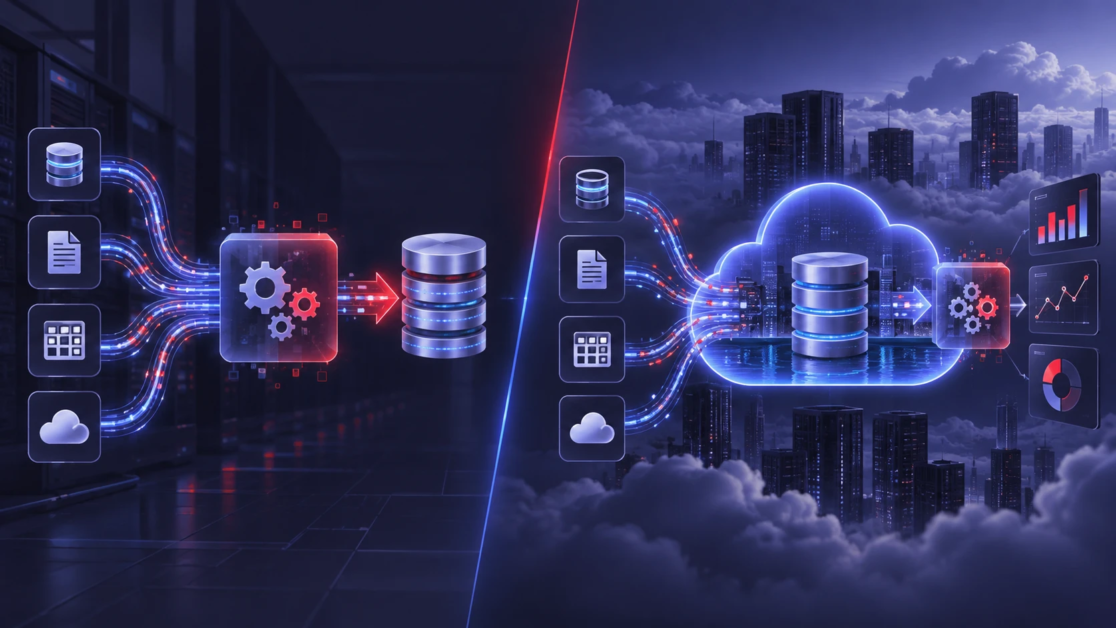


Choosing between a data lake and a data warehouse affects how teams store data, govern it, analyze it, and scale analytics over time. The best fit depends on data types, performance expectations, compliance requirements, and how quickly stakeholders need trusted answers. Understanding the difference helps avoid rework, unexpected cloud bills, and brittle pipelines.
Core Definitions
A data lake is a centralized repository designed to store large volumes of raw data in its original format. It commonly holds structured, semi-structured, and unstructured data such as logs, documents, events, and media. Data is typically transformed when it is read and prepared for analysis.
A data warehouse is a curated analytics system optimized for structured, query-ready data. It stores data that has been cleaned, standardized, and modeled to support reporting and business intelligence. Data is typically transformed before it is loaded so analysts can query consistent tables with predictable performance.
How Data Is Stored And Modeled?
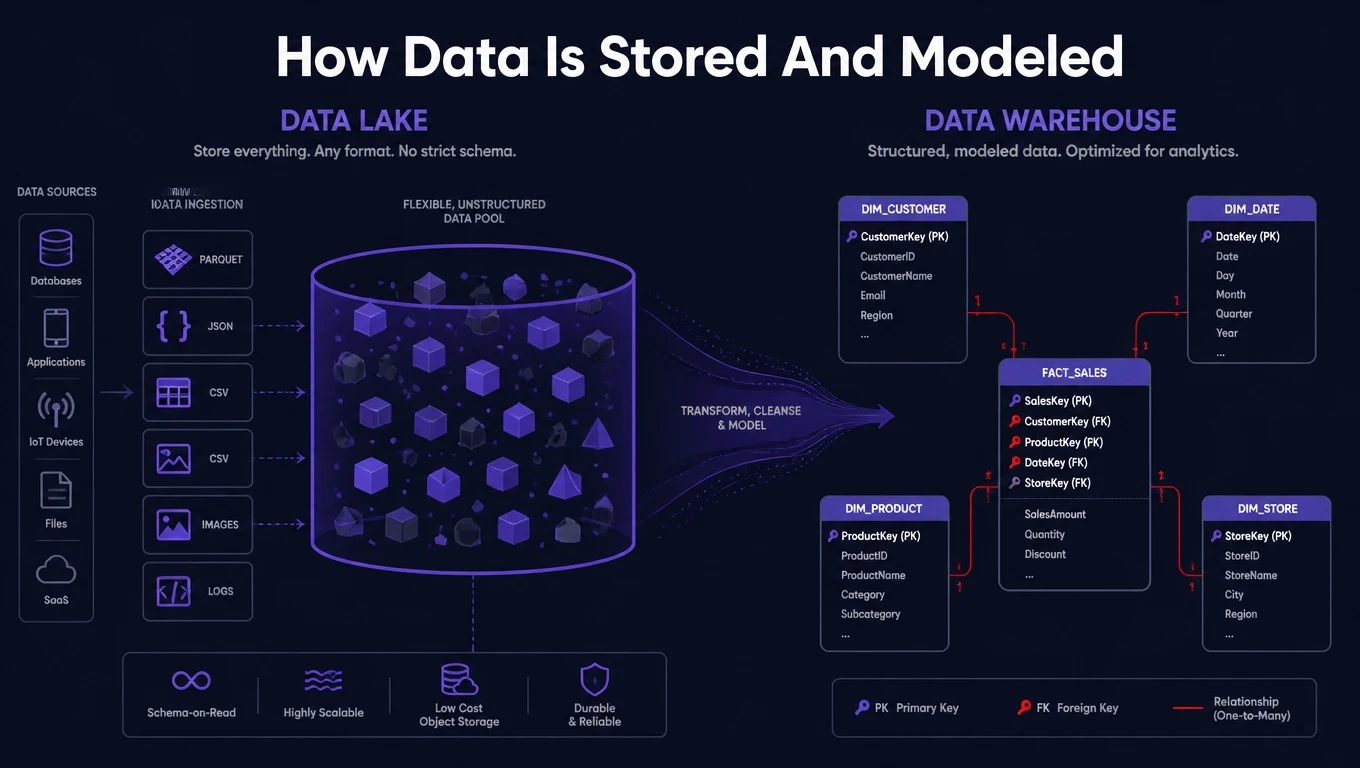
Data lakes focus on flexible storage. They commonly use object storage and open file formats that allow many tools to read the same data. This makes them strong for exploration and advanced analytics, but it also increases the need for cataloging and governance.
Data warehouses focus on schema and structure. They rely on modeled tables, consistent keys, and defined relationships that reflect business concepts. This yields faster time to insight for known questions, especially when many users need standardized metrics.
Schema Approaches And Data Processing
In many data lake implementations, schema is applied at query time. This approach supports changing data sources and lets teams ingest first and decide later. The tradeoff is that without strong standards, datasets can become hard to find, hard to trust, and duplicated across teams.
In many data warehouse implementations, schema is applied during ingestion and transformation. This supports clear definitions for dimensions, facts, and metrics used in dashboards and executive reporting. The tradeoff is that initial modeling can take time, and changing definitions can require careful migration.
Performance And Workload Fit
Data warehouses are optimized for high-concurrency analytics. They typically handle frequent SQL queries, dashboards, and scheduled reports with predictable response times. They also provide mature workload management features to keep performance stable as users grow.
Data lakes are well suited to large-scale processing and diverse workloads such as machine learning, log analytics, and batch transformations. Query performance depends heavily on file formats, partitioning, metadata, and the query engine used. Without tuning, interactive reporting can feel slower than a purpose-built warehouse.
Governance, Security, And Compliance
Warehouses often provide opinionated governance that is easier to enforce. Access controls, row-level security, and consistent data definitions support auditability. This makes warehouses a common choice for regulated reporting and tightly controlled KPIs.
Lakes can be governed well, but they require deliberate design. Strong catalogs, lineage, access policies, and data quality checks are essential to keep the lake usable. Without them, the lake can drift into a set of disconnected buckets with unclear ownership.
Data Quality And Trust
Warehouses typically emphasize curated, validated datasets. Standardized transformation logic reduces conflicting definitions across teams. This supports trust in dashboards and aligns stakeholders on a single source of truth.
Lakes can store both trusted and experimental data. That flexibility supports fast discovery, but it also increases the risk of using incomplete or poorly documented datasets. A clear tiering approach helps, separating raw, refined, and certified data products.
Cost And Scaling Considerations
Data lakes can be cost-effective for storing massive volumes of data, especially when much of it is cold or infrequently accessed. Storage is often inexpensive, and compute can be scaled separately based on processing needs. Costs can rise if many teams run heavy queries on poorly optimized files.
Data warehouses can cost more per unit of storage, but they can deliver efficient analytics at scale. Pricing depends on compute, concurrency, and performance tiering. Costs stay more predictable when data models and workloads are stable and well understood.
Data Lakehouse And Modern Hybrids
A lakehouse attempts to combine lake flexibility with warehouse-style management and performance. It typically uses open table formats, metadata layers, and governance controls to support both BI and advanced analytics. This can reduce data duplication and simplify architecture when implemented with discipline.
Hybrids can also be practical, using a lake for raw and historical data while a warehouse serves curated analytics. This pattern supports separation of concerns and lets teams optimize each layer for its strongest workloads.
Key Differences At A Glance
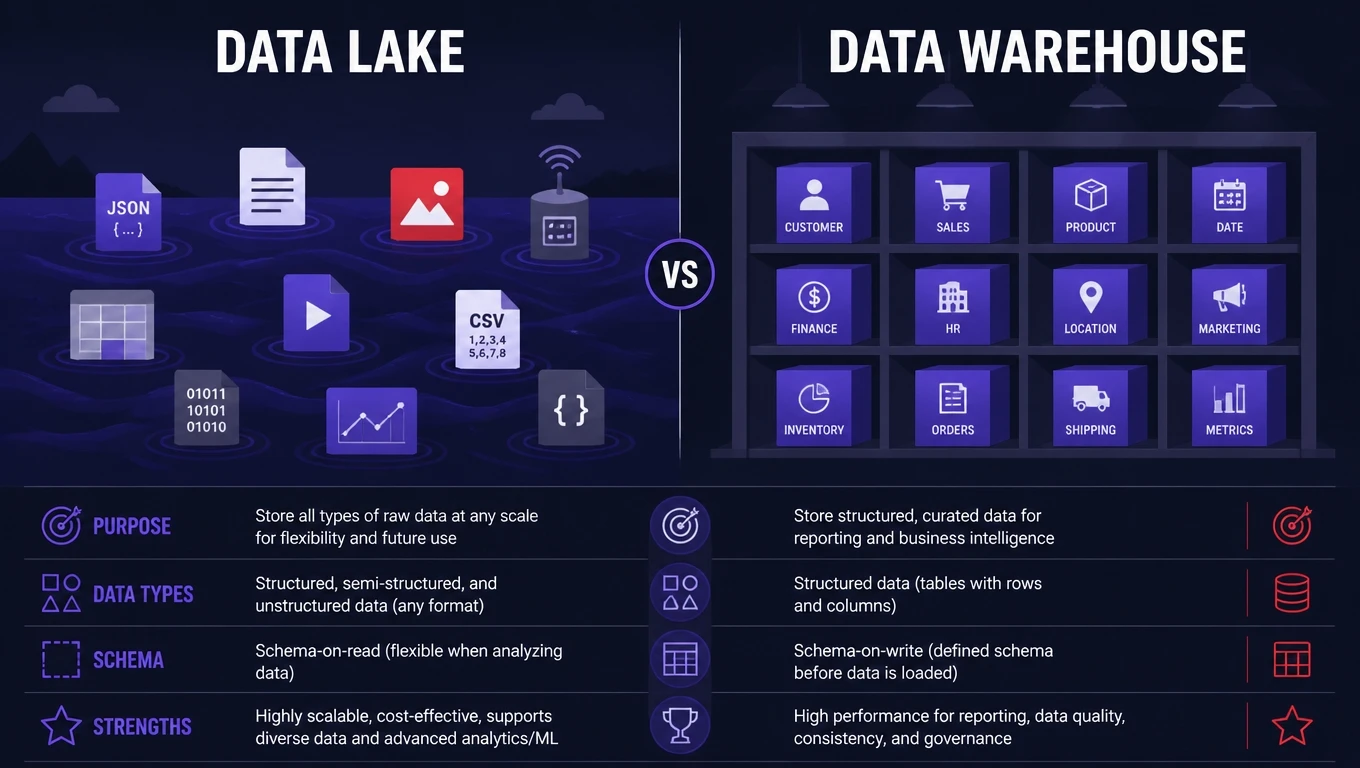
| Aspect | Data Lake | Data Warehouse |
|---|---|---|
| Primary Purpose | Store raw and varied data for flexible analysis | Serve curated data for reporting and BI |
| Data Types | Structured, semi-structured, and unstructured | Mainly structured and modeled |
| Schema | Often applied at read time | Often applied before load |
| Typical Strength | Exploration, ML, large-scale processing | Fast SQL analytics and consistent KPIs |
When A Data Lake Makes Sense?
A data lake fits best when data variety and volume are high. It supports rapid ingestion of new sources and keeps raw history available for future questions. It also provides a strong foundation for data science workflows that require access to granular, event-level information.
- High data diversity: Logs, events, documents, and third-party exports can coexist without forcing early modeling.
- Exploratory analytics: Analysts and data scientists can test hypotheses without waiting for a full dimensional model.
- Long-term retention: Historical data can be stored cheaply for later backtesting and feature engineering.
- Compute flexibility: Different engines can process the same stored data depending on workload needs.
These strengths are easiest to realize when metadata, ownership, and access rules are defined from the start.
When A Data Warehouse Makes Sense?
A data warehouse fits best when the organization needs consistent reporting and fast queries for many users. It is a strong choice for finance, operations, and executive dashboards where metric definitions must be stable. It also reduces confusion by centering analytics on curated tables and governed transformations.
- Trusted dashboards: Standard models support consistent KPIs across teams and tools.
- High concurrency: Many users can query the same system with predictable performance.
- Strong governance: Access controls and auditability are typically simpler to enforce.
- Operational reporting: Scheduled reports and self-serve BI become easier with modeled data.
These benefits increase when data contracts and metric definitions are managed as shared organizational assets.
How To Choose The Right Architecture?
The best decision is guided by workload needs rather than buzzwords. Many teams succeed with a hybrid approach that assigns clear roles to each layer. A structured evaluation prevents overbuilding and clarifies what must be governed tightly versus what can remain exploratory.
- Inventory your data sources: List structured systems, event streams, files, and unstructured inputs and note their growth rate and retention needs.
- Define your primary consumers: Identify who needs governed metrics, who needs exploration, and what latency and concurrency they require.
- Set governance requirements: Document compliance, access policies, lineage, and audit needs, then choose tooling that enforces them consistently.
- Map workloads to layers: Place raw ingestion and history where storage is efficient and place certified analytics where performance and trust are highest.
- Plan for operational ownership: Assign clear responsibility for pipelines, catalogs, data quality, and cost monitoring across teams.
This framework keeps the choice anchored to outcomes, not vendor features.
Common Pitfalls To Avoid
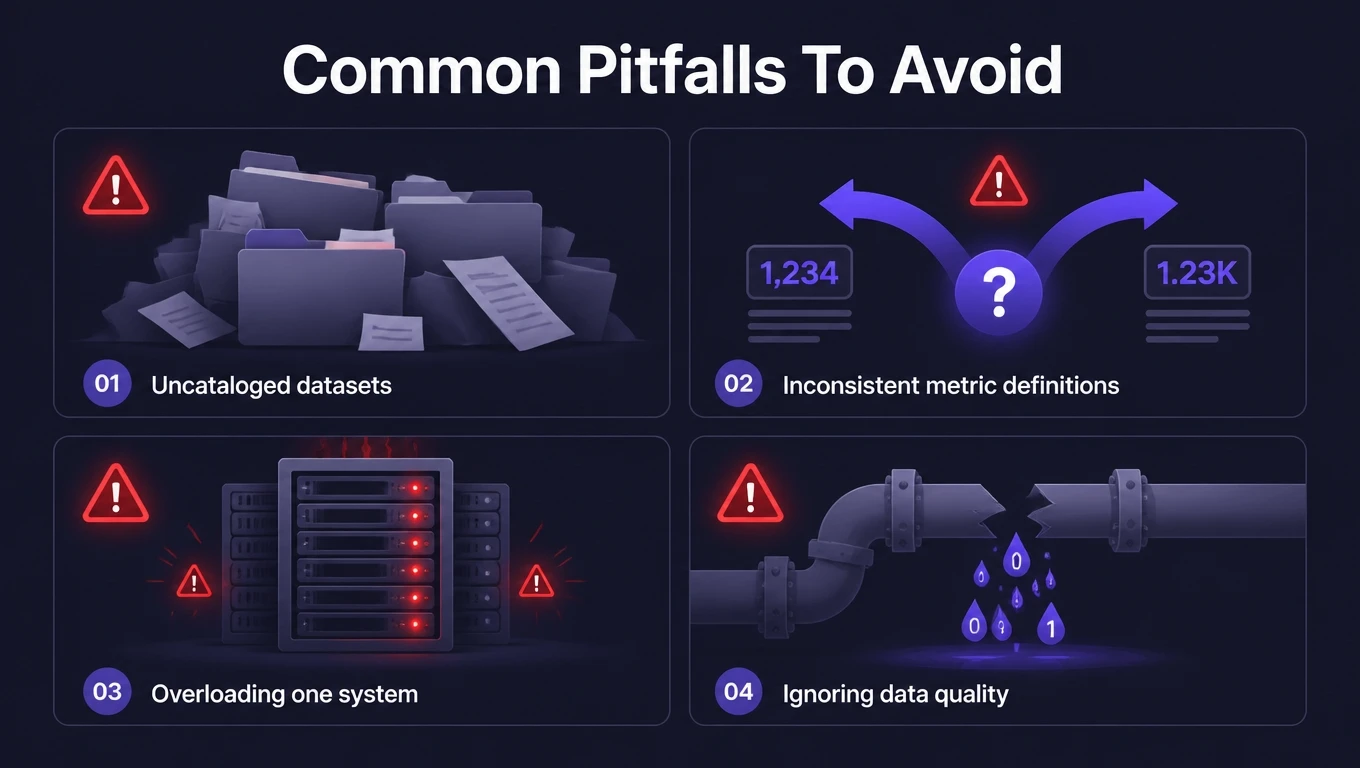
Most failures come from weak governance, unclear ownership, and unmanaged costs. Avoiding a few predictable issues can save months of cleanup. The goal is a platform that stays discoverable, secure, and useful as the organization grows.
- Uncataloged datasets: Without a catalog and clear naming standards, users waste time and duplicate data.
- Inconsistent metric definitions: Conflicting transformations lead to multiple versions of the same KPI and stakeholder distrust.
- Overloading one system: Forcing every workload into a single layer often creates performance bottlenecks and high bills.
- Ignoring data quality: Missing validations and monitoring allow silent pipeline failures to spread incorrect results.
Addressing these early makes both lakes and warehouses easier to scale and operate.
Conclusion
A data lake prioritizes flexibility and scale for raw, varied data, while a data warehouse prioritizes speed, structure, and trusted analytics. The right approach depends on data types, governance needs, and the balance between exploration and standardized reporting. Many modern teams use both, with clear boundaries between raw storage, refined processing, and certified analytics.
A careful selection process that accounts for performance, security, and operating ownership leads to a system that stays reliable over time. When the architecture matches real workloads, teams ship insights faster and avoid costly platform rewrites.
Frequently Asked Questions
Can A Data Lake Replace A Data Warehouse?
A data lake can support analytics, but replacing a warehouse requires strong governance, curated layers, and performance tuning. Many organizations still prefer a warehouse for high-concurrency BI and standardized KPIs. A hybrid or lakehouse approach often balances flexibility and trust.
Which Is Better For Business Intelligence?
A data warehouse is usually better for business intelligence because it is optimized for fast SQL queries and consistent reporting. Modeled data reduces ambiguity and makes dashboards easier to maintain. Lakes can support BI, but they need additional structure and controls to deliver the same reliability.
What Is The Main Difference Between Schema On Read And Schema On Write?
Schema on read applies structure when data is queried, which supports flexibility and faster ingestion. Schema on write applies structure before data is stored for analytics, which supports consistency and performance. The right choice depends on how stable the questions are and how strict governance must be.