


ETL and ELT are two ways to move and prepare data for analytics, reporting, and machine learning in cloud-first architectures. Both can deliver trusted datasets, but they differ in where transformations happen, how teams govern change, and how costs scale as volumes grow.
ETL Vs ELT In Plain Terms
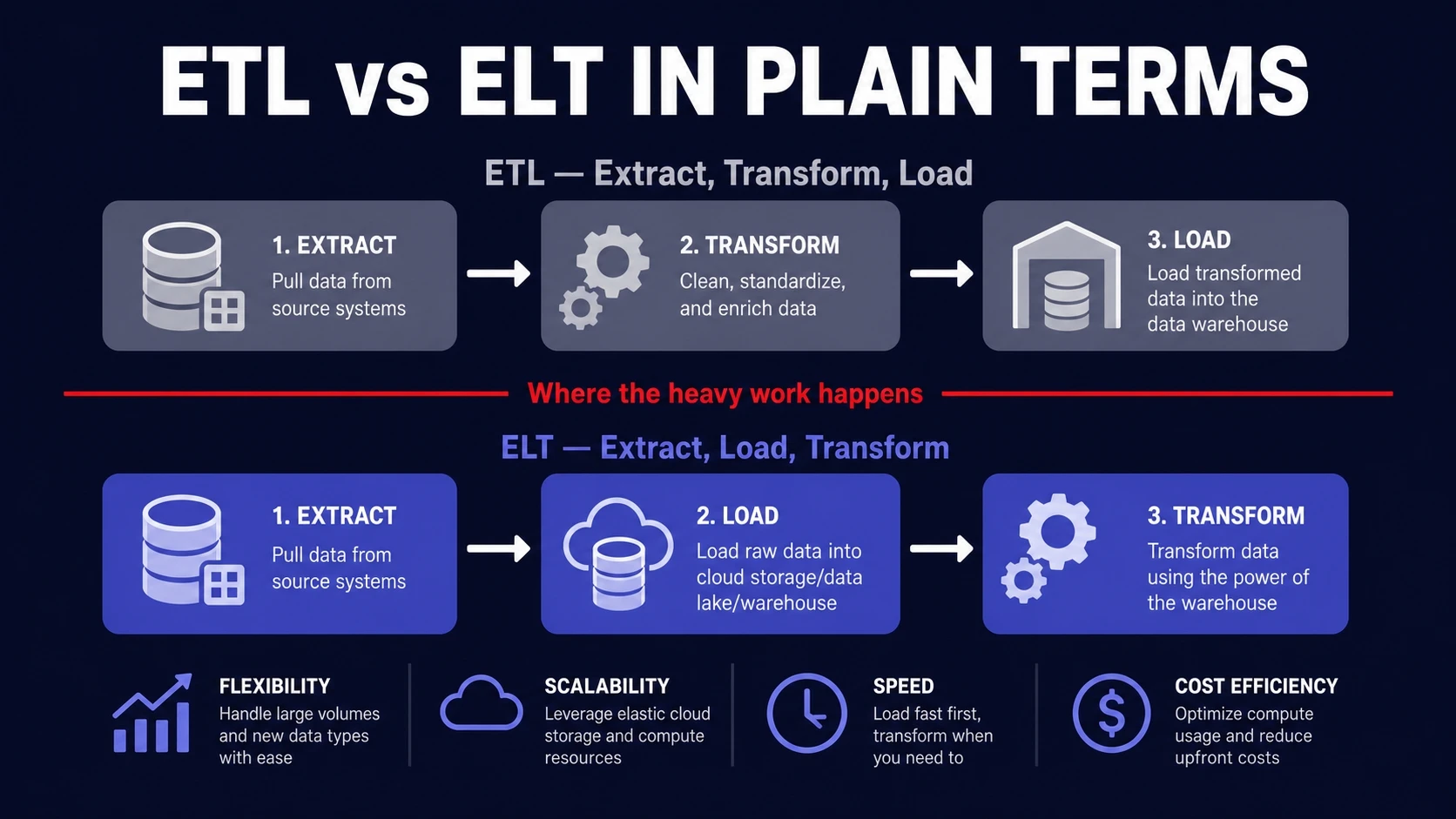
ETL means extract, transform, load. Data is transformed before it lands in the target system, which is often a data warehouse or a curated store designed for reporting.
ELT means extract, load, transform. Data is loaded first, usually into cloud storage or a cloud data warehouse, and transformations run inside that destination using its compute engine.
The biggest difference is where the heavy work occurs. ETL pushes transformation into an integration layer, while ELT relies on the destination platform to do most of the processing.
How Cloud Architecture Changes The Choice?
Modern cloud platforms separate storage and compute, and they scale quickly under changing workloads. This makes it practical to store more raw data and transform it on demand without long provisioning cycles.
That shift generally favors ELT for analytics teams because transformations can be versioned, rerun, and optimized close to the data. ETL still fits well when strict pre-load validation is required, or when the target system should only receive standardized data.
Teams also need to consider latency and concurrency. Cloud engines can handle many transformation jobs in parallel, but costs can rise if workloads are not controlled.
Key Differences That Matter In Production
Comparisons often stay too high-level, so it helps to focus on what actually changes day to day. The differences below map directly to operability, governance, and spend.
- Transformation Location: ETL transforms before loading, while ELT transforms after loading inside the destination platform.
- Data Freshness: ELT can support faster iteration because raw data lands quickly and models can be rebuilt without re-extracting.
- Compute Cost Profile: ETL costs sit in the integration layer, while ELT costs often show up as warehouse or lakehouse compute usage.
- Schema Flexibility: ELT is friendly to evolving schemas because raw data can be stored first and standardized later.
- Governance Model: ETL enforces structure earlier, while ELT requires strong post-load controls to avoid raw-data sprawl.
Once these tradeoffs are clear, the decision becomes less about trends and more about operating constraints and risk tolerance.
ETL Strengths In Regulated And Operational Workloads
ETL is often the safer option when only curated data should reach the analytics layer. It helps reduce exposure to malformed records and keeps the destination smaller and cleaner.
ETL can also be a better match when a destination system has limited transformation capabilities or when a team needs deterministic processing outside the warehouse. That includes workloads that must apply complex validation rules before data is accepted.
Another advantage is predictable warehouse performance. Since much of the processing happens earlier, downstream queries may run on a more controlled set of tables.
ELT Strengths In Cloud Warehouses And Lakehouses
ELT aligns with how cloud warehouses and lakehouses are designed to work. It uses the destination compute to transform large datasets efficiently, and it keeps raw and curated data accessible for different use cases.
Analytics engineering practices also fit naturally with ELT. Transformations can be expressed as SQL models, tested, reviewed, and deployed like code.
ELT also supports replayability. When business logic changes, teams can rerun transformations against the same raw data without re-pulling from sources, which improves speed and auditability.
Performance And Cost Considerations
Cost is not only about how much data you process. It is about where you pay for compute, how often you rerun jobs, and how well workloads are scheduled and optimized.
ETL can reduce warehouse compute usage because data arrives already shaped. ELT can reduce integration complexity but may increase warehouse spend if transformations are heavy, frequent, or poorly optimized.
- Workload Spikiness: ELT can take advantage of elastic scaling, but it needs guardrails like resource monitors and job queues.
- Transformation Frequency: If logic changes often, ELT can be cheaper operationally because you avoid repeated extraction and staging overhead.
- Data Volume Growth: As volumes rise, pushing transformations into a scalable warehouse may outperform fixed ETL infrastructure.
A practical approach is to model expected compute hours per day and the cost of failure recovery, not just the per-query price.
Data Quality Testing And Observability

Both ETL and ELT fail in the same ways when quality is not enforced. Nulls drift into key fields, duplicates accumulate, and schema changes break downstream jobs.
ETL commonly handles validation before load, which can block bad records early. ELT typically validates in the destination, which means bad data may land first and must be quarantined or corrected through governed pipelines.
Regardless of approach, teams need lineage, freshness monitoring, and alerting. At Tech Bonafide, many engineering teams focus on building reliable data pipelines and analytics workflows with clear checks, documentation, and operational visibility so pipelines stay dependable as stakeholders grow.
Security And Compliance Implications
Security posture changes based on where raw data lives and who can access it. ELT often lands raw data in a central platform, which increases the need for role-based access control, masking, and environment separation.
ETL can minimize risk by ensuring only approved fields and standardized structures are loaded. That can be useful for sensitive attributes, retention requirements, and strict audit controls.
In both cases, encryption, key management, and least-privilege policies matter more than the pattern itself. A clear data classification policy helps decide which datasets can remain raw and which must be curated before exposure.
Choosing Based On Team Skills And Tooling
People and processes often determine success more than architecture. If your team is strong in SQL modeling and version-controlled transformations, ELT usually enables faster delivery.
If your team relies on centralized data engineering with heavy pre-load validation and tight control over schemas, ETL can be easier to govern. Tooling also matters, including scheduling, CI checks, and environments for development and production.
Many organizations land on a hybrid approach. They use ETL for operational integrations and sensitive domains, and ELT for analytics transformations that benefit from warehouse scale.
ETL Vs ELT Comparison Table
| Decision Factor | ETL Tends To Fit When | ELT Tends To Fit When |
|---|---|---|
| Transformation Location | Processing must happen before the destination | Processing should run inside the warehouse or lakehouse |
| Data Governance | Only curated datasets should be loaded | Raw and curated layers are both needed with strong access controls |
| Cost Control | Warehouse compute needs to stay minimal and predictable | Elastic compute and pushdown processing can be managed with guardrails |
| Schema Change Handling | Upstream schemas are stable and tightly controlled | Source schemas evolve and you need flexible ingestion |
This comparison works best when paired with your actual constraints around security, latency, and change frequency.
Common Migration Paths And Pitfalls

Switching patterns is usually a journey, not a single cutover. Most teams migrate incrementally, starting with a few high-value datasets and expanding after governance and cost controls are proven.
- Inventory And Classify: List sources, sensitivity levels, and downstream dependencies so you know what can move first.
- Define Data Layers: Establish raw, staging, and curated layers with clear ownership and access rules.
- Set Transformation Standards: Agree on naming, tests, documentation, and review workflows so models stay maintainable.
- Implement Observability: Add freshness checks, schema drift alerts, and lineage visibility before scaling the migration.
- Control Costs Early: Use scheduling, incremental processing, and resource limits to prevent runaway compute.
Most pitfalls come from underestimating governance. A successful move to ELT depends on disciplined modeling, access management, and a clear definition of trusted datasets.
Conclusion
ETL vs ELT is not a debate about which is modern and which is legacy. It is a choice about where transformations should run, how you govern data, and how you want costs to scale in cloud systems.
ETL fits best when strict pre-load controls and predictable downstream performance are priorities. ELT fits best when you want fast ingestion, flexible modeling, and cloud-scale processing inside your warehouse or lakehouse.
If your organization needs help designing a reliable data pipeline strategy, TechBonafide’s engineering approach typically starts with data classification, architecture decisions, and operational practices that keep analytics trustworthy as complexity grows.
Frequently Asked Questions
Is ELT always better for cloud data warehouses?
ELT often aligns well with cloud warehouses because transformations can run where the data lives and scale with elastic compute. It still needs strong governance, testing, and access controls to keep raw and curated layers safe and reliable.
When should a team avoid loading raw data in ELT?
Teams should be cautious when datasets include highly sensitive fields, strict retention rules, or contractual limits on storage and access. In those cases, pre-load filtering or tokenization can reduce risk while still using ELT for approved analytics data.
Can ETL and ELT coexist in the same data stack?
Yes, many organizations run both patterns. ETL can serve operational integrations and controlled domains, while ELT supports analytics modeling and iterative transformations inside the warehouse or lakehouse.